Quality inspection is a critical step in modern manufacturing. As production speeds increase and products become more complex, manual inspection methods are no longer sufficient to ensure consistent product quality.
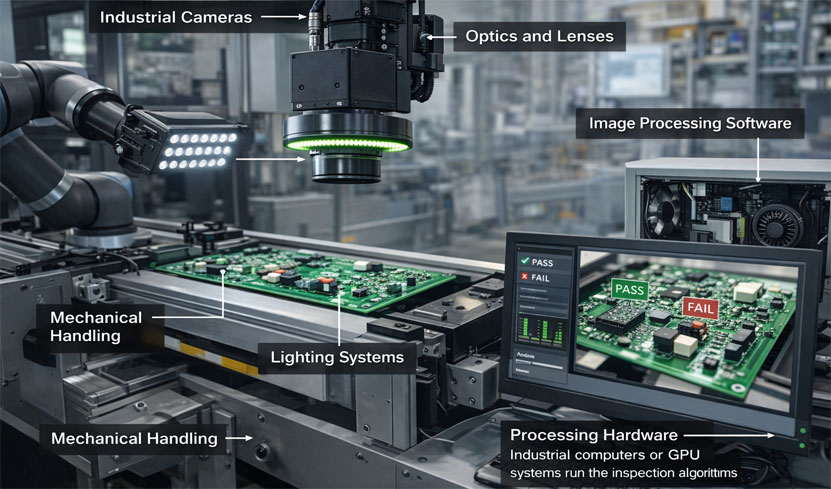
Automated Optical Inspection (AOI) is a machine vision–based technology that uses industrial cameras, lighting systems, and image processing software to automatically inspect products for defects during manufacturing.
AOI systems can detect defects such as missing components, surface defects, assembly errors, and dimensional deviations with high accuracy and speed.
Manufacturers across industries are adopting AOI systems to achieve 100% product inspection, improved quality control, and reduced production costs.
What is Automated Optical Inspection (AOI)?
Automated Optical Inspection (AOI) is a machine vision–based inspection technology used to analyze images of products and detect defects automatically.
AOI systems typically consist of:
These systems capture images of products and analyze them using algorithms or AI models to determine whether the product meets quality standards.
How AOI Systems Work
AOI systems follow a structured workflow to inspect products automatically.
Image Acquisition
Industrial cameras capture high-resolution images of products as they move through the inspection station.
Lighting Control
Specialized lighting systems illuminate the product to highlight defects and surface features.
Image Processing
The captured images are processed using machine vision algorithms.
Defect Detection
The system compares the captured image with reference models to identify defects.
Pass/Fail Decision
Each product is classified as acceptable or defective based on defined quality criteria.
Data Storage
Inspection results are recorded for traceability and quality analysis.
Types of AOI Systems
AOI systems can be classified based on their configuration and application.
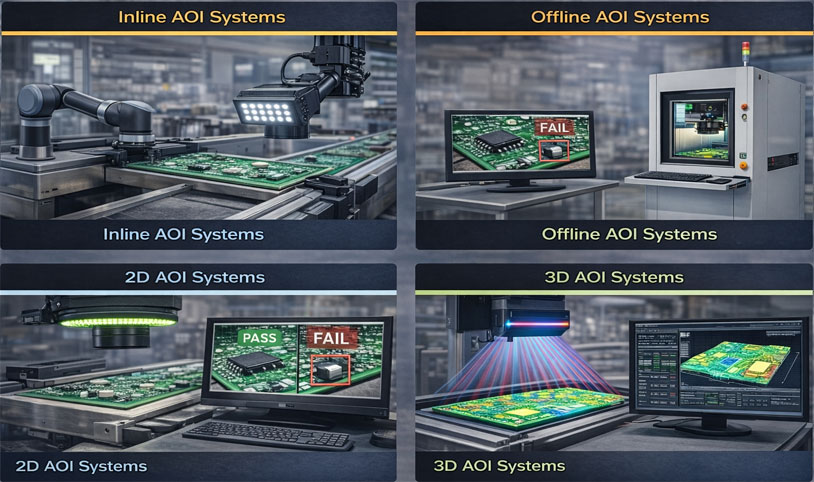
Inline AOI Systems
Installed directly on production lines to inspect products in real time.
Offline AOI Systems
Standalone inspection systems used for sampling inspection.
2D AOI Systems
Capture flat images to detect surface defects and assembly errors.
3D AOI Systems
Use structured lighting or laser scanning to inspect height and shape features.
Components of an AOI System
A typical AOI system integrates several components.
Industrial Cameras
Capture detailed images of products during manufacturing.
Optics and Lenses
Ensure clear imaging of inspection areas.
Lighting Systems
Highlight product features and defects.
Image Processing Software
Analyze captured images and detect defects.
Processing Hardware
Industrial computers or GPU systems run the inspection algorithms.
Mechanical Handling
Conveyors, robotic systems, or motion systems move products through the inspection station.
Defects Detected by AOI Systems
AOI systems can detect a wide range of defects.
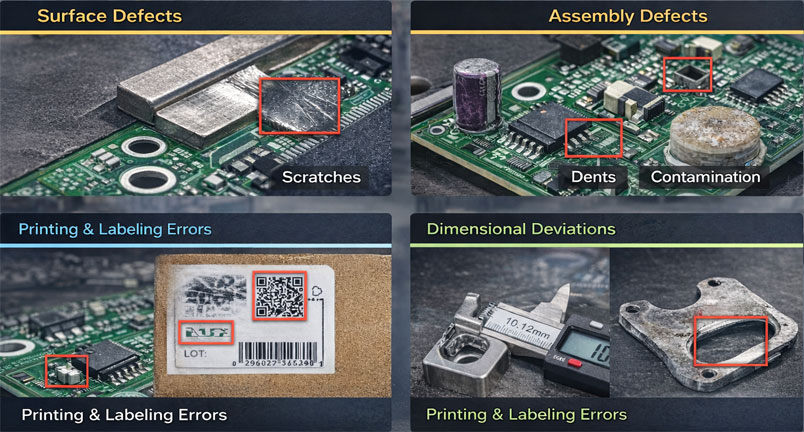
Surface Defects
- Scratches
- Cracks
- Dents
- Contamination
Assembly Defects
- Missing components
- Incorrect component placement
- Misalignment
Printing & Labeling Errors
- Incorrect logos
- Missing text
- Barcode defects
Dimensional Deviations
- Incorrect measurements
- Shape irregularities
Industries Using AOI Systems
AOI technology is widely used in many manufacturing sectors.
Electronics Manufacturing
PCB inspection and component placement verification.
Automotive Manufacturing
Inspection of engine components, sensors, and assemblies.
Textile Industry
Inspection of fabrics and garment printing.
Packaging Industry
Label verification and packaging inspection.
Metal Manufacturing
Surface defect detection on metal parts.
Glass and Ceramic Industry
Detection of cracks and surface defects.
Benefits of Automated Optical Inspection
100% Product Inspection
AOI systems inspect every product instead of sampling.
Improved Quality Control
Defects can be detected with high accuracy.
Faster Inspection Speed
Inspection occurs at production line speed.
Reduced Human Error
Automation eliminates inconsistencies in manual inspection.
Digital Quality Data
Inspection results can be stored and analyzed for process improvement.
AOI and Artificial Intelligence
Modern AOI systems increasingly use AI and deep learning algorithms to improve defect detection.
AI-based AOI systems can:
AI enables AOI systems to inspect products that were previously difficult to analyze using rule-based algorithms.
Challenges in AOI Implementation
Although AOI systems provide many advantages, their implementation requires careful design.
Lighting Design
Proper lighting is critical for accurate inspection.
Camera Selection
Choosing the correct camera type and resolution is important.
Product Variability
AI models must be trained to handle variations in products.
System Integration
AOI systems must integrate with production equipment and control systems.
Companies like Intelgic specialize in designing customized AOI systems tailored to complex manufacturing requirements.
The Future of AOI in Manufacturing
AOI technology continues to evolve with advancements in:
Artificial Intelligence
artificial intelligence
3D Vision Systems
3D vision systems
Edge Computing
edge computing
Robotics Integration
robotics integration
Smart Factory Technologies
smart factory technologies
Looking Ahead
Future AOI systems will enable fully autonomous quality inspection and predictive quality control.
Automated Optical Inspection (AOI) is transforming quality inspection in manufacturing by enabling fast, accurate, and automated defect detection.
By combining machine vision cameras, advanced lighting systems, and AI algorithms, AOI systems allow manufacturers to maintain consistent product quality while increasing production efficiency.
As manufacturing continues to move toward Industry 4.0 and smart factories, AOI will remain one of the most important technologies driving modern quality control.