Automated Dimensional Measurement Using Laser Profilers
Published on: Apr 06, 2026

Written by:Content team, Intelgic
Accurate dimensional measurement is essential in modern manufacturing. Components must meet precise specifications to ensure proper functionality, assembly compatibility, and product reliability. Even small dimensional deviations can cause performance issues, assembly failures, or product rejection.
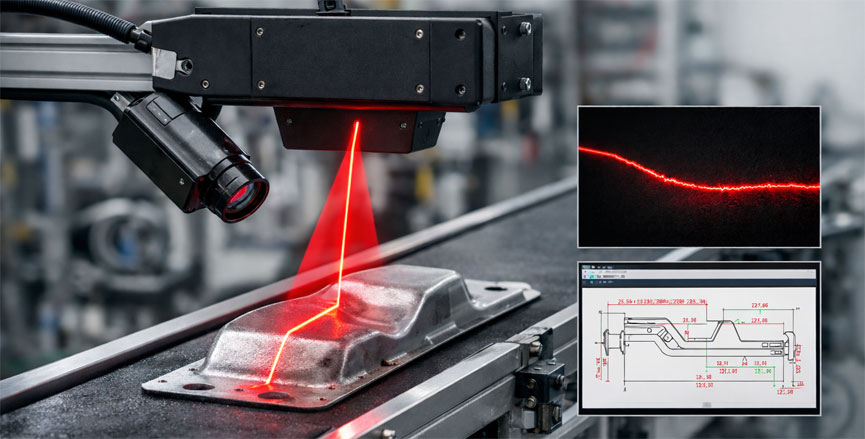
Traditional dimensional inspection methods such as manual gauges, calipers, and coordinate measuring machines (CMMs) are accurate but often slow and difficult to integrate into high-speed production lines.
Laser profilometers (laser profile sensors) provide a powerful solution for automated dimensional measurement. These sensors enable high-speed, non-contact measurement of objects directly on production lines, allowing manufacturers to perform real-time quality inspection without interrupting production.
What is a Laser Profilometer?
A laser profilometer, also known as a laser profile sensor, is a 3D measurement device that uses laser triangulation technology to capture the shape and dimensions of objects.
Laser Projection
Projects a laser line onto the object surface
Image Capture
Integrated camera captures reflected laser line
3D Generation
Multiple profiles create complete 3D representation
By analyzing the deformation of the laser line, the system calculates the precise surface profile of the object. When objects move under the sensor on a conveyor, the system captures multiple profiles and generates a complete 3D representation of the object surface.
How Laser Profilers Perform Dimensional Measurement
Laser profile sensors operate using a process called laser triangulation.
Step 1 — Laser Projection
A laser line is projected onto the surface of the object.
Step 2 — Image Capture
A camera inside the sensor captures the reflected laser line.
Step 3 — Profile Extraction
The sensor calculates the exact cross-sectional shape of the object.
Step 4 — 3D Model Generation
Multiple profiles are captured and combined to create a 3D model of the object.
This data allows the system to measure dimensions, shapes, and geometric features accurately.
Dimensional Features Measured by Laser Profilers
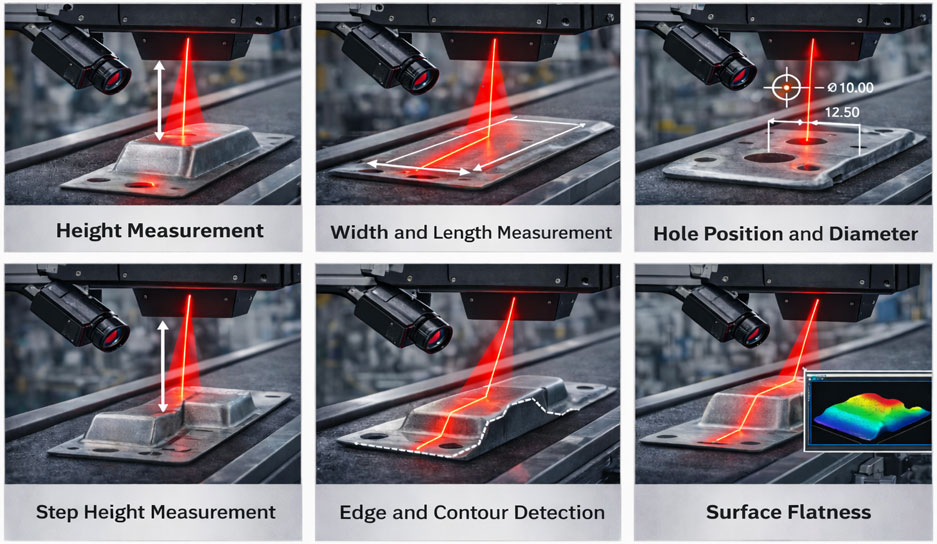
Height Measurement
Measure the height of components or surface features.
Width and Length Measurement
Determine the width and length of parts with high accuracy.
Hole Position and Diameter
Measure hole diameter and location on parts.
Step Height Measurement
Measure differences in height between surfaces.
Edge and Contour Detection
Identify edges, contours, and shapes of parts.
Surface Flatness
Measure flatness and detect surface deformation.
Advantages of Laser Profilers
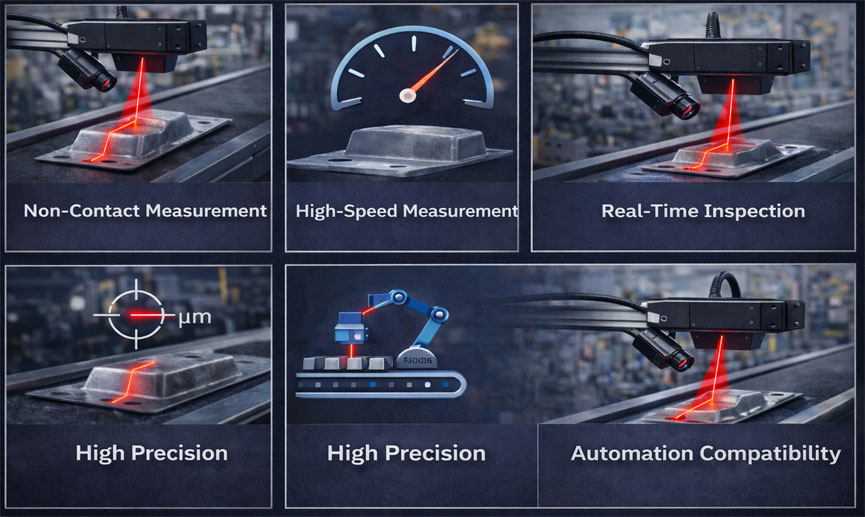
Non-Contact Measurement
Objects can be measured without physical contact, preventing damage to delicate parts.
High-Speed Measurement
Laser profilometers can capture thousands of profiles per second.
Real-Time Inspection
Measurements can be performed directly on production lines.
High Precision
Modern laser sensors achieve micron-level accuracy.
Automation Compatibility
Laser sensors can be easily integrated with conveyors, robots, and industrial automation systems.
Industrial Applications
Automotive Manufacturing
- Measurement of stamped metal parts
- Gap and flush inspection
- Gear profile measurement
Metal Fabrication
- Sheet metal thickness inspection
- Weld bead measurement
- Plate flatness inspection
Electronics Manufacturing
- PCB component height measurement
- Connector alignment verification
Packaging Industry
- Bottle cap height measurement
- Container shape inspection
Construction Materials
- Tile flatness inspection
- Dimensional inspection of building materials
Integration with Machine Vision and AI
Modern inspection systems often combine laser profilometers with machine vision cameras and AI software.
In such systems:
Laser sensors
Measure dimensional features
Cameras
Inspect surface defects
AI algorithms
Analyze data to detect anomalies
Laser Profilers vs Traditional Measurement Tools
| Feature | Laser Profilers | CMM Machines |
|---|---|---|
| Measurement Method | Non-contact | Contact probing |
| Inspection Speed | High | Slow |
| Production Line Integration | Easy | Difficult |
| Automation Capability | High | Limited |
| Inspection Coverage | 100% inspection | Sampling inspection |
The Future of Automated Dimensional Inspection
Advances in laser sensing technology are enabling more powerful measurement systems. Key trends include:
These technologies will enable fully automated dimensional inspection in smart factories.
Laser profilometers are transforming dimensional measurement in manufacturing by enabling high-speed, non-contact inspection directly on production lines.
By providing precise measurement data and integrating seamlessly with automation systems, laser profilometers allow manufacturers to maintain strict quality standards while improving production efficiency.
As smart factories continue to evolve, laser profile sensors will play a key role in automated dimensional inspection systems.