Automated Tire Inspection Using Machine Vision Cameras and AI
Published on: Mar 18, 2026

Written by:Content team, Intelgic
Automobile tires are one of the most critical safety components of a vehicle. Any defect in a tire can compromise performance, durability, and road safety. Tire manufacturers therefore maintain extremely strict quality standards to ensure that every tire leaving the factory meets the required specifications.
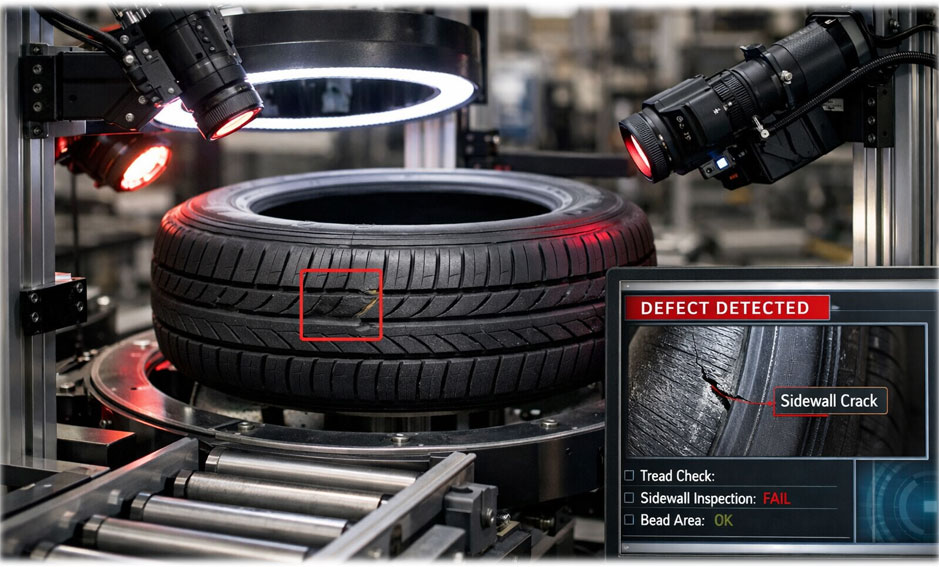
However, inspecting tires manually is challenging because tires have complex curved surfaces, deep tread patterns, and large circumferences. Defects can appear anywhere on the tire surface and may be difficult to detect visually during high-speed production.
Intelgic provides an automated tire inspection system using machine vision cameras and AI, enabling manufacturers to detect defects accurately and consistently during the production process.
The system uses rotational imaging to capture the entire tire surface and applies advanced AI algorithms to identify defects in real time.
Challenges in Tire Inspection
Tire inspection presents several unique challenges due to the structure and material properties of tires.
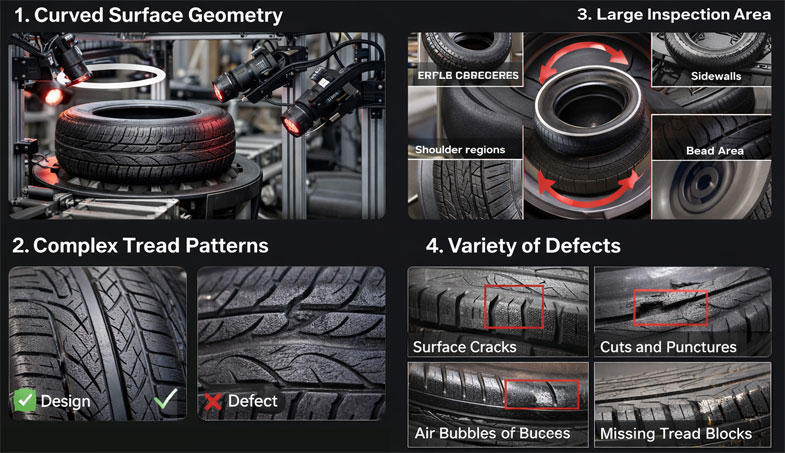
1. Curved Surface Geometry
Unlike flat products, tires have a circular and curved surface, making it difficult to capture all areas using a fixed camera.
2. Complex Tread Patterns
Tires contain detailed tread designs that vary across different models. Inspection systems must distinguish between intentional design features and defects.
3. Large Inspection Area
A complete inspection must cover:
- Entire tread surface
- Sidewalls
- Shoulder regions
- Bead area
This requires imaging systems capable of full 360-degree coverage.
4. Variety of Defects
Common tire defects include:
- Surface cracks
- Cuts and punctures
- Air bubbles or blisters
- Contamination or foreign particles
- Surface deformation
- Missing or damaged tread blocks
These defects must be detected accurately to prevent faulty tires from reaching the market.
Intelgic's Tire Inspection Solution
Intelgic has developed a fully automated tire inspection system that combines machine vision cameras, controlled lighting, rotational imaging, and AI-powered defect detection.
The system ensures that every part of the tire surface is inspected thoroughly and consistently.
Rotational Imaging Mechanism
To capture the complete surface of a tire, Intelgic uses a precision rotating mechanism.
Inspection Process
The tire is placed on the inspection station.
The tire is rotated using a controlled motorized system.
Industrial cameras capture images continuously as the tire rotates.
Multiple cameras capture different regions of the tire simultaneously.
The system generates a complete visual map of the tire surface.
This rotational imaging approach ensures full 360-degree coverage of the tire.
Optimized Lighting System
Lighting plays a crucial role in detecting surface defects on rubber materials.
Intelgic designs custom lighting setups to highlight tire defects effectively.
Lighting techniques may include:
Low-angle illumination to reveal cracks and cuts
Diffused lighting for uniform surface inspection
Multi-directional lighting to detect texture variations
These lighting configurations help enhance defect visibility on dark rubber surfaces.
AI-Based Defect Detection
At the core of the system is Intelgic's advanced AI architecture for industrial defect detection.
The AI models are trained using large datasets of tire images representing both normal conditions and defective samples.
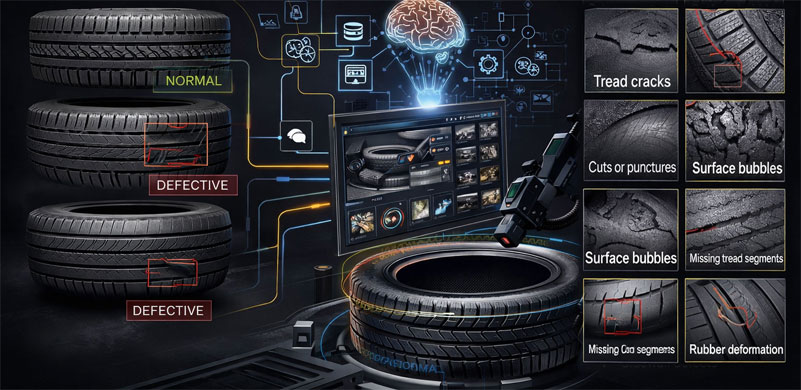
The AI system can detect defects such as:
Unlike rule-based systems, AI can learn complex tire patterns and detect subtle anomalies with high accuracy.
Inspection Workflow
The automated tire inspection process follows a structured workflow.
Step 1 — Tire Loading
The tire is placed on the rotating inspection station manually or via robotic handling.
Step 2 — Rotational Imaging
The tire rotates while industrial cameras capture high-resolution images of the surface.
Step 3 — Image Processing
Images are sent to the industrial GPU system running Intelgic's inspection software.
Step 4 — AI Defect Analysis
The AI model analyzes the images and identifies defects across the tire surface.
Step 5 — Quality Classification
Each tire is classified as pass or fail based on predefined quality standards.
Step 6 — Defect Reporting
The system stores inspection data including defect type, location, and images.
Benefits of Intelgic's Tire Inspection System
Complete 360-Degree Inspection
Rotational imaging ensures that every part of the tire is inspected.
Detection of Small Defects
AI can identify subtle defects that may be missed by manual inspection.
High-Speed Inspection
The system is designed to operate within high-volume tire production lines.
Consistent Quality Control
Automated inspection eliminates subjectivity in manual inspection.
Digital Quality Traceability
Inspection data can be stored for quality analytics and compliance.
Applications
Intelgic's tire inspection system can be used for:
Enabling Smart Manufacturing in Tire Production
The tire industry is increasingly adopting automation and AI-based quality inspection to ensure consistent product reliability and safety.
Intelgic's tire inspection solution enables manufacturers to detect defects early, reduce quality risks, and maintain strict manufacturing standards.
By combining machine vision cameras, rotational imaging mechanisms, advanced lighting, and AI-based defect detection, Intelgic delivers a powerful and scalable solution for automated tire inspection.