Rubber and tire manufacturing requires extremely high quality standards because the final products directly impact vehicle safety, durability, and performance. Even a small defect in a tire or rubber component can lead to premature wear, failure, or safety risks.
Traditionally, rubber and tire inspection has relied heavily on manual visual inspection, where operators examine the surface of the product to identify defects. However, manual inspection suffers from several limitations including fatigue, inconsistency, and difficulty detecting subtle defects.
With the advancement of machine vision and artificial intelligence (AI), manufacturers can now automate inspection processes with unprecedented accuracy and speed.
Intelgic provides AI-powered machine vision inspection systems for rubber and tire manufacturing, enabling manufacturers to detect defects in real time and maintain consistent quality across high-volume production.
Challenges in Rubber and Tire Inspection
Rubber products present unique challenges for automated inspection due to their material properties and complex geometries.
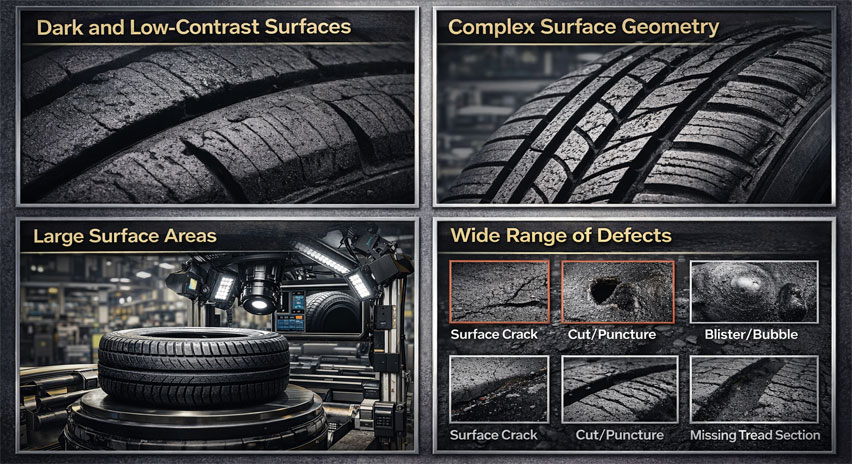
Dark and Low-Contrast Surfaces
Rubber is typically black or dark in color, which reduces contrast and makes defect detection difficult.
Complex Surface Geometry
Tires contain deep tread patterns and curved surfaces that require specialized imaging setups.
Large Surface Areas
A complete tire inspection must cover the entire circumference and multiple regions including tread, sidewall, and shoulder.
Wide Range of Defects
Rubber products may contain various defects including:
These defects must be detected reliably without slowing down production.
Machine Vision for Rubber Inspection
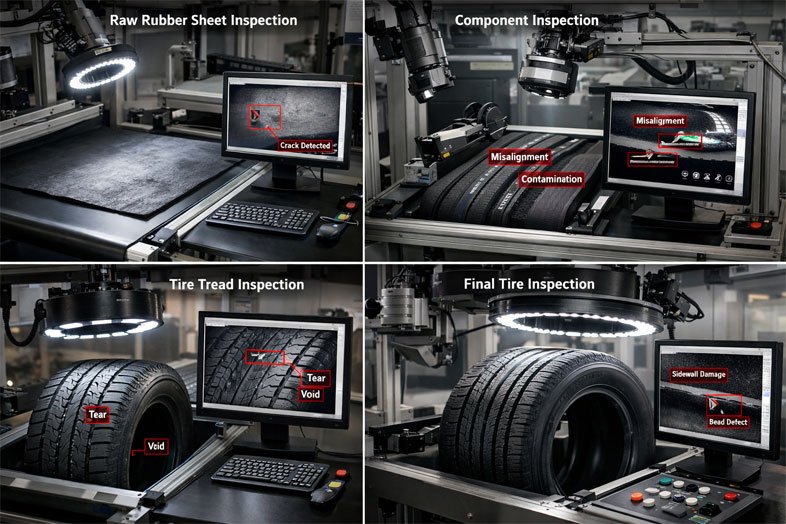
Machine vision systems use industrial cameras, lighting systems, and image processing algorithms to inspect products automatically. In rubber and tire manufacturing, machine vision systems can be deployed in multiple stages of production including:
- Raw rubber sheet inspection
- Component inspection
- Tire tread inspection
- Final tire inspection
High-resolution cameras capture images of the product surface, which are then analyzed by AI algorithms to identify defects.
Rotational Imaging for Tire Inspection
One of the most effective techniques for tire inspection is rotational imaging. Since tires have a circular shape, the inspection system rotates the tire during imaging.
Inspection Process
- The tire is placed on the inspection station
- A motorized mechanism rotates the tire
- Multiple cameras capture images during rotation
- The system creates a full 360-degree surface map
- AI analyzes the images for defects
This approach ensures complete coverage of the tire surface.
Line Scan Imaging for Rubber Sheet Inspection
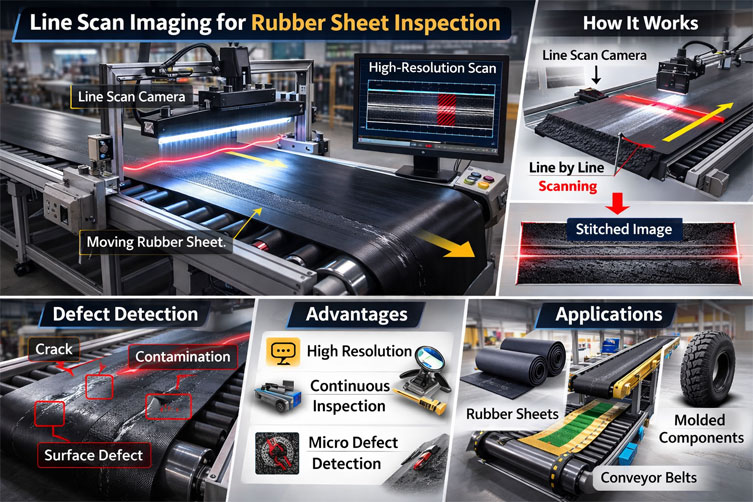
For flat rubber materials such as sheets or belts, line scan cameras are commonly used. Line scan cameras capture one line of pixels at a time while the material moves across the inspection station.
Advantages include:
Extremely high resolution imaging
Continuous inspection of large materials
Accurate detection of micro defects
This technique is ideal for inspecting rubber sheets, conveyor belts, and molded rubber components.
AI-Powered Defect Detection
At the core of Intelgic’s inspection systems is its advanced AI architecture for industrial defect detection. AI models are trained using large datasets of product images representing both good and defective conditions.
Surface cracks
Cuts and punctures
Air bubbles
Missing tread blocks
Surface contamination
Texture anomalies
Unlike rule-based systems, AI can learn complex product patterns and detect subtle anomalies with high accuracy.
Real-Time Inspection in Production Lines
Intelgic’s machine vision systems are designed to integrate seamlessly with existing manufacturing lines.
Inspection Workflow
Product moves through inspection station
Cameras capture high-resolution images
Images are processed using Intelgic software
AI detects defects in real time
System generates pass/fail decisions
Defective products are flagged for removal
This allows manufacturers to detect defects early and prevent defective products from reaching the market.
Benefits of AI-Based Rubber and Tire Inspection
100% Inspection
Every product can be inspected automatically.
Detection of Micro Defects
AI can identify extremely small defects that may be missed by human inspectors.
Consistent Quality Control
Automated inspection eliminates subjectivity in manual inspection.
Increased Production Efficiency
Inspection can be performed at full production speed.
Digital Quality Traceability
Inspection results can be stored and analyzed for process improvement.
Applications in Rubber and Tire Manufacturing
Intelgic’s AI inspection solutions can be used across multiple rubber manufacturing processes.
Tire Manufacturing
- Tread inspection
- Sidewall inspection
- Final tire inspection
Rubber Components
- Seals and gaskets
- O-rings
- Rubber bushings
- Automotive rubber parts
Rubber Sheets and Materials
- Conveyor belts
- Rubber sheets
- Molded rubber components
The Future of Quality Inspection in Rubber Manufacturing
As manufacturing moves toward Industry 4.0 and smart factories, AI-powered inspection systems are becoming essential tools for ensuring consistent product quality.
Intelgic’s machine vision solutions enable manufacturers to reduce defects, improve safety, and optimize production processes.
By combining industrial cameras, advanced lighting design, AI-based defect detection, and automated inspection workflows, Intelgic delivers scalable solutions for modern rubber and tire manufacturing environments.
AI-driven machine vision systems are transforming the way manufacturers inspect rubber and tire products. Automated inspection enables higher accuracy, faster detection, and improved manufacturing efficiency.
Intelgic’s solutions provide a powerful platform for real-time defect detection, digital quality management, and intelligent manufacturing, helping manufacturers maintain the highest standards of product quality.