One Missing Component Can Lead to a Costly Product Return
In manufacturing, assembling a product or preparing a component kit often requires operators to pick multiple parts from different bins, buckets, or containers. A typical assembly kit may contain:
Operators must select the correct parts, count the required quantities, and place them into an assembly box or package. Although the process appears simple, repetitive manual picking introduces several quality challenges:
One or more required parts are accidentally skipped.
Too many or too few parts are included.
Similar-looking parts are mixed up.
Unnecessary parts are added to the kit.
Assembly speed and accuracy vary between operators.
These errors can result in:
Intelgic addresses these challenges with an AI-powered robotic assembly and kitting solution that identifies individual components, picks them from designated containers, counts them, and places the correct quantity into an assembly box or package.
By combining AI machine vision with industrial robotics, manufacturers can automate repetitive picking and kit assembly operations while improving accuracy, consistency, and traceability.
How Intelgic’s AI-Powered Robotic Assembly System Works
Intelgic’s robotic assembly system combines industrial cameras, AI-based part recognition, robotic motion control, and intelligent assembly verification.
Identify the Assembly Kit and Required Components
The system receives an assembly recipe or bill of materials (BOM) defining the required components and quantities. For example:
The AI system uses this information to determine which components must be picked and how many are required to complete the kit. Different products or customer orders can have different assembly recipes.
AI-Based Part Identification Using Cameras
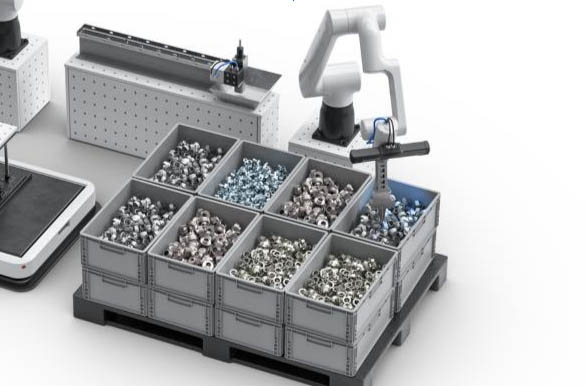
Industrial cameras capture images of components stored in different bins or buckets. Intelgic’s AI analyzes visual features such as:
The AI identifies the correct component and determines its position for robotic picking.
For randomly arranged or overlapping parts, 3D cameras or depth sensors can help determine the location, orientation, and accessibility of individual components. This is particularly important for similar-looking mechanical parts or components that are not organized in fixed positions.
NIST identifies robotic bin picking and 3D part localization as important applications of perception systems in manufacturing automation.
Robotic Picking and Automated Counting
Robotic Picking from Multiple Bins
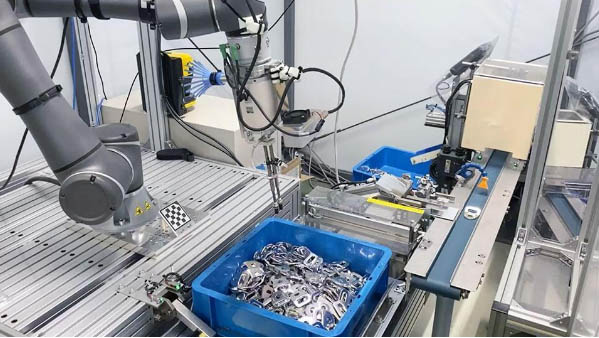
Once the correct component is identified, the vision system guides the robotic arm to pick it using a suitable gripper. The robot can pick parts from:
Depending on the application, the robot may use:
The robot selects the correct component based on the active assembly recipe rather than relying solely on a fixed picking sequence.
Automated Component Counting and Quantity Control
One of the most important capabilities of Intelgic’s robotic assembly system is automated component counting. The system maintains a count of every successfully picked and placed component.
For example, when the assembly requires 12 washers, the robot continues picking until all 12 have been verified as placed.
The system can use the following to verify successful transfers:
Helps prevent missing components, incorrect counts, and unintended duplicates.
Intelligent Placement and Final Verification
Intelligent Placement into the Assembly Box or Package
The robot places each selected component into the designated assembly box, tray, fixture, or package. Depending on the product, components can be:
For true mechanical assembly applications, the robotic system can also be configured for appropriate insertion, positioning, or fastening operations using suitable tooling and sensors.
Final AI Verification Before Releasing the Kit
Before the kit moves to the next production stage, Intelgic’s vision system can perform a final verification. The AI compares the completed kit with the required BOM and checks for observable errors, including:
A kit is released only after the configured verification checks are satisfied.
From Manual Picking to Intelligent Robotic Assembly
Applications of AI Robotic Assembly and Kitting
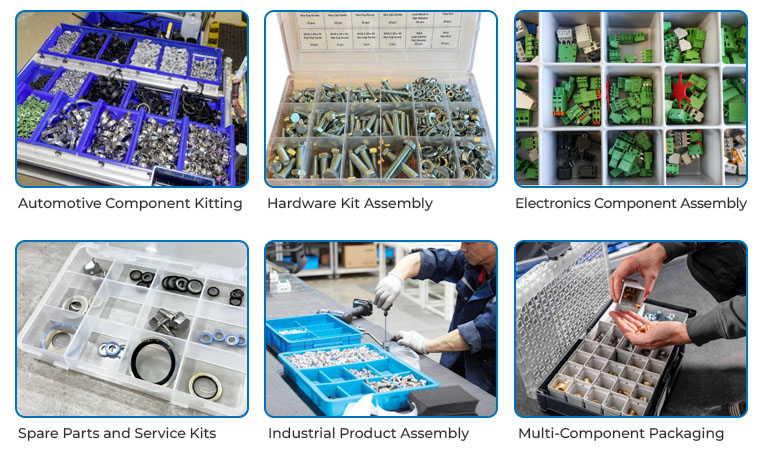
Automatically collect bolts, brackets, washers, clips, and connectors required for automotive assemblies. Helps prevent incomplete component kits from reaching assembly stations.
Prepare installation and maintenance kits containing precise quantities of screws, nuts, fasteners, spacers, and fittings.
Identify and place connectors, housings, cable assemblies, and mechanical components into dedicated assembly trays or fixtures.
Automatically prepare spare-part kits containing the correct components and quantities for equipment maintenance and repair.
Pick and position components for pumps, valves, motors, control panels, and other industrial equipment.
Assemble product packages containing multiple accessories, installation parts, and supporting components before shipment.
Advanced Capabilities of Intelgic’s Robotic Assembly System
The system can retrieve the component list and required quantities from an ERP, MES, or production order system. When the product model changes, the appropriate assembly recipe can be loaded automatically.
AI can learn distinctions between components based on their geometry, dimensions, markings, and other visible characteristics. Where visually similar parts cannot be reliably distinguished using standard cameras, calibrated 3D measurements or identification codes can provide additional verification.
Components do not always need to be presented in fixed positions. With appropriate 3D vision and gripping technology, the robot can identify accessible parts in randomly filled bins and calculate suitable picking positions.
If a component slips from the gripper or is not successfully transferred, the system can detect the failure and retry the operation without automatically increasing the verified component count.
The system can generate a digital record for each kit, including component identities, required quantities, verified quantities, assembly time, exceptions, and final verification status.
A single robotic cell can support multiple kit configurations when the required parts, robot reach, tooling, and cycle time are compatible.
Business Benefits of Robotic Assembly Automation
Reduce wrong-part selection and quantity errors
Verify required components before release
Repeatable picking, counting, and placement
Reduce rework, returns, and corrective handling
Support different BOMs and product variants
Record verified assembly events and exceptions
The financial benefit depends on production volume, labor utilization, current picking error rates, component complexity, and the cost of correcting incomplete kits.
For manufacturers experiencing frequent customer returns due to missing or incorrect parts, automated verification can be particularly valuable.
Why Intelgic for AI-Powered Robotic Assembly?
Intelgic combines industrial robotics, machine vision, and AI software to develop intelligent manufacturing automation solutions. Our robotic assembly approach includes:
Intelgic’s existing vision-guided robotic pick-and-place solutions and AI-based part identification technology provide a foundation for application-specific robotic assembly and kitting systems.
Each robotic workcell is designed around component geometry, material handling requirements, production throughput, and the customer’s assembly workflow.
What Is Required to Automate Your Assembly Process?
To evaluate robotic assembly automation, manufacturers should provide:
Images, dimensions, materials, and weights of parts.
Component types and required quantities for each product.
Videos or descriptions of manual picking and packaging.
Bin dimensions, arrangement, and part orientation.
Target cycle time, daily volume, and number of product variants.
Packaging layout, placement positions, and any mechanical assembly operations.
Based on these inputs, Intelgic can design a robotic picking and assembly concept and validate:
The Right Component. The Right Quantity. Every Time.
Manual picking and assembly errors may appear small, but a single missing screw, incorrect bracket, or extra component can result in product returns, production delays, and dissatisfied customers.
AI-powered robotic assembly changes how manufacturers approach these repetitive operations. By combining intelligent part recognition, robotic picking, automated counting, and final assembly verification, Intelgic helps manufacturers build a more consistent and reliable assembly process.
Don’t just automate component picking. Automate assembly accuracy.
Frequently Asked Questions
What is AI-powered robotic assembly? +
AI-powered robotic assembly combines cameras, computer vision, and industrial robots to identify, pick, position, and assemble components according to predefined production requirements.
How does Intelgic’s robotic system identify different components? +
The system uses AI and industrial cameras to recognize components based on shape, size, geometry, markings, and other visual features. 3D vision can provide additional information for complex parts.
Can a robot pick components from multiple bins or buckets? +
Yes. The robot can be programmed to pick components from multiple bins, trays, conveyors, or containers within its operating range.
How does the system ensure the correct quantity of each component? +
The system tracks verified pick-and-place operations and compares the completed count with the required BOM. Additional camera checks can confirm kit contents before release.
Can the system detect missing or extra components? +
Yes. AI inspection can identify detectable missing, incorrect, or extra components, depending on their visibility, presentation, and the validation of the inspection process.
Can the robot pick randomly arranged components? +
Yes. With appropriate vision and gripping technology, the robot can pick accessible components from randomly arranged bins. The feasibility depends on part overlap, geometry, material, and available gripping surfaces.
Can one robotic system assemble different product kits? +
Yes. Recipe-based configurations can support multiple products and component combinations, subject to gripper compatibility, robot reach, and cycle time requirements.
Does the system support integration with ERP and MES? +
Yes. The system can be integrated with manufacturing software to retrieve BOMs and production orders, track assembly completion, and report results.
Can robotic assembly help reduce product returns? +
Yes. By reducing missing, wrong, and extra component errors, robotic assembly can help lower returns and complaints associated with incomplete or incorrect kits.
Can Intelgic automate both picking and actual mechanical assembly? +
Yes, depending on the application. Beyond kitting and pick-and-place, robotic systems can be engineered for operations such as component insertion, positioning, or fastening using appropriate tooling and process sensors.
Can the system generate digital assembly records? +
Yes. Each assembly kit can have a record containing the product ID, component list, verified quantities, operation timestamps, and final inspection results.
How can manufacturers get started with Intelgic’s robotic assembly solution? +
Manufacturers can share component samples or images, BOMs, picking process videos, bin layouts, and production requirements. Intelgic can then evaluate the application and propose an appropriate AI vision and robotic assembly architecture.