How AI Preserves Tribal Knowledge from Experienced Manufacturing Operators
Ask an experienced manufacturing operator how to perform a task, and the answer may go far beyond the written standard operating procedure.
The operator may know that one component is easily confused with another, that a particular product variant requires extra attention or that a subtle visual change often indicates an emerging problem. This knowledge may have been developed over years of observation, troubleshooting and hands-on experience.
Much of it may never have been formally documented.
When experienced employees retire, change roles or leave the organization, manufacturers risk losing more than production capacity. They can also lose valuable operational knowledge that influences quality, safety and efficiency.
Artificial intelligence offers manufacturers a new way to preserve part of this expertise. By combining expert input, Visual AI, digital work instructions and process-event data, Intelgic helps convert practical knowledge into guided workflows that can support operators during production.
The goal is not to convert every human insight into an algorithm. It is to prevent important, repeatable knowledge from disappearing when the person who holds it is no longer available.
What is tribal knowledge in manufacturing?
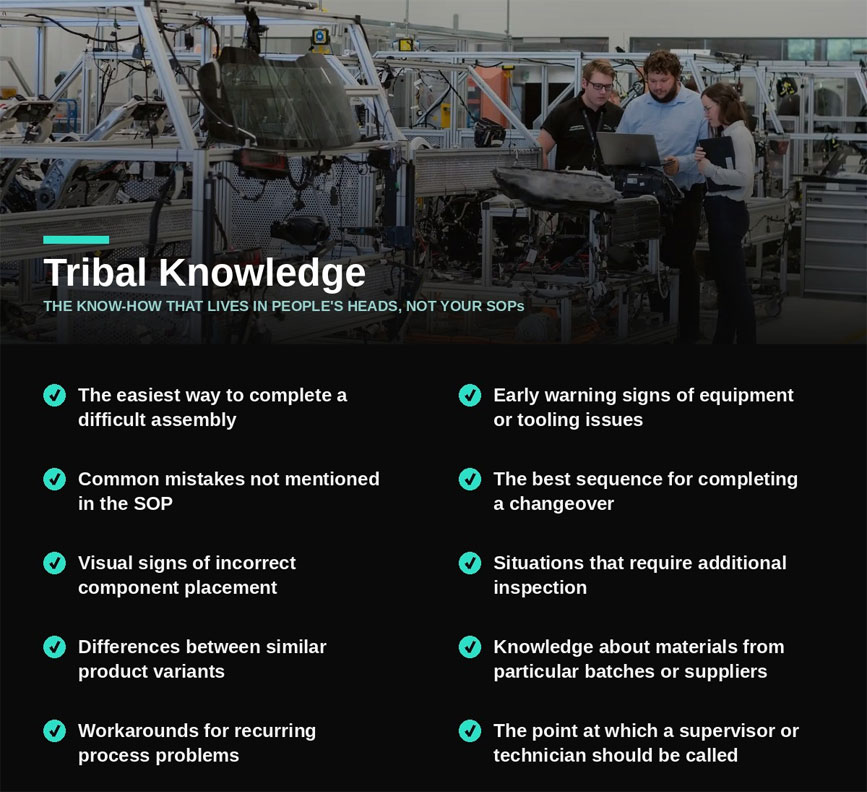
Tribal knowledge is practical information shared informally among a group of employees but not fully captured in official documents, training systems or process controls.
This knowledge is often learned by watching an experienced colleague, asking questions or making mistakes.
The term “tribal knowledge” should not imply that the information is unreliable. Some of it can be extremely valuable. The problem is that it may be unavailable to people outside the group and can disappear without warning.
Why tribal knowledge develops
Formal documents cannot always capture everything that happens in a real production environment.
SOPs usually describe the approved method, but experienced operators also encounter:
Over time, employees develop practical methods for recognizing and handling these conditions.
Tribal knowledge also develops when documentation processes are slow. An operator may discover a better method, but the information may remain within one shift or workstation because there is no simple way to capture, review and distribute it.
Why losing experienced operators creates manufacturing risk
When an experienced employee leaves, the organization may lose knowledge in several areas.
New operators may know the documented steps but not the small details that make execution reliable.
Experienced employees often recognize abnormalities before they become obvious defects.
They may know which checks to perform first, reducing downtime and unnecessary escalation.
They understand how apparently minor differences between products affect the operation.
Senior operators often act as informal mentors for new employees.
Their experience helps distinguish isolated errors from recurring process weaknesses.
If this knowledge is not captured, manufacturers may experience longer training cycles, inconsistent quality, increased rework and greater dependence on the remaining experts.
Why traditional knowledge-capture methods are not enough
Manufacturers commonly preserve knowledge through SOPs, checklists, training videos, skills matrices and classroom instruction. These methods remain essential, but they have limitations.
An expert may find it difficult to recall every important decision when speaking away from the workstation.
A document can state the correct step without explaining what the operator should look for or why the step often fails.
Training videos may demonstrate a complete operation, but operators cannot always search through them while production is running.
The written process and the day-to-day production method may gradually diverge.
Information may be stored successfully but remain difficult to access at the moment an operator needs it.
AI-supported knowledge preservation addresses both capture and application. It helps structure expert knowledge and makes validated guidance available during execution.
How AI helps preserve manufacturing knowledge
AI can support knowledge preservation through a repeatable cycle:
This is more than digitizing a paper SOP. It creates a living operational knowledge system connected to the shopfloor.
How Intelgic captures expert operator knowledge
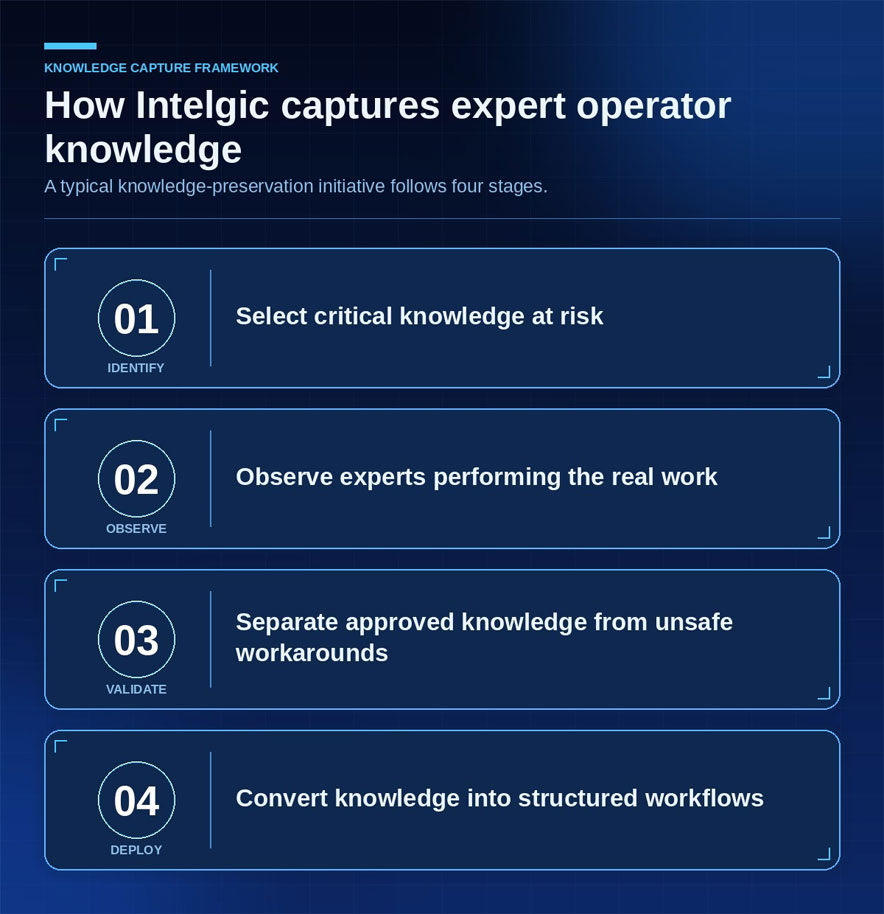
Intelgic combines camera-based SOP monitoring with real-time operator guidance. A typical knowledge-preservation initiative can follow these stages.
Not every informal practice should be captured. Manufacturers should begin with knowledge that affects:
Priority should be given to processes heavily dependent on a small number of experienced employees.
Knowledge capture should happen close to the process.
Experienced operators can be observed while completing normal and variant-specific tasks. They can explain:
This contextual approach often reveals information that would not emerge during a conference-room interview.
Not all tribal knowledge should be standardized.
Some informal practices may compensate for:
Before expert knowledge becomes part of a digital workflow, it should be reviewed by the appropriate process, quality and safety personnel.
AI should distribute validated knowledge—not automatically reproduce every existing behavior.
Approved knowledge can be translated into:
“Before installing this component, check the marking near the edge. The two variants look identical from the front.”
Verify the component marking before installation. Variant B requires marking X42.
If the marking can be read reliably through a camera or scanner, the check may also become a digitally monitored process event.
5. Use Visual AI to recognize relevant process events
Intelgic’s Visual AI can observe configured work areas and recognize relevant objects, actions or conditions.
Depending on the use case, the system may help determine whether: