AI-Powered Part Identification and Robotic Sorting Using Machine Vision
Manufacturing and warehouse operations often handle many parts that look similar but differ in dimensions, shape, size, color, holes, edges, markings, or other visual features. Identifying these parts manually and placing them into dedicated bins is repetitive, time-consuming, and prone to sorting errors.
Traditional automation can sort parts when every item arrives in a fixed position and follows a simple rule. It becomes less reliable when parts are mixed, randomly oriented, overlapping, or visually similar.
Intelgic automates this process by combining industrial cameras, 2D and 3D machine vision, state-of-the-art AI, and robotic handling.
The system identifies each part from its dimensions, geometry, size, and visual characteristics, determines its location and orientation, and instructs a robot to pick it and place it into the correct dedicated bin or bucket.
This creates an intelligent sorting system capable of seeing, understanding, deciding, and physically handling parts.
What Is AI-Based Part Identification and Robotic Sorting?
AI-based part identification is the process of recognizing and classifying components using visual and geometric information captured by cameras or 3D sensors.
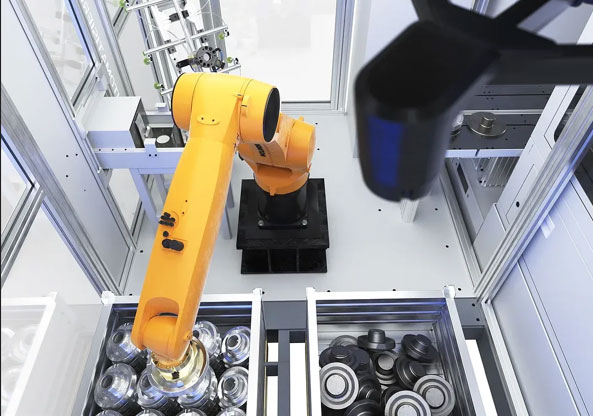
After identifying a part, the system determines where it is located and communicates the required picking information to an industrial robot or collaborative robot. The robot picks the component using a suitable gripper and transfers it to the correct destination.
Unlike a conventional fixed sorting machine, an AI-powered system can learn the differences between complex parts and adapt to normal production variation.
Why Automated Part Identification Is Challenging
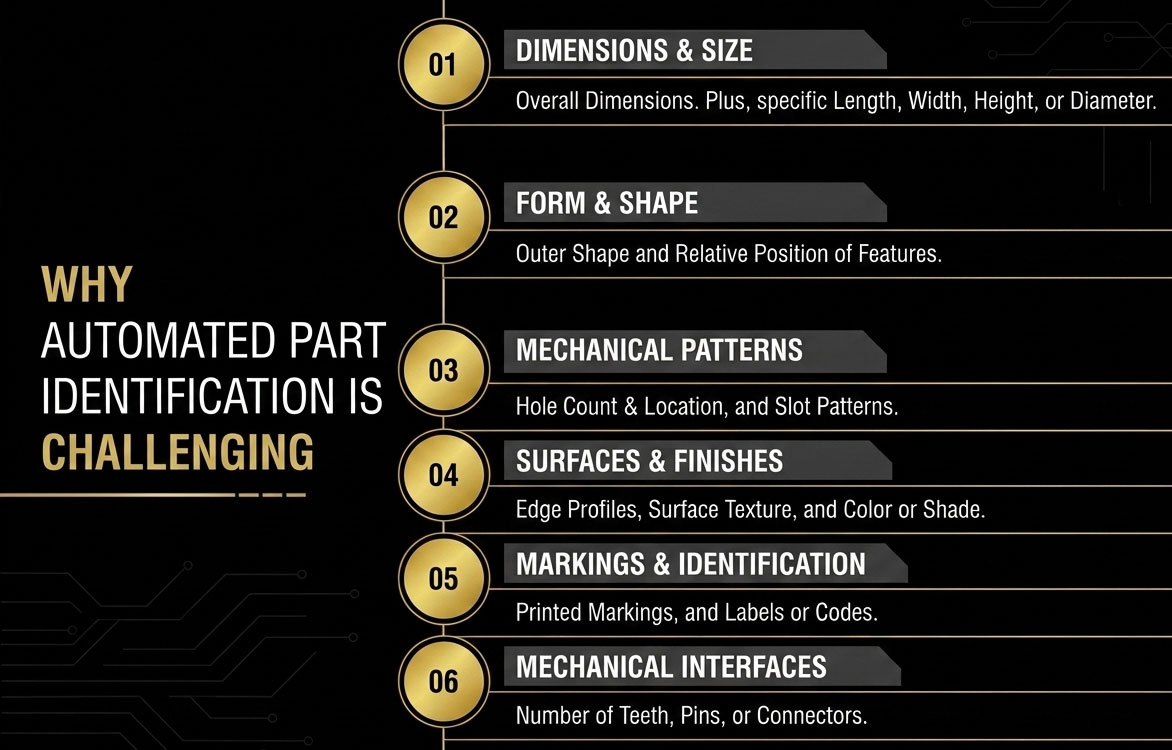
Parts may differ in ways that are easy for an experienced operator to recognize but difficult to describe using conventional programming.
The challenge becomes greater when parts are randomly mixed, rotated or flipped, touching or overlapping, partially hidden, reflective, dark or low contrast, small, similar in appearance, presented in bulk containers, moving on a conveyor, or manufactured with acceptable dimensional variation.
Intelgic designs the imaging, AI, robot, gripper, and handling strategy around these real operating conditions.
How Parts Can Be Identified
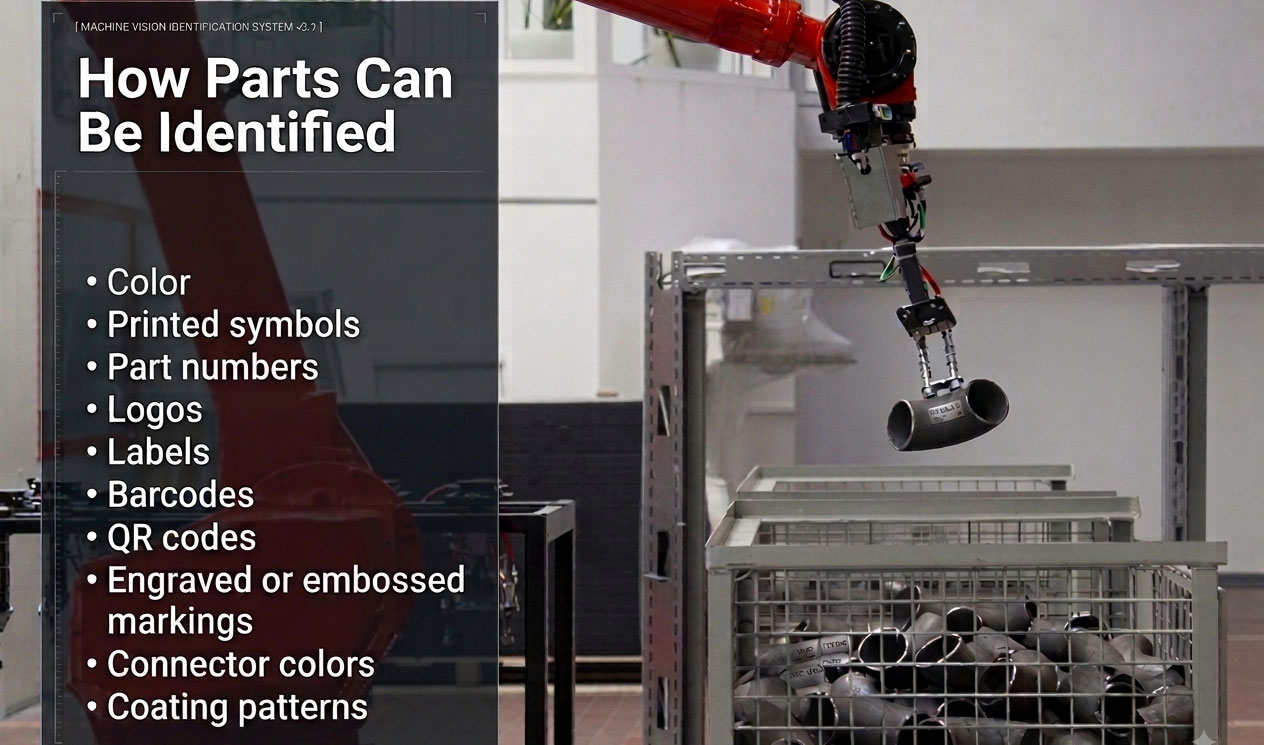
No single feature is sufficient for every application. Intelgic can combine multiple identification methods to improve reliability.
Parts can be differentiated by measurements such as length, width, height, diameter, thickness, hole diameter, distance between holes, slot dimensions, feature spacing, and profile measurements.
For flat parts, calibrated 2D imaging may be sufficient. When height, depth, or full geometry is important, a 3D camera or laser-profile sensor may be required. Telecentric optics may be used in precision applications to reduce perspective error and improve measurement consistency.
A part's outline and internal geometry can provide a strong visual signature.
AI can distinguish parts with complex shapes even when they arrive in different orientations.
Components that have a similar shape may still differ in scale. The system can use calibrated image or 3D data to classify parts according to their physical size. Calibration is important because an object appearing larger in an image may simply be closer to the camera. Intelgic configures the system so image information can be related to real-world dimensions.
Some parts cannot be differentiated by geometry alone. Visual features may include:
Intelgic can combine object-recognition AI with OCR and code-reading technologies when product identity depends on markings.
Three-dimensional imaging captures depth, height, and surface profile. It is valuable for identifying:
A 3D point cloud can help the system understand both part identity and picking orientation.
Applications of AI Part Identification and Sorting
The technology can be applied in many manufacturing and logistics processes.
Different components arriving in a mixed batch can be identified and placed into separate bins.
Parts randomly arranged inside a container can be detected, localized, picked, and transferred to a machine, conveyor, fixture, or dedicated bin.
Parts moving on a conveyor can be classified and picked or diverted according to type, model, size, or destination.
The system can identify and collect the components required for a production kit, improving kit completeness and reducing incorrect-part selection.
A robot can identify the required part, determine its orientation, and load it into a CNC machine, press, assembly station, or inspection fixture.
Mixed or randomly presented parts can be recognized and oriented before being supplied to an assembly process.
Returned, received, or unpackaged components can be identified and routed to the correct storage location.
Parts can be identified and separated into accepted, rejected, rework, or manual-review categories after inspection.
Similar product variants can be recognized and placed into the correct container or production flow.
How Intelgic Automates the Process
A reliable robotic sorting system requires close coordination between vision, AI, controls, and mechanical handling.
Parts are supplied to the inspection and picking area through conveyors, bins, trays, pallets, chutes, vibratory feeders, tables, racks, or returnable containers. The presentation method affects visibility, picking access, and system cycle time.
Parts spread across a conveyor may be easier to image and pick than deeply entangled components inside a container. Intelgic evaluates the complete material flow before selecting the automation concept.
Industrial cameras capture the images required for recognition. Depending on the application, the system may use area-scan cameras, high-resolution cameras, color cameras, monochrome cameras, stereo-vision cameras, 3D time-of-flight cameras, structured-light sensors, laser-profile sensors, robot-mounted cameras, fixed overhead cameras, or specialized illumination.
Lighting is engineered to make relevant differences visible while reducing glare, shadow, and environmental variation.
Intelgic's AI analyzes the captured image or 3D data to locate and classify every visible part. The system can use object detection, image classification, instance segmentation, shape matching, anomaly detection, OCR, barcode and QR-code reading, dimensional measurement, and 3D point-cloud analysis.
For mixed components, instance segmentation can separate individual objects even when several parts appear within the same image. Each detected part can be assigned:
Recognizing a part is only one part of the task. The robot must know where and how to pick it.
For simple flat parts on a conveyor, a 2D position and rotation may be sufficient. Random bin picking commonly requires full 3D pose estimation.
The vision coordinate system is calibrated with the robot coordinate system. Intelgic's control system sends which part to pick, where it is located, how it is oriented, which gripper setting to use, where it must be placed, and which path or approach direction is appropriate. The robot then executes the pick-and-place operation.
The correct end-of-arm tooling is essential for reliable handling. Possible gripping technologies include vacuum grippers, two-finger grippers, three-finger grippers, parallel grippers, magnetic grippers, soft grippers, adaptive grippers, custom mechanical grippers, and multi-tool gripper assemblies.
Gripper selection depends on part material, weight, shape, surface condition, available gripping area, fragility, oil or contamination, orientation, required cycle time, and product variation. A system handling several part families may use an adaptive gripper, automatic tool changing, or multiple gripping methods.
After picking, the robot transfers each part to its assigned destination. Destinations may include dedicated sorting bins, buckets, trays, pallets, assembly fixtures, machine-loading stations, packaging containers, rework areas, reject containers, and quality-review stations.
The AI classification result determines the destination automatically. The robot can also place parts in a controlled orientation when the next process requires organized presentation.
The system can verify whether the pick and placement were completed successfully by confirming that the original location is empty, detecting a part in the gripper, checking the destination bin, monitoring bin fill level, counting sorted components, confirming correct placement, and recording unsuccessful pick attempts.
Conveyors, Random Bins, Similar Parts, and Unknown Items
In conveyor applications, the system must locate objects while they are moving.
This configuration is useful when parts are separated sufficiently and production requires continuous flow.
Random bin picking is more complex because components may overlap, interlock, or hide one another. A 3D vision system captures the bin and generates depth information. Intelgic's AI identifies the visible components and determines which part offers the safest and most reliable pick.
After a successful pick, the system captures new data and recalculates the next target. Difficult applications involving highly reflective, flexible, transparent, or heavily entangled parts may require specialized presentation or separation methods in addition to AI and robotics.
A key advantage of AI-based inspection is its ability to combine several small differences. Two parts may have the same overall outline but differ in one additional hole, hole spacing, slot position, edge radius, connector count, surface marking, height, thread location, color, or printed part number.
Intelgic's AI can analyze these features together instead of relying on a single rule. Dimensional checks, shape analysis, OCR, and 3D information can be combined to improve identification confidence. When confidence falls below a defined threshold, the system can place the item in a manual-review or unknown-part bin rather than risk incorrect sorting.
An automated system should not force every object into a known category. Intelgic can configure an unknown-part workflow in which the system:
This makes the process safer and supports controlled expansion to new part families.
AI Models, Robots, Quality Inspection, and Factory Integration
Industrial part recognition differs from general image recognition. Components may be reflective, oily, dusty, partially hidden, or visually similar. Their orientation and presentation may change continuously.
The solution may combine deep-learning AI with deterministic machine-vision measurements. AI provides flexibility for complex appearance, while calibrated vision verifies dimensions and specific features.
Industrial robots are suited to high-speed sorting, heavy parts, large working areas, continuous production, high payloads, and demanding environmental conditions.
Appropriate guarding and safety systems are generally required.
Cobots may be suitable for flexible workstations, lower-speed applications, frequent product changes, small or medium parts, operations near human workers, and rapid redeployment.
A cobot application still requires a complete safety assessment. The gripper, part, speed, payload, and surrounding equipment all influence the required safeguards.
Part identification and defect inspection can be combined in a single automation cell. Before placing a part into its destination, the system may inspect it for missing features, cracks, surface damage, incorrect dimensions, deformation, contamination, incorrect assembly, or printing or marking errors.
The robot can then sort the component into accepted, rejected, rework, or review bins. This reduces repeated handling and turns the sorting station into an intelligent quality-control cell.
Integration enables the system to receive work orders, select product recipes, update inventory, report sorting results, and coordinate with upstream and downstream processes.
The system can provide operational information such as number of parts identified, quantity by part type, parts sorted per hour, pick success rate, misclassification or review rate, robot cycle time, bin fill level, unknown-part frequency, rejected-part count, downtime, repeated pick failures, and results by batch or shift.
These insights help manufacturers improve part presentation, gripper performance, production planning, and material flow.
Industries and Applications
AI-powered part identification and robotic sorting can support many industries.
Brackets, fasteners, gears, connectors, clips, stamped parts, machined components, and interior and exterior parts.
Precision components, fasteners, brackets, machined parts, and assembly kits.
Connectors, housings, switches, PCB-related components, cables, and accessories.
Laser-cut parts, stampings, forgings, castings, machined components, and sheet-metal parts.
Molded parts, caps and closures, product housings, accessories, and packaging components.
Returned components, spare parts, mixed inventory, order-kitting items, and product variants.
Material categories, reusable components, product types, and size- or shape-based separation.
Benefits of AI-Powered Robotic Sorting
Factors That Determine System Performance
The performance of a part-identification and robotic-sorting system depends on number of part types, similarity between components, smallest distinguishing feature, part size and weight, surface reflectivity, presentation method, degree of overlap or entanglement, required cycle time, robot reach and payload, gripper access, bin dimensions, environmental lighting, required identification confidence, and upstream and downstream processes.
Testing with representative parts and real presentation conditions is important before finalizing the system.
A Customized Automation Solution
No two part-sorting applications are identical. A conveyor carrying separated components requires a different solution from a bin containing randomly piled metal parts.
Intelgic develops application-specific systems that may combine:
The complete cell is engineered around the actual parts, production requirements, and destination process.
Transform Part Sorting with Intelgic
Manual identification and sorting of mixed parts can limit production speed, create errors, and consume skilled labor.
Intelgic combines AI, industrial cameras, 3D vision, robots, and intelligent software to automate the entire process. The system identifies parts using their dimensions, shape, size, and visual features; determines their position and orientation; and directs a robot to place each one into its dedicated bin.
The result is a flexible automation system that can see parts, understand their differences, and handle them accurately.
Frequently Asked Questions
Common questions about AI-powered part identification, robotic sorting, random bin picking, quality inspection, and factory-system integration.
01
How does AI identify similar manufacturing parts?
How does AI identify similar manufacturing parts?
AI analyzes a combination of dimensions, contours, holes, slots, edges, textures, colors, markings, and other visual features. Calibrated 2D or 3D measurements can be added when precise geometric differences are important.
02
Can the system recognize randomly oriented parts?
Can the system recognize randomly oriented parts?
Yes. The vision system can identify parts across different rotations and calculate the position and orientation required for robotic picking.
03
Can a robot pick mixed parts from a bin?
Can a robot pick mixed parts from a bin?
Yes. A 3D vision system can identify accessible parts in a randomly arranged bin, calculate their pose, and guide the robot through a safe picking path. Feasibility depends on overlap, entanglement, reflectivity, and gripper access.
04
What happens when the AI does not recognize a part?
What happens when the AI does not recognize a part?
The system can classify it as unknown and move it to a dedicated review bin. This is safer than assigning a low-confidence identity.
05
Can the system inspect parts while sorting them?
Can the system inspect parts while sorting them?
Yes. Identification can be combined with checks for missing features, surface damage, incorrect dimensions, deformation, contamination, or other visible defects.
06
Can Intelgic integrate the system with MES or warehouse software?
Can Intelgic integrate the system with MES or warehouse software?
Yes. The system can connect with PLC, MES, ERP, WMS, quality databases, and other factory systems to receive work orders, update inventory, report results, and maintain traceability.
07
Should an industrial robot or cobot be used?
Should an industrial robot or cobot be used?
The choice depends on payload, speed, reach, workspace, part type, and safety requirements. Industrial robots are generally suited to high-speed or heavy-duty applications, while cobots may suit flexible, lower-speed workstations.