Improve Manufacturing Operator Efficiency with AI Assistants and Camera-Based Training
Experienced manufacturing operators carry valuable knowledge that is rarely captured completely in SOP documents or work instructions. They understand how to perform difficult operations, recognize unusual conditions, avoid common mistakes, handle product variations, and complete work efficiently without compromising quality.
These skills may have developed through years of practical experience. When experienced operators move into quality or supervisory roles, or leave the organization, their knowledge can leave with them. New operators must then build the same understanding through classroom training, shadowing, trial and error, and repeated production experience. Depending on process complexity, achieving proficiency can take months or even years.
Intelgic helps manufacturers preserve and transfer this operational knowledge using camera-based AI Assistants.
Industrial cameras observe work at the manufacturing station. Intelgic's AI analyzes process steps in real time, compares them with approved SOPs and work instructions, and guides operators while they perform the job. The same system measures process execution, identifies difficult steps, discovers training opportunities, and helps transfer proven working methods across the workforce.
The Hidden Knowledge of Experienced Operators
An SOP defines how a manufacturing process should be performed. However, even a detailed document may not capture every practical decision involved in efficient execution.
Experienced operators may know:
Some of this knowledge is explicit and can be documented. Much of it is tacit knowledge developed through experience. If the organization does not capture it, new operators must rediscover it independently.
What Is an AI Operator Assistant?
An AI Operator Assistant is a camera-based system that observes manufacturing work, understands the current process step, and provides guidance during execution.
Intelgic's AI Assistant connects four types of information:
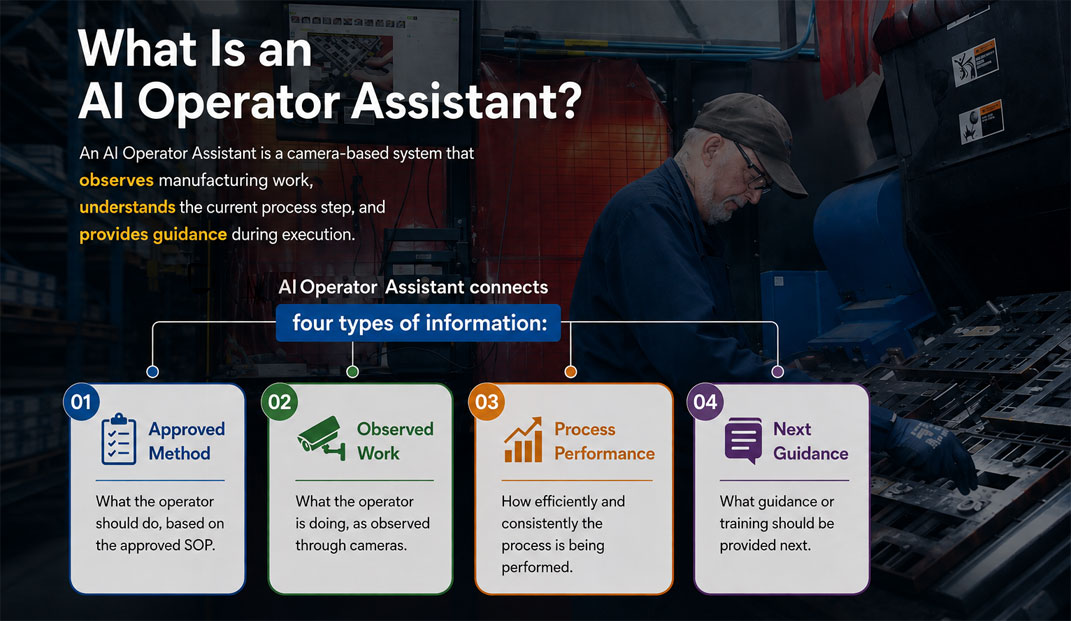
What the operator should do, based on the approved SOP.
What the operator is doing, as observed through cameras.
How efficiently and consistently the process is being performed.
What guidance or training should be provided next.
This creates an interactive learning environment directly at the workstation. Instead of separating training from production, the AI Assistant provides reinforcement while the operator performs real work.
How Intelgic's AI Assistant Works
The implementation begins with the approved production process. Intelgic works with the manufacturer's process experts, quality teams, experienced operators, and trainers to understand:
Experienced operators can demonstrate the approved method under controlled conditions. Their actions can help clarify process details that are difficult to communicate through text alone. Any captured best practice should be reviewed and approved by engineering, quality, safety, and production teams before it becomes part of the AI-guided workflow.
Industrial cameras are positioned to observe the relevant process areas. The system may capture:
Depending on the workstation, Intelgic may use:
Camera placement is designed around the manufacturing process and the events the AI must recognize.
Intelgic configures the AI using approved process information and representative production data. Training data may include:
The AI learns to recognize where the operator is within the process and whether the required actions are being performed.
As the operator works, the AI analyzes the camera stream and converts visual activity into structured process events.
Each event can be associated with a timestamp, work order, product, station, and process step.
The AI compares actual process events with SOPs, work instructions, MES work orders, Bills of Materials, product recipes, variant requirements, quality-control plans, and expected process sequences.
The AI Assistant can provide guidance through workstation screens, visual work instructions, highlighted component locations, step-by-step prompts, audio notifications, stack lights, Andon systems, tablets, projected instructions, and connected tools.
The operator receives help at the moment it is relevant.
When an incorrect or incomplete action is detected, the AI continues observing the station. The system can verify that:
This creates a closed feedback loop between instruction, execution, correction, and confirmation.
Training Operators During Production
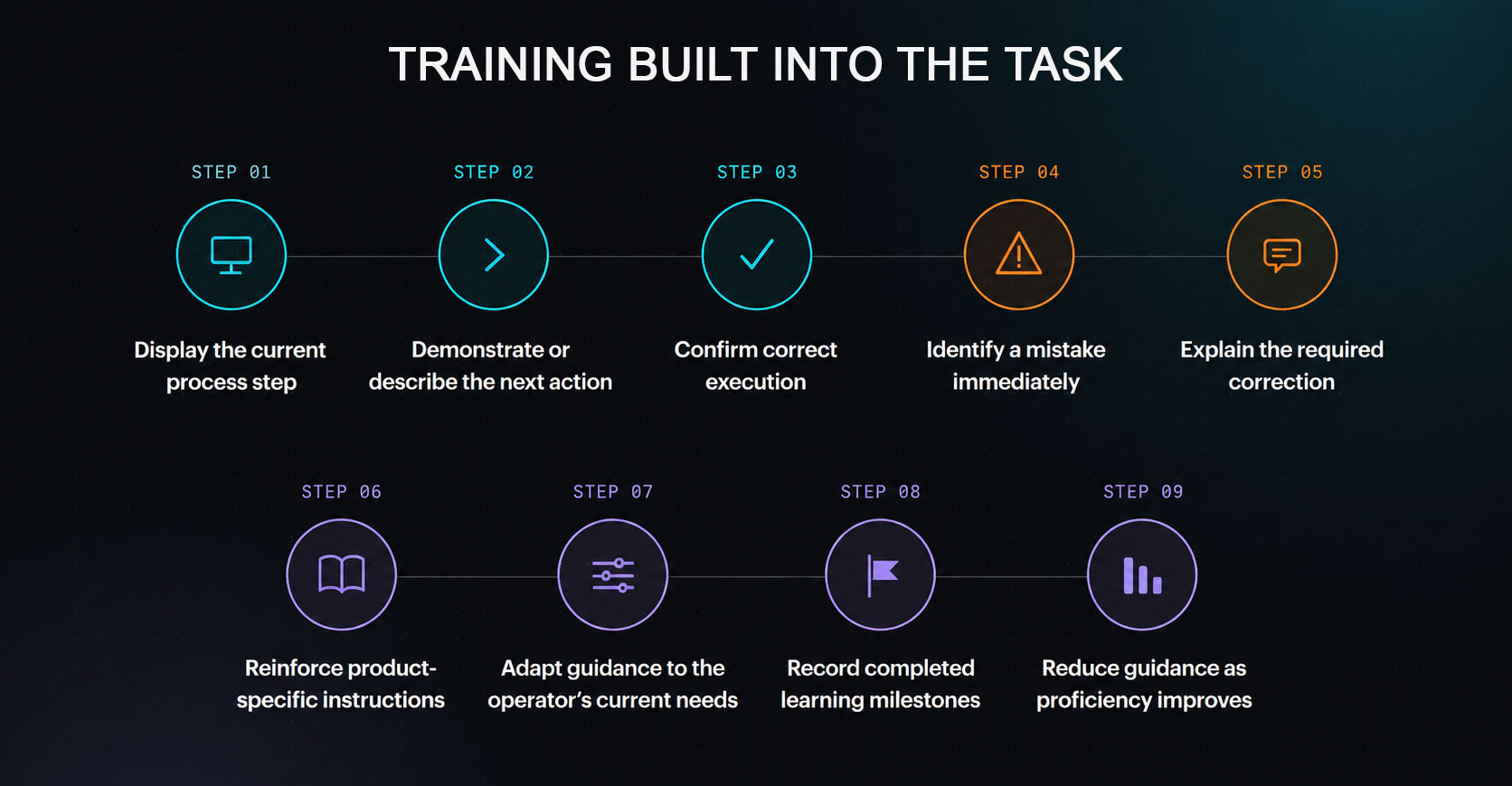
Traditional training often occurs away from the workstation. Operators may attend a session, read instructions, watch a demonstration, and later attempt to apply what they learned during production. An AI-assisted workstation provides contextual training during the task itself.
A new operator may initially receive detailed step-by-step instructions. As the operator demonstrates consistent process execution, the system can provide fewer prompts and intervene only when needed. This creates an adaptive training experience instead of providing the same instructions to every operator indefinitely.
Capturing and Transferring Knowledge Across the Workforce
Intelgic's AI can help convert expert performance into reusable organizational knowledge. A controlled knowledge-capture process may include:
The goal is not to copy every personal habit of the fastest operator. Speed alone does not define best practice. The approved method must also satisfy product quality, operator safety, ergonomics, SOP compliance, tool requirements, equipment limitations, repeatability, and customer requirements. AI helps capture expert knowledge, while authorized manufacturing teams decide which practices should become the standard.
Once expert knowledge is reviewed and digitized, the AI Assistant can make it available consistently across operators, shifts, workstations, production lines, plants, product variants, and training programs.
A less-experienced operator no longer needs to wait for the most experienced person to become available. The approved process knowledge is delivered directly at the workstation. The AI can help transfer:
This turns individual experience into controlled organizational knowledge.
Measuring Operator Efficiency Responsibly
Operator efficiency is not a single number. It should be evaluated in the context of process quality, product mix, material availability, equipment condition, training level, workstation design, and upstream constraints.
The system should support coaching and process improvement, not make unsupported conclusions from isolated data.
Creating an Operator Efficiency Scale
Intelgic can help manufacturers create a role- and process-specific proficiency scale. A sample framework might include:
The scale should be based on multiple observations over an appropriate period and reviewed by qualified supervisors or trainers. AI analytics should not be treated as the sole basis for employment, disciplinary, compensation, or promotion decisions.
Discovering Difficult Steps and Training Opportunities
A process may appear straightforward on paper while one or two steps repeatedly create difficulty. Intelgic can identify difficult steps by measuring average step duration, step-time variation, repeated attempts, error frequency, assistance requests, correction time, skip frequency, rework association, differences between new and experienced operators, and product-variant impact.
Analytics may show that a cable-routing step takes twice as long for new operators, creates the most repeated attempts, produces frequent orientation errors, requires the most AI guidance, and causes downstream rework.
Training recommendations may be based on repeated difficulty with one process step, frequent wrong-component selection, high dependence on guidance, incorrect sequence, missed quality checks, unstable cycle time, difficulty with a particular variant, repeated corrective actions, low confidence during uncommon processes, or incomplete competency coverage.
A training dashboard may show: Process: Connector Assembly. Training opportunity: Connector orientation. Evidence: 7 corrections across 40 cycles. Recommended module: Orientation and locking confirmation. Suggested review: Supervisor coaching. Recommendations should be reviewed by a supervisor or qualified trainer before being assigned.
Intelgic analytics can identify process executions that are SOP compliant, first-time right, consistent, within the expected cycle-time range, free from repeated movements, completed without unnecessary assistance, and associated with acceptable quality.
Repeated examples of high-quality execution can help process teams understand which approved methods work well. The fastest observed cycle should not automatically become the standard if it includes unsafe movement, omitted checks, or unsustainable working pace.
Individualized Operator Training
Different operators may require help with different parts of the same process. Intelgic's AI Assistant can support individualized guidance based on approved role and training information.
The system can provide additional prompts for specific steps while allowing the operator to complete familiar steps independently. As proficiency improves, guidance can be reduced.
Process Analytics, Skill Matrices, and Manufacturing Integration
Manufacturers often maintain a skill matrix showing which operators are trained or approved for each process. Intelgic can supplement a skill matrix with observed, process-specific evidence.
The AI output should complement formal qualification and supervisor assessment rather than replace them.
New product introductions require operators to learn new components, sequences, tools, and quality checks. Intelgic's AI Assistant can support this transition by loading product-specific work instructions, highlighting new process steps, verifying component selection, tracking where operators require assistance, comparing actual and expected cycle time, identifying unclear instructions, discovering difficult assembly features, and updating training priorities.
Early production data can help engineering and training teams improve the process before full-scale deployment.
A single line may produce several product variants with different assembly requirements. The AI Assistant can identify or receive the active variant from MES, work order, PLC, barcode or QR code, RFID, OCR, or vision-based product recognition.
It then loads the appropriate components, tools, process steps, sequence, quality checks, guidance, and expected cycle time.
This supports operators during frequent changeovers and reduces dependence on memorizing every product combination.
Intelgic's Certainty platform can manage the complete operator-assistance and efficiency workflow. Certainty can:
Certainty connects physical operator activity with digital manufacturing instructions and training information.
Intelgic can integrate its AI Assistant with MES, ERP, SAP, PLC, SCADA, learning-management systems, digital work instructions, quality-management systems, human-reviewed skill matrices, tool controllers, Bill of Materials, production databases, order-management systems, and cloud or on-premises dashboards.
Integration gives the AI the context required to provide product- and process-specific guidance.
Each production cycle can create a structured record containing product ID, work order, product variant, workstation, operator role or authorized identifier, SOP version, steps completed, step timestamps, guidance provided, detected deviations, corrective actions, process result, AI model version, and training status.
Traceability settings can be configured according to operational requirements and workforce-data policies.
Intelgic can provide dashboards for SOP-compliance trends, step-level cycle time, guidance frequency, correction frequency, difficult process steps, training progress, product-variant proficiency, repeated process errors, first-time-right execution, workstation performance, process stability, and knowledge and skill coverage.
Reports can be filtered by process, station, product, variant, shift, training stage, and time period. Access to individual-level analytics should be role-controlled and limited to authorized purposes.
Responsible Use of Operator Analytics
Camera-based operator assistance must be implemented transparently and responsibly. Manufacturers should define:
AI-generated efficiency scores should never be interpreted without context or used as the sole basis for consequential workforce decisions.
These goals should remain the primary objective of the system.
Implementing an AI Operator Assistant
A typical implementation follows these steps:
Preserve Experience and Make It Available at Every Station
Manufacturing expertise should not disappear when an experienced operator changes roles, retires, or leaves the organization. Intelgic helps manufacturers transform approved expert knowledge into an AI-guided production resource.
Cameras observe how work is performed. AI recognizes process steps, compares execution with work instructions, provides real-time guidance, and measures where operators need support. Analytics reveal difficult steps, learning progress, process variation, and opportunities to improve training.
The knowledge of experienced operators can then be standardized, reviewed, and delivered through AI Assistants to new and developing operators directly at the workstation.
Build a More Capable Manufacturing Workforce with Intelgic
Intelgic's camera-based AI Assistants help manufacturers preserve operational knowledge, accelerate workplace learning, improve process consistency, and make training more targeted.
The system does more than monitor performance. It turns approved manufacturing expertise into real-time guidance.
New operators receive help as they work. Experienced operators contribute knowledge that remains within the organization. Supervisors receive evidence about difficult steps and training opportunities. Process teams gain insights that were previously difficult to discover.
Contact Intelgic to discuss AI-assisted operator training, knowledge transfer, SOP monitoring, and manufacturing-efficiency analytics.