What Happens When Your Best Assembly Expert Is Not Available?
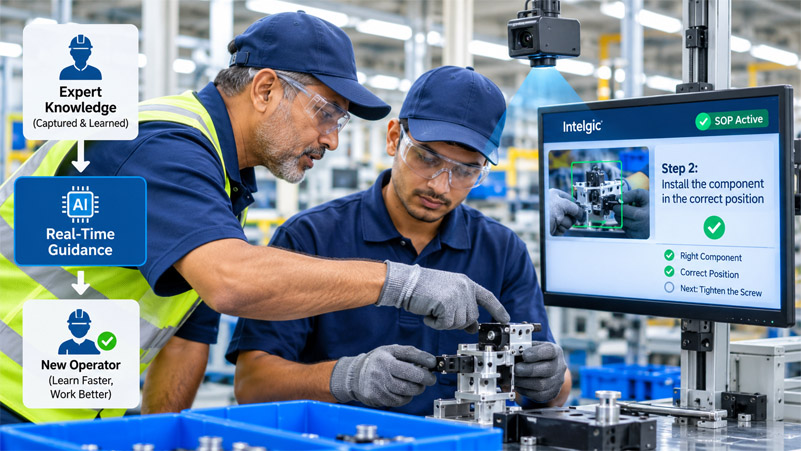
Every manufacturing facility has a few highly experienced operators who know how to perform complex assembly operations correctly and efficiently.
These experts understand the standard operating procedures (SOPs), know the right sequence of operations, recognize common mistakes, and often solve problems that are not clearly explained in written work instructions.
But there is a challenge.
Your best operators cannot be present at every workstation, on every shift, every day.
Some retire, move to other roles, or leave the organization. New employees require extensive training, while less experienced operators may struggle with complex assembly sequences, component selection, and critical quality checkpoints.
The result? Longer training periods, inconsistent work quality, repeated mistakes, and increased dependence on a few skilled individuals.
What if manufacturers could capture the knowledge of their best operators and make that expertise available to every worker, at every station, on every shift?
Intelgic addresses this challenge with its AI-powered SOP monitoring and operator assistance platform.
The platform can learn from approved expert demonstrations, understand manufacturing work instructions, monitor operator activities, and provide real-time guidance.
Intelgic turns expert manufacturing knowledge into an AI-powered co-worker that helps new operators learn faster, perform complex operations correctly, and avoid costly assembly mistakes.
The Manufacturing Challenge: Expertise Is Difficult to Transfer
Manufacturing knowledge is not always fully documented.
An experienced operator often knows much more than what is written in an SOP:
How to position a difficult component correctly.
Which part or tool should be selected for each operation.
The correct sequence of assembly activities.
How to recognize a misplaced or missing component.
Which mistakes frequently occur during assembly.
When an operation is complete and ready for the next step.
Much of this practical knowledge is acquired through years of experience.
When experts are unavailable, new operators rely on printed instructions, videos, occasional supervision, and trial and error.
This challenge is supported by manufacturing research. A 2024 Procedia CIRP paper highlights how organizations rely on undocumented expert knowledge and explores using camera recordings, object recognition, and activity recognition to generate assembly instructions.
Traditional training transfers knowledge at a particular moment. AI-assisted guidance can make approved knowledge available continuously while the work is being performed.
How Intelgic Captures Expert Knowledge and Transfers It to AI
Intelgic’s SOP AI platform combines industrial cameras, computer vision, activity recognition, and intelligent process verification.
The system can be trained using demonstrations from experienced operators, supported by approved SOPs, engineering instructions, and process requirements.
Record the Best Operator Performing the SOP
An experienced operator performs the assembly process while industrial cameras capture the activities.
The recording can include component selection, hand movements, part positioning, tool usage, assembly sequences, and critical verification steps.
Convert Expert Demonstrations into AI-Recognizable Actions
Intelgic’s AI analyzes the captured activities to identify objects, movements, interactions, and process sequences.
The engineering team maps those observations to the approved SOP and establishes what constitutes correct execution.
This is important because expert demonstrations alone do not necessarily establish every engineering requirement or acceptable process variation.
Build an Intelligent Assembly SOP
The system creates a configurable representation of the assembly process, including:
Deploy the AI Agent at Assembly Stations
Once configured and validated, the AI Agent can support other operators performing the same process.
It monitors activities, verifies required operations, detects recognizable deviations, and provides guidance based on the approved work instructions.
Continuously Improve the AI’s Understanding
Supervisors and process experts can review flagged activities, approve corrections, and update procedures as manufacturing requirements evolve.
The organization’s captured process knowledge remains available within its controlled AI platform rather than depending entirely on individual employees.
AI as a Real-Time Assembly Trainer and Co-Worker
Unlike traditional training videos or printed instructions, Intelgic’s AI Agent can respond to what an operator is actually doing.
It doesn’t simply display the next instruction. It can evaluate whether the required operation has been completed.
Guide Operators Step by Step
The AI provides instructions based on the active SOP and current assembly stage.
For example, during a mechanical assembly process, the system can guide an operator through positioning the housing, installing a gasket, placing internal components, attaching the cover, and completing fastening operations.
Detect Mistakes While They Happen
The AI monitors visible activities and identifies deviations such as:
Provide Immediate Corrective Guidance
Instead of waiting for a supervisor or final inspection, the AI informs the operator about the mistake and how to correct it.
For example:
The operator attempted to install the housing cover before the gasket was detected.
Install the gasket in the designated groove, verify its position, and then proceed with the housing cover.
Illustrative AI workstation interface, not an actual Intelgic product screenshot.
Verify the Correction Before Proceeding
After an operator corrects the mistake, the AI checks whether the required visible action has been completed.
For processes with suitable manufacturing-system integration, the station can require successful checkpoint verification before advancing.
The difference is significant: the AI does not just tell operators what to do. It can help ensure that they actually complete the required operation.
Provide Assistance Across Multiple Shifts
The same approved SOP knowledge can support operators working on morning, evening, and night shifts.
This reduces dependence on a particular expert being physically available, while supervisors remain responsible for exceptional, ambiguous, or safety-critical situations.
Where AI-Guided Operator Training Adds the Most Value
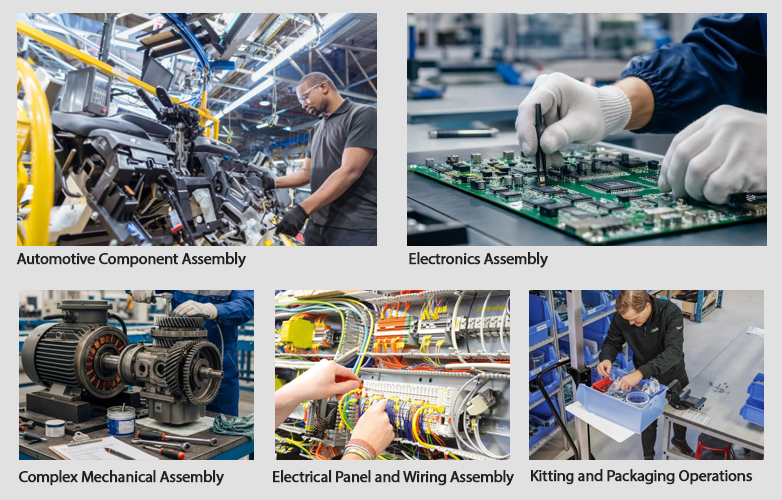
Guide new operators through multi-step assembly procedures, verify component installation, and identify missed operations before parts move downstream.
Verify component selection, connector placement, cable routing, and visually identifiable assembly checkpoints.
Assist with multi-component assemblies involving housings, bearings, seals, fasteners, and critical installation sequences.
Help operators follow component placement, wiring routes, connector identification, and installation sequences.
Guide component selection, verify quantities, and help prevent missing, incorrect, or extra parts in kits and packages.
Traditional Operator Training vs. AI-Powered Assembly Assistance
How AI Can Help New Operators Become Proficient Faster
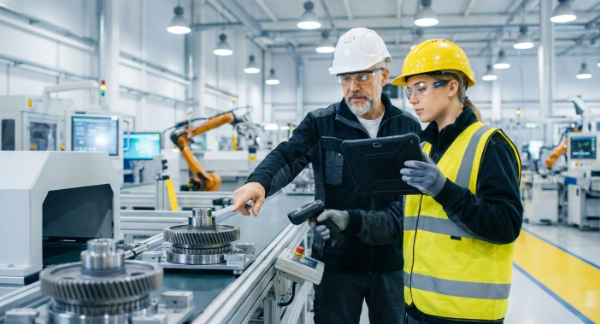
The objective of AI-assisted training is not to make every new employee an expert overnight. It is to shorten the path to reliable, independent performance.
With conventional training, operators learn through demonstrations, repeated practice, occasional corrections, and experience.
AI makes these learning opportunities available during actual production work.
- ◆Demonstrations
- ◆Repeated practice
- ◆Occasional corrections
- ◆Experience
- ✓New operators receive immediate guidance when they make mistakes
- ✓Experienced operators work with fewer interruptions
New operators can receive immediate guidance when they make mistakes, while experienced operators can work with fewer interruptions.
Research supports the potential of this approach.
A 2026 study on smart worker guidance demonstrated real-time SOP deviation detection and operator warnings in a complex GPU assembly application.
Another 2026 study found that AI-based feedback improved trainee awareness of performance during assembly tasks.
These are research findings, not Intelgic-specific performance claims.
How Manufacturers Benefit from AI-Powered Operator Assistance
Give new operators step-by-step support during actual work
Preserve approved workflows beyond employee turnover
Identify missing and incorrect operations earlier
Provide consistent assistance across shifts
Verify critical steps across operators and stations
Analyze errors, correction patterns, and training needs
These benefits can be measured using operator training time, first-pass yield, assembly error frequency, rework hours, and the number of interventions required before independent operation.
Beyond Training: AI Creates a Continuous Learning System
Intelgic’s AI-powered SOP platform can also help manufacturers improve the way expertise is developed and maintained.
Analyze which assembly steps new operators frequently miss or perform incorrectly.
Provide more detailed guidance to new operators and less frequent prompts to experienced operators, based on authorized training settings and validated performance.
Use expert-reviewed activity data to identify missing instructions, confusing steps, or opportunities to simplify workflows.
Update approved process recipes when products, components, or assembly procedures change.
Maintain reusable, version-controlled process instructions even when experienced employees retire or leave.
A 2024 research paper specifically examined generating assembly instructions from recorded expert processes using machine vision and activity recognition, showing a practical direction for industrial knowledge capture.
What Makes Intelgic’s Approach Different?
Intelgic combines knowledge capture, visual process recognition, real-time SOP monitoring, and corrective operator guidance.
The platform can be configured to:
Complex processes require application-specific training, validated observation coverage, and approved rules for exceptions. AI is particularly effective when the required actions and completion criteria are clearly defined and observable.
For measurements, fastening torque, or machine parameters that cannot be verified visually, Intelgic can integrate data from compatible industrial tools and control systems.
The Future: Every New Operator Has Access to an Expert AI Co-Worker
Imagine a manufacturing facility where a new operator starts working on a complex assembly process.
The operator does not need to memorize every step immediately or depend on an experienced colleague for every question.
An AI Agent understands the approved assembly workflow, monitors the operation, identifies recognizable mistakes, and provides guidance at the right moment.
The organization no longer depends exclusively on a small group of experts to transfer every piece of process knowledge.
The expertise of your best operators becomes a reusable organizational capability, available across workstations and shifts.
The AI does not replace expert judgment. It helps extend expert-approved knowledge to more people, more consistently.
Your Best Operator’s Knowledge Should Never Leave the Factory
Manufacturers spend years developing their most experienced operators. Yet much of that expertise remains with individual employees and can be difficult to transfer when they retire, change positions, or leave.
Intelgic’s AI-powered SOP monitoring and operator assistance platform helps manufacturers capture approved expert practices, transfer them into intelligent assembly workflows, and guide other operators during actual production.
By monitoring assembly activities, detecting mistakes, and verifying corrective actions, AI can help new employees become more proficient while reducing avoidable manufacturing errors.
Frequently Asked Questions
How can AI help train new manufacturing operators?
AI can guide operators through approved assembly steps, monitor their actions, detect observable errors, and provide immediate corrective feedback during production.
Can AI learn assembly procedures from experienced operators?
Yes. Camera recordings of expert demonstrations can be analyzed using computer vision and activity recognition. The recognized activities are then mapped to validated SOPs and work instructions.
Can AI replace experienced manufacturing trainers?
AI can reduce repetitive training demands and make expert-approved instructions available more consistently. Experienced trainers remain essential for validating procedures, handling unusual situations, and teaching skills that cannot be fully captured through cameras.
Can AI detect assembly mistakes in real time?
Yes. Properly configured AI can detect visible errors such as missing components, incorrect placement, skipped steps, and wrong assembly sequences.
How does Intelgic’s AI Agent guide operators?
The AI Agent monitors the current assembly activity, compares it with the approved SOP, and provides relevant guidance through a workstation interface when a deviation occurs.
Can AI verify that an operator corrected a mistake?
Yes, when the corrective action has observable completion criteria. The system can verify the corrected operation before marking the corresponding checkpoint complete.
Does the system work for complex assembly operations?
Yes, subject to appropriate configuration and validation. Complex processes may require multiple cameras, additional sensor data, and detailed process definitions.
Can the same AI knowledge be used across different production shifts?
Yes. Approved process recipes and trained models can support multiple stations and shifts, providing standardized guidance to different operators.
Can AI assist operators working with different product variants?
Yes. The system can load product-specific SOPs and assembly recipes based on work orders, part identification, or manufacturing system integration.
Can AI help retain manufacturing knowledge when experts retire?
Yes. Captured demonstrations, validated procedures, and trained process recognition models can preserve important elements of operational knowledge within the organization.
Can Intelgic integrate AI operator guidance with existing manufacturing software?
Yes. The platform can be integrated with MES, ERP, PLCs, and other systems to retrieve production information and exchange process verification data.
How can manufacturers measure the effectiveness of AI-based operator training?
Manufacturers can compare training duration, first-pass yield, missed SOP steps, rework rates, correction frequency, and time to independent operation before and after implementation.
Does AI require operators to wear cameras or special equipment?
Not necessarily. Fixed industrial cameras around the workstation can monitor many assembly operations without requiring wearable devices.
Will AI automatically learn new assembly processes without human involvement?
Not reliably. New processes require approved SOP definitions, representative training data, engineering validation, and testing before being deployed for quality-critical guidance.
How can manufacturers get started with Intelgic’s AI operator assistance solution?
Start by selecting a complex assembly process, documenting the approved SOP, and recording expert operators performing the required steps. Intelgic can then assess AI recognition, checkpoint verification, corrective guidance, and workstation integration.