Turning Every Manufacturing Operator into an AI-Guided Expert for Zero-Defect Manufacturing
Every manufacturing plant has a small group of highly experienced operators who seem to know instinctively when something is wrong. They recognize the correct component at a glance. They remember the exact sequence for every product variant. They notice subtle abnormalities, avoid common mistakes and know how to respond when a process does not proceed as expected. These abilities are developed through years of experience. But manufacturers cannot place an expert beside every operator at every workstation. Experienced employees retire, new workers need time to learn, product variations increase, and standard operating procedures become more complex. Intelgic addresses this challenge with an AI-powered operator-guidance and SOP-monitoring system. Cameras and computer vision observe defined manufacturing activities, compare them with the correct process and guide operators while the work is being performed. The objective is simple: capture expert process knowledge and make it available to every operator, during every shift and at every relevant workstation.
The difference between having an SOP and following it correctly
Standard operating procedures are essential to manufacturing quality. They define how an operation should be completed safely, consistently and efficiently. However, the existence of an SOP does not guarantee its correct execution. On a busy shopfloor, operators may encounter:
- ◆Similar-looking components
- ◆Multiple product variants
- ◆Complicated assembly sequences
- ◆Frequent changeovers
- ◆Instructions that are difficult to consult while working
- ◆Pressure to meet production targets
- ◆Language and literacy differences
- ◆Fatigue or distraction
- ◆Limited access to experienced supervisors
- ◆Long gaps between initial training and actual production.
Paper instructions, videos and classroom training explain what should happen. They cannot normally determine whether an operator is performing each step correctly in real time. This creates a gap between documented knowledge and actual process execution. AI-guided work helps close that gap.
What is an AI-guided manufacturing operator?
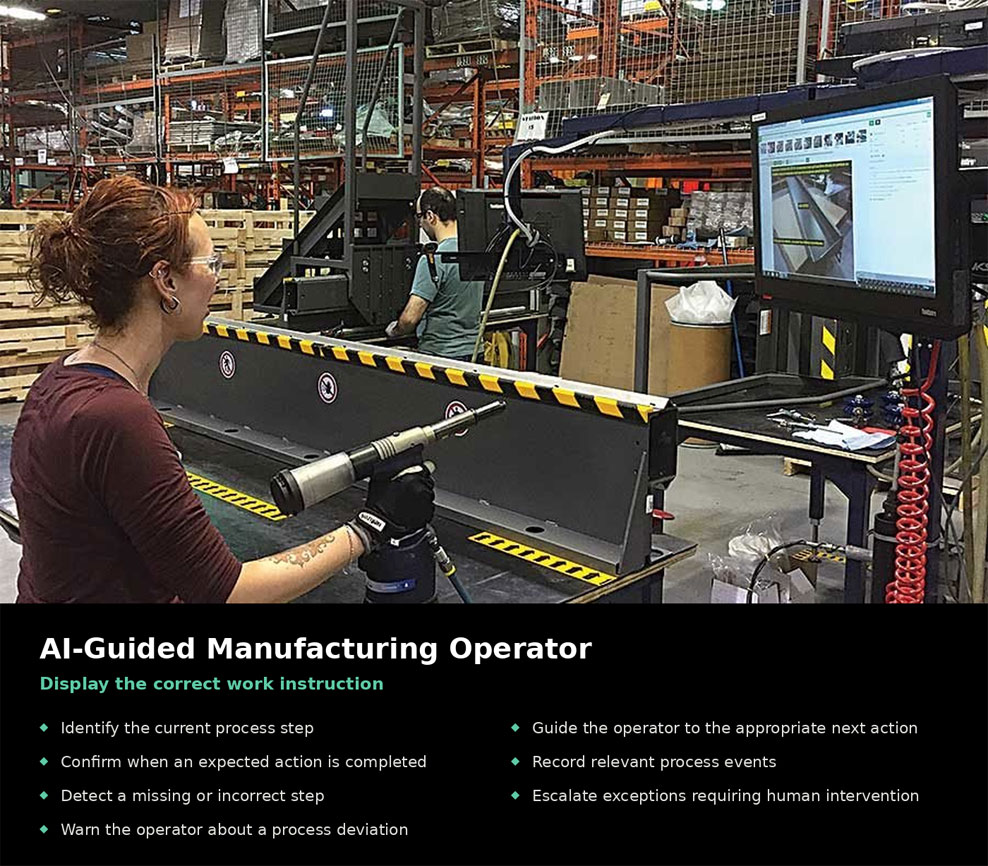
An AI-guided operator is a person supported by a digital system that understands the expected production process, monitors observable activities and provides contextual assistance. The operator continues to perform the work and exercise human judgment. AI functions as a digital process assistant that can:
- ◆Display the correct work instruction
- ◆Identify the current process step
- ◆Confirm when an expected action is completed
- ◆Detect a missing or incorrect step
- ◆Warn the operator about a process deviation
- ◆Guide the operator to the appropriate next action
- ◆Record relevant process events
- ◆Escalate exceptions requiring human intervention.
Unlike static work instructions, AI guidance responds to what is happening at the workstation. The result is a more interactive relationship between the operator, the SOP and the production process.
Why manufacturing errors are usually process problems
When a defect is traced to an operator error, the most immediate response is often additional training. Training is valuable, but it does not remove every condition that allowed the error to occur. A process may still depend on the operator remembering:
- ◆Which component belongs to a particular variant
- ◆Which tool must be used
- ◆Whether every fastener has been installed
- ◆Which operation comes next
- ◆Whether an inspection has been completed
- ◆What to do when an abnormal condition occurs.
Human beings can make mistakes even when they are trained, capable and motivated. A better approach is to design the process so the correct action is easier to perform and an incorrect action is identified as early as possible. This is the principle behind mistake-proofing, or Poka-Yoke. AI extends this philosophy to manual operations that depend on visual recognition, human movement and process sequence.
How Intelgic creates an AI-guided workstation
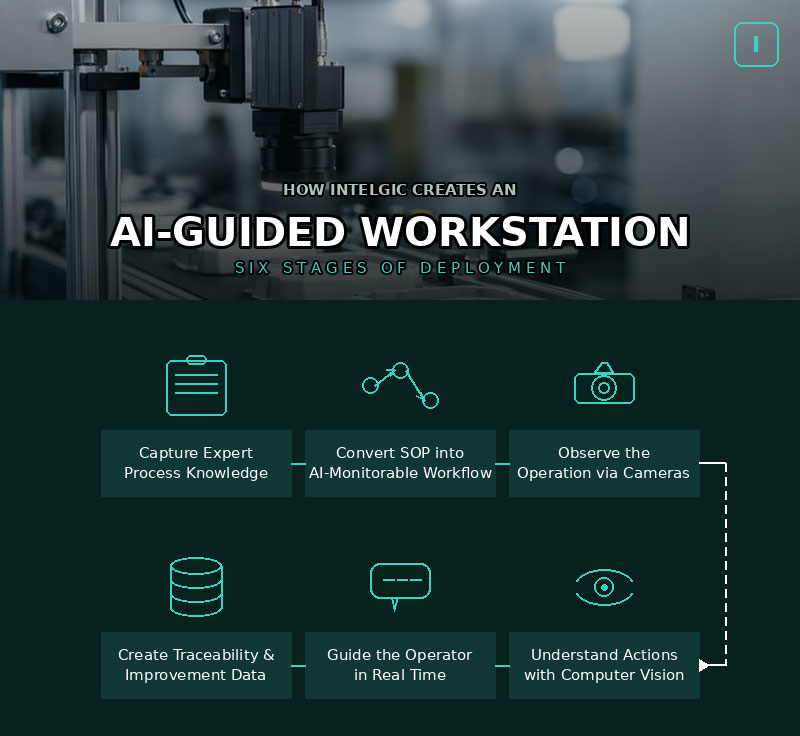
Intelgic uses cameras, computer vision and digital process rules to monitor configured shopfloor activities. The observed operation is compared with a defined SOP so that operators can receive assistance during execution. A typical implementation includes the following stages.
1. Capture expert process knowledge
The first step is to understand how the operation should be performed. Process engineers, supervisors, quality teams and experienced operators identify:
- ◆The correct sequence of work
- ◆Critical-to-quality steps
- ◆Required components and tools
- ◆Acceptable process variations
- ◆Known failure modes
- ◆Conditions requiring an alert
- ◆Situations requiring supervisor intervention.
The SOP is then broken into steps that can be monitored or confirmed. Involving experienced operators is especially important. Written instructions may explain the official process, while experienced employees often understand the practical details that prevent errors under real production conditions.
2. Convert the SOP into an AI-monitorable workflow
The documented process is translated into a sequence of observable events. For example:
- 01Confirm the correct product variant
- 02Pick component A
- 03Place component A in the assembly
- 04Pick component B
- 05Position component B correctly
- 06Use the required tool
- 07Complete the fastening operation
- 08Perform the quality check
- 09Release the completed assembly.
The system is configured to identify the relevant objects, actions and work zones. Not every SOP condition can be confirmed visually. Some operations may also require information from barcode readers, torque tools, PLCs, sensors, MES platforms or other production systems.
3. Observe the operation using cameras
Cameras are positioned to view the relevant workstation without unnecessarily monitoring unrelated areas. Depending on the application, the system may observe:
- ◆Component bins
- ◆The assembly area
- ◆Fixtures
- ◆Tools
- ◆Work-in-progress
- ◆Inspection zones
- ◆Packaging areas
- ◆The interaction between the operator and relevant objects.
Camera placement, lighting, object visibility and possible obstructions are evaluated during deployment. The purpose is not simply to record video. It is to give the AI sufficient visual information to recognize configured process events.
4. Understand actions with computer vision
Intelgic’s computer-vision system analyzes the camera feed to identify relevant objects and activities. Depending on the use case, it may determine whether:
- ◆The correct component is present
- ◆A required component is missing
- ◆A part has entered the correct work zone
- ◆An operation was performed in sequence
- ◆A step was skipped
- ◆The assembly remained at a step for an unusual amount of time
- ◆The expected verification was completed
- ◆The process is ready to advance.
The detected events are compared with the configured workflow. This allows SOP compliance to be assessed during production rather than only through retrospective audits or final inspection.
5. Guide the operator in real time
The system can provide the operator with the instruction appropriate to the current situation. When a step is completed correctly, it can confirm completion and present the next instruction. When a possible deviation occurs, it can display a prompt such as:
- ◆“Complete the previous step before proceeding.”
- ◆“Required component not detected.”
- ◆“Check component selection.”
- ◆“Verify component orientation.”
- ◆“Quality inspection is pending.”
- ◆“Use the specified tool.”
- ◆“Supervisor assistance required.”
This immediate feedback is critical. An alert delivered after the product leaves the workstation may help identify a defect, but it cannot help the operator prevent it. Real-time guidance moves quality control closer to the point of execution.
6. Create traceability and improvement data
AI-guided operations can also create structured records of relevant process events. Manufacturing teams can use this information to investigate:
- ◆Frequently missed steps
- ◆Recurring sequence deviations
- ◆Product variants associated with more errors
- ◆Stations requiring better instructions
- ◆Training needs across teams or shifts
- ◆Cycle-time abnormalities
- ◆Workstation-layout problems
- ◆Opportunities for physical mistake-proofing or automation.
A recurring alert should not automatically be treated as an operator-performance problem. It may indicate confusing instructions, similar packaging, poor material placement or an unnecessarily complex process. The data can therefore support both operator development and process improvement.
How AI helps an average operator perform like an expert
An experienced operator possesses three valuable capabilities: process knowledge, situational awareness and the ability to recognize abnormalities. AI guidance helps make elements of these capabilities available to less-experienced operators.
It puts knowledge at the point of work
Operators do not need to leave the workstation, search through a manual or rely entirely on memory. The appropriate instruction is delivered while the operation is happening.
It reduces dependence on memorization
A worker may need to produce several product variants with different components or sequences. AI can present the workflow associated with the active variant.
It provides immediate feedback
Traditional training may reveal mistakes during a review or quality inspection. AI assistance can identify configured deviations when they occur, helping the operator correct the process sooner.
It reinforces correct habits
Repeated confirmation of the correct sequence helps operators learn through guided execution.
It makes expert knowledge scalable
Once a validated workflow has been configured, the same guidance can be made available across relevant operators, shifts and stations.
It supports consistent execution
Operators may have different experience levels, but the expected process remains the same. AI provides a common reference for how the operation should be completed.
A practical example: variant-based manual assembly
Consider a workstation producing three versions of the same product. Each version looks similar but requires a different component and assembly sequence. Without real-time guidance, an operator must identify the variant, remember the corresponding bill of materials and complete the correct sequence. With Intelgic:
- 01The active product or variant is identified
- 02The appropriate digital workflow is selected
- 03The operator receives the first instruction
- 04The camera monitors the relevant work area
- 05AI confirms that the expected component is selected
- 06The next instruction appears after the step is verified
- 07If a required component is not detected, the operator receives an alert
- 08If the sequence differs from the SOP, the system prompts corrective action
- 09Relevant completion and exception events are recorded.
The operator remains in control of the operation. AI provides process awareness that would otherwise depend heavily on experience and memory.
The role of AI in zero-defect manufacturing
Zero-defect manufacturing is the pursuit of producing every item correctly the first time by preventing errors and controlling variation at the source. It is an operating philosophy—not a claim that technology can guarantee that defects will never occur. AI-guided work supports this objective in several ways.
Preventing errors before more value is added
A wrong component detected immediately is easier to correct than a wrong component discovered after multiple downstream operations.
Improving first-time-right production
Real-time guidance can help operators complete configured steps correctly during the first attempt.
Reducing process variation
The same validated workflow can guide different operators and shifts, supporting more consistent execution.
Strengthening quality at the source
Quality becomes part of the production activity instead of depending exclusively on end-of-line inspection.
Accelerating root-cause analysis
Structured exception information helps teams distinguish isolated mistakes from recurring process problems.
Supporting continuous improvement
Patterns in deviations can inform better SOPs, workstation layouts, training programs and error-proofing controls. AI is therefore one layer in a broader zero-defect strategy that can also include process design, physical Poka-Yoke, tool controls, statistical process control, preventive maintenance and employee-led improvement.
Benefits for operators
An effective AI-guidance system should make work easier, safer and more predictable. Potential operator benefits include:
- ◆Greater confidence when performing unfamiliar tasks
- ◆Less pressure to memorize every product variation
- ◆Faster access to the correct instruction
- ◆Immediate support after a possible deviation
- ◆Reduced dependence on finding a supervisor
- ◆More consistent training
- ◆Easier transition between products or workstations
- ◆Faster development of process competence.
The system should support the operator—not create a feeling of constant personal surveillance.
Benefits for manufacturers
For manufacturing organizations, AI-guided operations can support:
- ◆Faster onboarding
- ◆Reduced training dependency
- ◆Better SOP adherence
- ◆Earlier detection of process deviations
- ◆Improved first-time-right performance
- ◆Lower rework and scrap
- ◆More consistent execution across shifts
- ◆Digital process traceability
- ◆Better visibility into training requirements
- ◆Standardization across multiple facilities.
The actual outcome depends on the selected process, deployment quality and baseline performance. Manufacturers should define measurable objectives before beginning a pilot.
Measuring the success of AI operator guidance
Useful performance indicators include:
- ◆First-pass yield
- ◆Defects per unit
- ◆Rework rate
- ◆Scrap rate
- ◆Number of missed or incorrect steps
- ◆Average operator-training time
- ◆Time to independent working
- ◆Cycle time and cycle-time variation
- ◆Alert frequency
- ◆False-alert rate
- ◆Percentage of deviations corrected at the workstation
- ◆Supervisor interventions per shift
- ◆SOP-compliance rate.
Metrics should be compared with a reliable baseline. The pilot should also collect operator feedback, because a technically accurate system can still fail if its guidance is confusing or disruptive.
Responsible AI on the shopfloor
Camera-based AI must be implemented transparently. Before deployment, manufacturers should clearly communicate:
- ◆Which process activities are monitored
- ◆Why cameras are being used
- ◆Whether video or only process events are retained
- ◆How long information is stored
- ◆Who can access the information
- ◆How alerts and performance data will be used
- ◆How operators can challenge an incorrect alert
- ◆What happens when the AI has low confidence.
Where possible, monitoring should focus on the workstation and relevant process objects rather than the identity of the individual. Operators should also participate in workflow design and pilot testing. Their involvement improves both system usability and organizational trust.
Where should manufacturers begin?
The best first use case is usually a process that is:
- ◆Manual or semi-automatic
- ◆Repetitive enough to define clearly
- ◆Associated with measurable errors or rework
- ◆Dependent on sequence, part selection or visual confirmation
- ◆Visible from a practical camera position
- ◆Difficult to error-proof using a simple fixture
- ◆Valuable enough to justify improvement.
A controlled pilot can begin with one workstation and a limited number of critical steps. The manufacturer should establish a performance baseline, validate the AI under real production conditions, measure false alerts and involve operators throughout the pilot. Expansion should occur only after the system demonstrates reliable operational value.
Building a workforce where expertise is available everywhere
Manufacturing expertise has traditionally been concentrated in the minds of experienced operators, supervisors and process engineers. Intelgic helps transform that expertise into an active digital system. By combining computer vision, SOP monitoring and real-time work guidance, Intelgic helps operators understand what to do, confirms relevant steps and calls attention to possible deviations while corrective action is still practical. This does not reduce the importance of human skill. It creates an environment in which people can build and apply that skill more effectively. The future of manufacturing is not a choice between people and AI. It is a model in which AI gives people the process knowledge and real-time assistance needed to perform consistently at their best.
Transform your operators into AI-guided experts
Are training time, missed steps, process variation or operator-dependent quality limiting your production performance? Intelgic can help identify a suitable process for AI-powered SOP monitoring and real-time operator guidance. Talk to an Intelgic expert to explore an AI-guided workstation pilot.
Talk to an Intelgic expertFrequently asked questions
What is an AI-guided manufacturing operator?
An AI-guided operator is a manufacturing employee supported by a system that monitors configured process activities, provides the appropriate work instruction and alerts the operator when a possible deviation is detected.
How does AI operator guidance work?
Cameras observe the relevant work area, while computer vision recognizes configured objects and actions. The detected events are compared with the SOP, allowing the system to confirm progress and provide contextual instructions or alerts.
Can AI turn an inexperienced operator into an expert?
AI cannot instantly replace the judgment and experience developed over many years. It can, however, give newer operators access to validated process knowledge, step-by-step guidance and immediate feedback, helping them achieve consistent performance sooner.
Can AI eliminate manufacturing defects?
No technology can guarantee zero defects in every environment. AI can support the zero-defect objective by detecting configured process deviations earlier, guiding corrective action and reducing dependence on memory and manual observation.
Does AI-guided manufacturing replace operator training?
No. It complements training by reinforcing the correct process during actual production. Operators still require safety, equipment and process training.
Can computer vision monitor SOP compliance?
Computer vision can monitor SOP steps that are visually observable and configured for recognition. Some requirements may need additional information from sensors, tools, PLCs, barcode systems or manufacturing software.
Does Intelgic record employees continuously?
The exact data captured and retained depends on the implementation. Manufacturers should configure monitoring around necessary process activities and establish transparent policies covering access, retention, privacy and acceptable use.
What manufacturing processes are suitable for AI guidance?
Common candidates include manual assembly, kitting, packaging, inspection, product changeovers, tool verification and other repeatable operations involving visible objects, actions or sequences.
How can a manufacturer measure the ROI of AI operator guidance?
ROI can be assessed through changes in first-pass yield, rework, scrap, training time, supervisor interventions, cycle-time variation and the number of deviations corrected before products leave the workstation.