Intelgic · Talk to Us

How Intelgic’s AI Improves First-Time-Right Production
Back to Knowledge base
Intelgic · Technical Guide First-Time-Right Error Prevention & Operator Guidance

How Intelgic’s AI Improves First-Time-Right Production

First-Time-Right (FTR) production means completing a product or manufacturing operation correctly on the first attempt, without rework, repair, repetition, or additional inspection.

Intelgic · Manufacturing Automation Published: 2026/10/05 FTR · Error Prevention · Operator Guidance · AI Vision
00 · Introduction

How Intelgic’s AI Improves First-Time-Right Production

First-Time-Right Production

Improving FTR requires more than finding defects at the end of the production line. Manufacturers must identify errors while the process is still taking place and guide the operator or machine before the product moves to the next operation.

Intelgic’s Certainty platform is designed and developed for industrial process monitoring, operator guidance, and quality inspection. Its state-of-the-art AI is trained using representative shop-floor data to create process intelligence for each manufacturing operation.

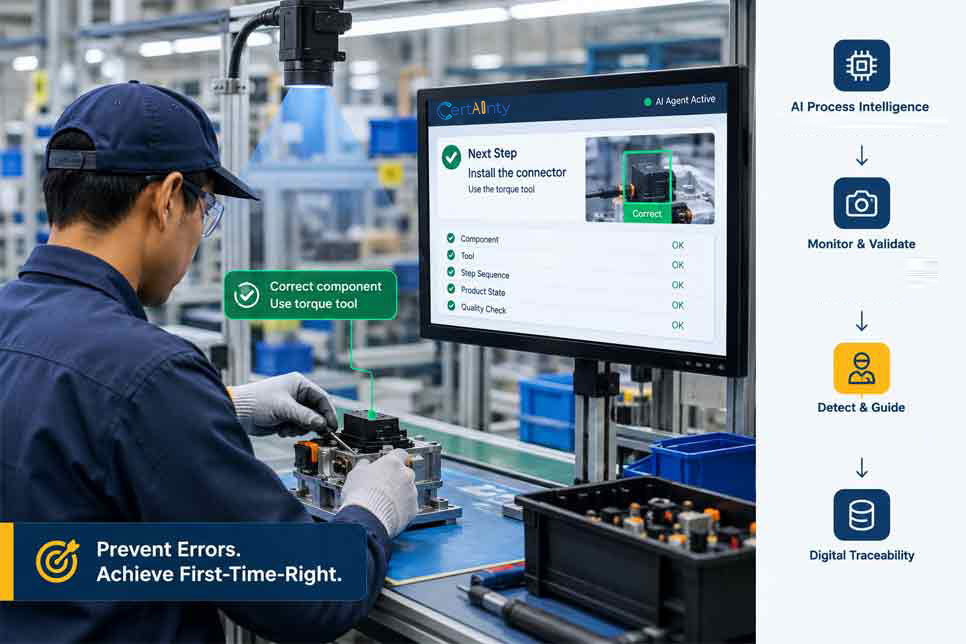
During production, a Certainty AI agent follows and validates the approved process. It confirms the correct components, tools, steps, sequences, product states, and visible quality conditions. When it detects a mistake, Certainty does more than flag the error—it guides the operator to perform the correct action at the appropriate time.

This combination of real-time detection, immediate guidance, process validation, and digital traceability helps manufacturers prevent errors from becoming defects and improve First-Time-Right performance.

01 · Guide Section

What Is FTR (First-Time-Right) Production?

First-Time-Right measures whether a product or process is completed correctly without requiring additional work.

A product may not be considered First-Time-Right when it requires:

◆Rework
◆Repair
◆Reassembly
◆Reinspection
◆Process repetition
◆Additional adjustment
◆Component replacement
◆Quality containment
◆Deviation approval
◆Scrap and remanufacture

FTR can be measured at the operation, station, line, product, batch, or plant level. The exact calculation should be defined consistently within the manufacturer’s quality system.

A common calculation is:

FTR Rate Formula
FTR rate=Products completed correctly the first timeTotal products processed×100

A high FTR rate indicates that the process is consistently producing conforming output without corrective intervention.

02 · Guide Section

Why First-Time-Right Matters

Low FTR creates costs that extend beyond the rework station.

Process errors can lead to:

◆Additional labor
◆Production delays
◆Increased work in progress
◆Material waste
◆Scrap
◆Reinspection
◆Line stoppages
◆Missed delivery targets
◆Extra quality containment
◆Reduced equipment utilization
◆Incomplete traceability
◆Customer complaints
◆Warranty costs

Rework may also introduce new risks. Repeated disassembly, handling, fastening, cleaning, or repair can damage components that were initially acceptable.

Improving FTR helps stabilize production by preventing avoidable mistakes at their source.

03 · Guide Section

Common Causes of Low FTR

First-Time-Right performance may be affected by many connected factors.

01Missed process steps
An operator or machine may skip a required cleaning, assembly, fastening, inspection, or verification step.
02Incorrect sequence
Every operation may be completed, but not in the approved order.
03Wrong component selection
Components may look similar while having different dimensions, materials, ratings, orientations, or applications.
04Missing components
A seal, clip, washer, connector, fastener, label, or other required item may be omitted.
05Incorrect position or orientation
The correct component may be installed backward, rotated, misaligned, or placed in the wrong location.
06Tool used at the wrong location
A tool may visit the wrong fastener, joint, connector, or assembly point.
07Process parameters outside limits
Torque, pressure, temperature, welding parameters, dispensing quantity, or test values may fall outside the approved range.
08Product-variant confusion
Mixed-model production may require different components, instructions, tools, and quality criteria for each variant.
09Unclear work instructions
Operators may have difficulty determining the next step, correct component, or approved recovery action.
10Defects detected too late
An error may become hidden after assembly or may not be discovered until final inspection, testing, or customer use.
04 · Guide Section

Moving Quality Control Earlier in the Process

Traditional final inspection asks
Is the completed product acceptable?
FTR improvement also asks
Is the process creating the product correctly at this moment?

Intelgic’s AI moves verification closer to the operation. Instead of waiting until the product reaches final inspection, Certainty can monitor each defined step and detect a deviation when it occurs.

For example, the platform can identify that:

◆The wrong seal was selected.
◆A connector has not been fully inserted.
◆A fastening point was skipped.
◆A label does not match the product.
◆A component is incorrectly oriented.
◆A cleaning step was missed.
◆Adhesive was applied before surface preparation.
◆A tool visited the wrong location.
◆The product is about to leave the station with an incomplete process.

The operator can correct the issue before it becomes a downstream defect.

05 · Guide Section

From Shop-Floor Data to Process Intelligence

Certainty uses representative shop-floor data to learn the visual conditions associated with the manufacturing operation.

Training data may include

◆Acceptable products
◆Defective products
◆Correct process steps
◆Incorrect process steps
◆Different product variants
◆Component positions
◆Tool movements
◆Operator actions
◆Normal process variation
◆Lighting variation
◆Temporary obstructions
◆Valid rework operations
◆Incorrect recovery attempts

The approved SOP becomes structured process intelligence

The approved SOP is converted into structured process intelligence defining:

◆Required steps
◆Correct sequence
◆Expected components
◆Component locations
◆Required tools
◆Tool-use zones
◆Process time limits
◆Quality checkpoints
◆Machine conditions
◆Conditional branches
◆Rework procedures
◆Evidence required for completion
◆Pass, fail, and review rules

The Certainty AI agent uses this process intelligence to validate operations during execution.

06 · Guide Section

Real-Time Operator Guidance

Detecting an error is useful, but preventing it from moving forward is more valuable.

When Certainty identifies a mistake, it can provide an instruction such as:

◆Select the correct component.
◆Install the missing seal.
◆Return the incorrect part.
◆Rotate the component to the correct orientation.
◆Complete the skipped fastening point.
◆Use the specified tool.
◆Inspect the connector position.
◆Remove the protective film.
◆Repeat the cleaning step.
◆Wait for the machine result.
◆Follow the approved rework sequence.

The operator interface can display

◆Current process step
◆Next required action
◆Correct component
◆Correct tool
◆Assembly location
◆Detected error
◆Recovery instruction
◆Process-completion status

After the corrective action is performed, the AI agent validates the result before allowing the process to continue.

07 · Guide Section

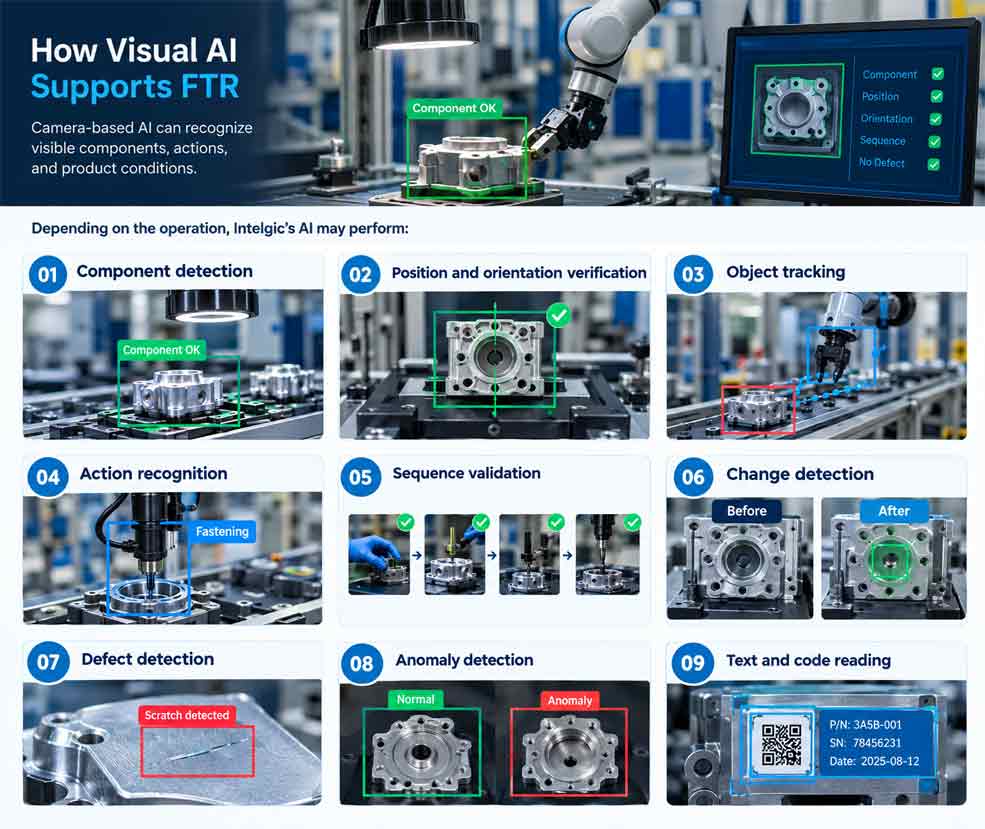
How Visual AI Supports FTR

How Visual AI Supports FTR

Camera-based AI can recognize visible components, actions, and product conditions.

Depending on the operation, Intelgic’s AI may perform:

01Component detection
Confirms that the correct component is present.
02Position and orientation verification
Checks whether the component has been installed in the correct location and orientation.
03Object tracking
Follows components, tools, hands, or robots through the defined work area.
04Action recognition
Identifies activities such as picking, placing, inserting, fastening, cleaning, scanning, dispensing, and removing.
05Sequence validation
Confirms that events occurred in the approved order.
06Change detection
Compares the product before and after an operation to confirm the expected visible change.
07Defect detection
Identifies visible defects such as scratches, cracks, dents, missing material, incorrect assembly, contamination, or coating problems.
08Anomaly detection
Flags product conditions or process events that differ from validated examples of acceptable production.
09Text and code reading
Reads labels, serial numbers, part numbers, date codes, barcodes, and data-matrix codes.
08 · Guide Section

Combining AI Vision with Machine Data

Visual AI cannot directly measure every manufacturing requirement. Intelgic’s Certainty platform can combine camera evidence with results from production equipment.

For example:

01Camera confirms the fastening tool visited the correct bolt → 02Fastening controller reports achieved torque and angle → 03Certainty links both results to the same product and fastener location

The platform can integrate data from:

◆PLCs
◆Torque tools
◆Fastening controllers
◆Welding controllers
◆Robots and cobots
◆Adhesive dispensers
◆Leak testers
◆Electrical testers
◆Dimensional gauges
◆Barcode readers
◆RFID systems
◆Machine sensors
◆Safety systems

Combining visual and machine evidence creates a more complete understanding of the process and helps prevent incomplete or incorrect operations.

09 · Guide Section

How Certainty Supports First-Time-Right Production

01Product identification — The system identifies the product, serial number, variant, and work order using a barcode, data-matrix code, RFID tag, PLC signal, MES record, or verified operator selection.
02Automatic recipe selection — Certainty loads the correct process and inspection recipe.
03Initial-condition verification — The system confirms that the correct product, fixture, tools, and components are available before the operation begins.
04Live process monitoring — Industrial cameras capture images or video while AI identifies components, actions, tool movements, and changes in the product.
05Step and sequence validation — Certainty compares detected events with the active recipe and confirms that each step occurs in the correct order.
06Error prevention — If the system detects a deviation, it can notify the operator before the process advances.
07Operator guidance — Certainty provides the appropriate corrective instruction for the detected condition.
08Recovery validation — The AI verifies that the correction was completed according to the approved recovery process.
09Final quality verification — The product can undergo a final visual, dimensional, functional, or process-data check.
10Digital record creation — Certainty stores the process evidence, results, deviations, guidance, recovery actions, and final status.

What the recipe may define

◆Required components
◆Component locations
◆Assembly sequence
◆Required tools
◆Camera views
◆AI models
◆Time limits
◆Machine signals
◆Process parameters
◆Quality criteria
◆Rework instructions
◆Evidence requirements
10 · Guide Section

Supporting Mixed-Model Production

Mixed-model production can reduce FTR when similar products require different parts or assembly sequences.

Certainty can store a separate recipe for every product variant. A recipe may include different:

◆Component lists
◆Component locations
◆Assembly steps
◆Process sequences
◆Tool requirements
◆Camera views
◆AI models
◆Quality limits
◆Test requirements
◆Rework procedures

The correct recipe can be loaded automatically from the product identity or manufacturing order.

This reduces reliance on the operator remembering every difference between closely related variants.

11 · Guide Section

Preventing Errors Before Assembly

FTR improvement can begin before the component reaches the product.

AI can verify:

◆Correct material at the station
◆Correct component-bin location
◆Correct tool availability
◆Fixture readiness
◆Product identity
◆Component label
◆Part orientation
◆Work-order match
◆Required safety or quality condition

Detecting an incorrect part before installation is more efficient than finding it after the assembly has been completed.

12 · Guide Section

Detecting Hidden-Step Errors

Some components become inaccessible after the next assembly step.

Examples include:

◆Seals beneath covers
◆Internal clips
◆Hidden connectors
◆Insulation
◆Adhesive beneath a panel
◆Internal fasteners
◆Protective films
◆Routing of cables or hoses
01Component installed → 02Visible evidence captured and validated → 03Component covered by next step → 04Record linked to serial number

Certainty can capture and validate the visible evidence before the component becomes covered. The step-completion record can then be connected to the product serial number.

This helps prevent hidden assembly errors from reaching final inspection.

13 · Guide Section

Managing Rework Without Losing Control

The objective of FTR is to reduce rework, but manufacturers still need a controlled process when errors occur.

Certainty can distinguish between:

First-pass completion
Corrected-before-completion
Standard rework
Engineering-approved deviation
Failed product
Review-required condition

When rework is necessary, the platform can load an approved recovery recipe and guide the operator through each step.

The record may include:

01Original process error
02Time of detection
03Corrective instruction
04Rework steps
05Replacement components
06Repeat tool or test results
07Reinspection
08Final disposition

This prevents a reworked product from being incorrectly counted as First-Time-Right while maintaining complete traceability.

14 · Guide Section

Digital Proof of First-Pass Completion

Certainty can create a digital record for every product or manufacturing operation.

The record may include:

◆Part number
◆Serial number
◆Product variant
◆Work order
◆Station identification
◆SOP and recipe version
◆AI-model version
◆Required sequence
◆Detected sequence
◆Step-completion timestamps
◆Component verification
◆Tool and machine results
◆Inspection images
◆Detected deviations
◆Operator guidance
◆Corrective actions
◆Rework status
◆Final result
◆First-Time-Right status

This provides objective evidence showing whether the product passed through the operation without correction or rework.

15 · Guide Section

FTR Analytics and Root-Cause Identification

Certainty can aggregate production results to show where FTR losses occur.

Dashboards may display
  • ✓FTR rate
  • ✓First-pass failures
  • ✓Rework frequency
  • ✓Missed steps
  • ✓Incorrect sequences
  • ✓Wrong-component selections
  • ✓Missing components
  • ✓Tool-related errors
  • ✓Defects by product variant
  • ✓Defects by station
  • ✓Defects by line
  • ✓Defects by shift
  • ✓Step duration
  • ✓Cycle time
  • ✓Error-recovery time
  • ✓Quality trends over time
Analytics can help identify problems involving
  • !Confusing work instructions
  • !Similar-looking parts
  • !Incorrect material presentation
  • !Poor workstation ergonomics
  • !Tooling failures
  • !Fixture variation
  • !Supplier quality
  • !Product design
  • !Inadequate lighting
  • !Process bottlenecks
  • !Training requirements
  • !Unrealistic cycle times

FTR analytics should be used to improve the overall production system rather than assuming every process error is caused by the operator.

16 · Guide Section

Measuring the Impact on FTR

Before deployment, manufacturers should establish a baseline.

Useful baseline measurements

◆Current FTR rate
◆Rework rate
◆Scrap rate
◆Defects per operation
◆Most frequently missed steps
◆Wrong-component frequency
◆Average rework time
◆Quality-inspection time
◆Cost of poor quality
◆Downstream defect escapes

After deployment, the same definitions should be used to compare performance.

The analysis should distinguish

01Errors prevented before completion
02Errors corrected during the cycle
03Products requiring formal rework
04Products rejected
05Review-required results
06False alarms
07Defects detected downstream

The actual improvement depends on the process, original error rate, system design, operator adoption, AI performance, and corrective actions taken by the manufacturer.

17 · Guide Section

Certainty AI Platform

Certainty manages the complete process-monitoring and quality-verification workflow.

It can coordinate:

◆Product identification
◆Recipe selection
◆Process-state tracking
◆Camera and sensor triggering
◆Image and video acquisition
◆AI event detection
◆Component verification
◆Step validation
◆Sequence validation
◆Real-time operator guidance
◆Machine-data collection
◆Error-recovery workflows
◆Visual defect detection
◆Pass/fail/review logic
◆FTR status
◆Digital traceability
◆PLC and MES integration
◆Quality analytics

The platform connects the approved manufacturing process with real-time shop-floor evidence.

18 · Guide Section

Integration with Existing Systems

PLC integration

Certainty can exchange:

◆Product-present signals
◆Product identity
◆Station status
◆Process-start commands
◆Recipe confirmation
◆Current-step status
◆Step-completion signals
◆Error conditions
◆Process completion
◆Pass/fail/review results
◆Line-release commands
◆Fault and alarm information

MES integration

MES connectivity can support:

◆Work-order retrieval
◆Automatic recipe selection
◆Serial-number tracking
◆Product genealogy
◆Process-result storage
◆Rework workflows
◆Production reporting
◆Quality traceability
◆FTR reporting
◆Recipe revision control

Additional integration

Certainty can also connect with:

◆ERP systems
◆SCADA
◆Quality-management systems
◆Document-management systems
◆Factory databases
◆Data historians
◆Cloud platforms
◆Customer-specific software
19 · Guide Section

Cloud-Based FTR Analytics

Process and quality results can be transferred to a secure cloud analytics environment, subject to the manufacturer’s cybersecurity and data-governance policies.

Authorized teams can compare:

◆Plants
◆Production lines
◆Stations
◆Product variants
◆Suppliers
◆Shifts
◆Time periods
◆Error categories
◆Rework causes

Cloud analytics can reveal recurring FTR losses that may not be visible when each station is analyzed separately.

Where cloud storage is restricted, an on-premises or hybrid architecture can keep sensitive images locally while sharing approved FTR statistics.

20 · Guide Section

Protecting Worker Privacy

Camera-based process monitoring should focus on the manufacturing operation rather than unnecessary surveillance of employees.

A privacy-conscious deployment may use:

◆Cameras focused on tools, components, and work zones
◆Fields of view that exclude faces
◆Digital privacy masks
◆Edge or on-premises processing
◆Disabled audio
◆Event-based image retention
◆Defined retention periods
◆Role-based access
◆Audit logs
◆Aggregated analytics

Operators should understand the purpose of the system, the information being collected, how the results are used, and how long the data is retained.

21 · Guide Section

Important Limitations

Intelgic’s AI can validate conditions that are visible, optically measurable, or confirmed by connected equipment.

Camera-based AI does not directly measure:

◆Torque or preload
◆Internal weld quality
◆Material strength
◆Hidden cracks
◆Adhesive properties beneath a closed assembly
◆Leak rate
◆Electrical performance
◆Chemical composition
◆Internal component condition after obstruction

These requirements may need suitable process controllers, test equipment, metrology systems, or nondestructive inspection methods.

FTR also depends on more than operator execution. Material quality, machine condition, tooling, product design, process capability, and supplier performance can affect the result.

Certainty provides process intelligence, guidance, inspection, and evidence. The manufacturer remains responsible for defining and validating the approved process and acceptance criteria.

22 · Guide Section

Validating an AI System for FTR Improvement

Before production deployment, the manufacturer should validate:

◆Product variants
◆Approved process steps
◆Correct process sequences
◆Required components and tools
◆Visual evidence for each step
◆Machine and tool interfaces
◆Normal operator variation
◆Intentionally missed steps
◆Incorrect-sequence scenarios
◆Wrong-component scenarios
◆Temporary camera obstructions
◆Error-recovery workflows
◆Image-quality checks
◆False-accept and false-reject performance
◆Digital record accuracy
◆Recipe and AI-model version control
◆FTR measurement rules

Periodic checks should confirm that cameras, lighting, AI models, recipes, integrations, and reporting functions remain within the validated conditions.

23 · Guide Section

Improving First-Time-Right Production with Intelgic

Intelgic’s Certainty platform helps manufacturers improve FTR by monitoring the process while it is being performed.

Its state-of-the-art AI uses shop-floor data to create process intelligence, validate the correct steps and sequence, detect mistakes in real time, and guide the operator toward the appropriate corrective action.

Certainty also combines camera evidence with machine and tool data, stores digital process records, integrates with existing PLC and MES systems, and provides analytics for identifying recurring causes of FTR loss.

This shifts quality from late defect detection toward real-time process control and error prevention.

Talk to Intelgic

Looking to improve First-Time-Right production? Contact Intelgic to discuss an AI-powered process-monitoring, operator-guidance, and quality-inspection system built on the Certainty platform.

Contact Intelgic
24 · Guide Section

Frequently Asked Questions

What does First-Time-Right mean in manufacturing? +

First-Time-Right means completing a product or operation correctly on the first attempt without rework, repair, repetition, or additional correction.

How does Intelgic’s AI improve FTR? +

Intelgic’s AI monitors manufacturing operations, detects missed or incorrect steps, verifies components and sequences, guides operators, and confirms corrective actions before the product moves forward.

Does Certainty only detect mistakes? +

No. Certainty can guide the operator toward the correct action at the appropriate time and validate that the recovery step was completed properly.

Can Certainty detect the wrong component? +

Yes. Camera-based AI can identify and compare components with the active product recipe when the relevant visual features are detectable.

Can the system verify that steps occurred in the correct order? +

Yes. The Certainty AI agent tracks the current process state and compares detected events with the approved sequence.

Can Certainty combine camera results with torque-tool data? +

Yes. Visual evidence showing the tool location can be associated with torque and angle results from the fastening controller.

Can one system support mixed-model production? +

Yes. Certainty can store separate components, sequences, tools, camera views, AI models, and quality criteria for each product variant.

Does a corrected error still count as First-Time-Right? +

That depends on the manufacturer’s FTR definition. Certainty can distinguish first-pass completion, in-cycle correction, formal rework, failure, and review so the manufacturer can calculate FTR consistently.

Can Certainty integrate with existing PLC and MES systems? +

Yes. Certainty can exchange product identity, recipes, process states, results, alarms, rework information, and traceability data with existing manufacturing systems.

Does camera-based AI replace all quality controls? +

No. Visual AI verifies visible or optically measurable conditions. Torque, leak rate, electrical performance, internal defects, and material properties may require additional equipment or inspection methods.


Head Quarter

17352 Murphy Ave Suite 101
Irvine, CA 92614
Phone: (949) 317-2420

Branch Office

5ES7-H, 5Th Floor, East Tower, Mani Casadona, Plot no -IIF/04, Action Area -IIF, Newtown, Kolkata-700160

Certificate

intelgic ISO 27001 certification

Social links

©2026 Intelgic Inc. All Rights Reserved.