AI-Based Fabric Inspection for Color, Design and Stitching Defects
Fabric quality can change at almost every stage of textile and garment production. Variations in yarn, weaving, knitting, dyeing, printing, cutting and sewing can create defects that reduce product value or make the finished material unacceptable.
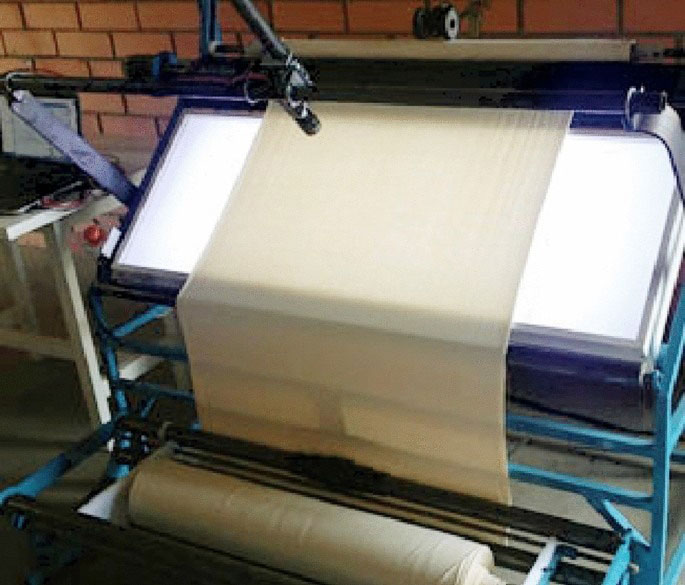
Manual inspection remains common, but it becomes difficult when fabric is wide, moves continuously or contains complex colors and patterns. Inspector fatigue, changing ambient light and subjective judgment can lead to inconsistent results.
Intelgic addresses these challenges with industrial imaging, line-scan technology and AI-based defect detection. The system can inspect continuously moving fabric on a conveyor or examine fabric panels and finished products inside a controlled inspection cell. It detects, classifies and records defects while supporting real-time quality decisions.
Why Automated Fabric Inspection Is Important
A small defect in a fabric roll may later appear in a highly visible section of a garment, automotive seat, mattress or upholstered product. If the defect is discovered only after cutting or stitching, the manufacturer has already invested additional material, labor and machine time. Automated inspection helps manufacturers detect problems closer to their source. It can support:
- Continuous inspection across the complete fabric width
- Consistent quality decisions across shifts
- Early detection of weaving, dyeing and printing problems
- Reduction of defective material entering cutting and sewing
- Objective defect classification and measurement
- Roll mapping and quality grading
- Image-based evidence for analysis and supplier discussions
- Improved traceability from fabric roll to finished product
Fabric Defects That Intelgic Can Detect
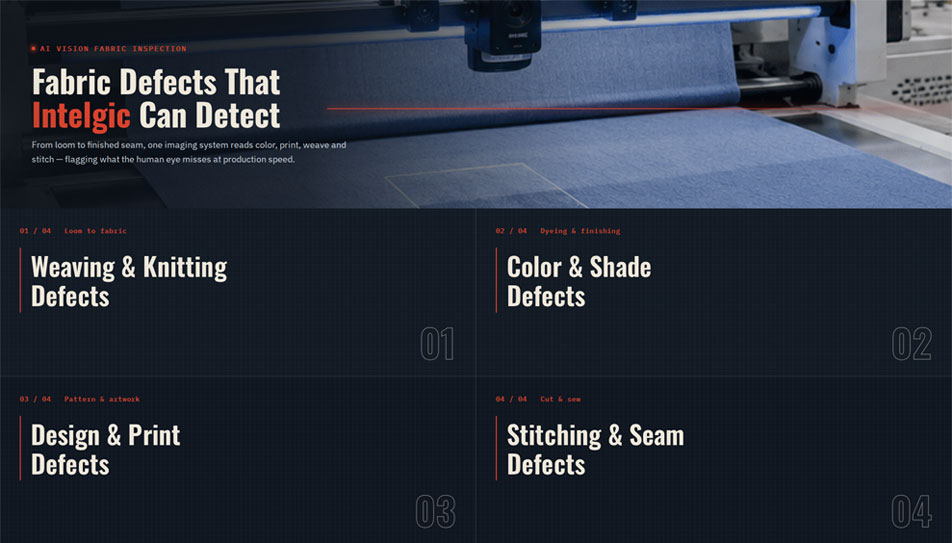
A fabric inspection system must do more than identify obvious holes. It must distinguish genuine quality problems from acceptable variations in texture, color and pattern.
Color and shade defects
Color variation may occur across the width of the fabric, along its length or between different regions of a printed design. Intelgic’s imaging system can be configured to detect:
- Uneven dyeing
- Light or dark patches
- Side-to-center shade variation
- Color bands
- Streaks
- Dye spots
- Fading
- Incorrect color combinations
- Shade differences between panels
- Print-to-background color variation
Color measurement is highly dependent on illumination, camera calibration and process tolerances. Intelgic therefore uses controlled lighting and color-calibrated imaging where reliable shade comparison is required.
Design and print defects
Printed and patterned fabrics require both defect detection and design verification. The AI system can identify:
- Missing design elements
- Incorrect artwork
- Broken or incomplete prints
- Pattern discontinuity
- Misregistration between colors
- Shifted or rotated designs
- Repeated-pattern errors
- Double printing
- Ink smears
- Unwanted spots
- Incorrect pattern spacing
- Distorted logos or graphics
- Design-to-cut misalignment
The captured image can be aligned with an approved reference design. This allows the system to recognize unexpected differences even when the fabric shifts slightly during inspection.
Weaving and knitting defects
Structural defects alter the regular texture of a woven or knitted material. Depending on the fabric type and required resolution, Intelgic’s system can detect:
- Missing warp or weft yarn
- Broken yarn
- Thick or thin yarn
- Slubs
- Holes
- Ladders
- Dropped stitches
- Knots
- Floats
- Creases
- Weft bars
- Reed marks
- Oil stains
- Foreign fibres
- Surface contamination
Different defects respond differently to light. A hole, for example, may be easier to detect with backlighting, while a raised fibre or surface crease may require directional illumination.
Stitching and seam defects
Fabric inspection can continue after cutting and sewing. When panels or finished products are presented within an inspection cell, the system can detect:
- Missing stitches
- Skipped stitches
- Broken thread
- Loose stitching
- Uneven stitch spacing
- Incorrect stitch path
- Seam deviation
- Open seams
- Puckering
- Thread loops
- Untrimmed thread
- Incorrect thread color
- Double stitching
- Improper seam width
- Stitching outside the permitted region
The system can also verify whether a seam follows the intended contour and measure its displacement from a reference path.
How a Line-Scan Camera Images Moving Fabric
A conventional area camera captures a complete rectangular image in one exposure. A line-scan camera captures one narrow row of pixels at a time. As the fabric moves beneath the camera, consecutive image lines are joined to create a continuous two-dimensional image. The movement of the fabric effectively forms the second image dimension. This imaging method is well suited to roll-to-roll materials and other continuous webs. Published research has demonstrated line-scan inspection using controlled fabric movement, LED line lighting and the assembly of successive scan lines into a complete fabric image. Line-scan fabric inspection research
1. Controlled fabric presentation
The fabric travels over a conveyor, roller or inspection table. The mechanical arrangement keeps the inspection region as flat and stable as possible. Tension control and guiding are important. Excessive vibration, wrinkles or side-to-side movement can distort the image and make accurate measurement more difficult.
2. Encoder-based synchronization
An encoder measures the movement of the conveyor or fabric web. Its pulses trigger image acquisition so each scanned line corresponds to a defined distance of fabric travel. Synchronization prevents the digital image from becoming stretched or compressed when line speed changes. Encoder-based line-scan acquisition is an established approach for maintaining consistent spatial resolution in moving-fabric inspection. Fabric line-scan acquisition study
3. Continuous line illumination
A high-intensity LED line light illuminates the narrow region being captured. The lighting geometry is selected according to the fabric and the target defects. Possible arrangements include:
- Bright-field lighting for general color and surface inspection
- Dark-field or low-angle lighting for raised fibres, texture changes and surface damage
- Backlighting for holes, edge defects and material-density variations
- Diffuse lighting for reflective or coated fabrics
- Polarized lighting to reduce glare
- Multiple lighting angles for difficult defect combinations
Lighting stability is particularly important for shade inspection. Changes in illumination could otherwise appear as false color variation.
4. High-resolution image formation
The required camera resolution depends on the fabric width and the smallest defect that must be detected. A wider fabric or smaller defect may require a higher-resolution camera or several cameras with overlapping fields of view. The system continuously builds image sections as the material moves. These sections can be processed immediately rather than waiting for the entire roll to finish.
5. Real-time AI analysis
Each image section is sent to the inspection software. The AI model locates suspicious regions, classifies known defect types and assigns a confidence score. The system can record the position of a defect across the fabric width and its distance from the beginning of the roll. This information can be used to generate a digital defect map.
Imaging Fabric Inside an Inspection Cell
Not every fabric product is presented as a continuous roll. Cut panels, stitched assemblies, patterned components and finished garments may be better inspected in a dedicated cell. Inside an inspection cell, the product is placed on a controlled table, conveyor or fixture. The enclosure blocks variable ambient light and creates repeatable imaging conditions. A line-scan system can image the product in several ways:
- The fabric panel moves beneath a stationary line-scan camera
- A camera and light assembly travels over a stationary fabric
- A motorized inspection table moves the product at a controlled speed
- Multiple line-scan cameras inspect wide or multi-sided products
For products that can be captured in one view, Intelgic may use area-scan cameras instead. The correct imaging method is selected according to product size, required resolution, cycle time and the type of defect.
Advantages of an inspection cell
A controlled cell can provide:
- Repeatable product positioning
- Stable, calibrated illumination
- High-resolution imaging
- Multiple views of the same product
- Different lighting modes during one inspection
- Inspection of cut pieces and finished assemblies
- Precise measurement of seams, prints and pattern placement
- Isolation from factory-lighting changes
Inspection cells are particularly useful for checking garment panels, airbags, seat covers, technical textiles, stitched leather, footwear components and other shaped textile products.
How AI Detects Fabric Defects
Traditional machine vision works well when defects can be described using fixed rules, such as a specific color limit or seam-position tolerance. Fabric, however, contains natural texture and appearance variation. The same defect may also look different on another color, weave or design. AI models learn visual features from representative production images. Depending on the application, Intelgic can use one or more AI approaches.
Supervised defect detection
The model is trained with labelled examples of defects such as holes, stains, broken yarn, shade patches or skipped stitches. It then learns to locate and classify similar defects in new images.
Anomaly detection
Some defects are rare, making it difficult to collect enough examples of every possible fault. An anomaly-detection model can learn the normal appearance of an acceptable fabric and identify regions that deviate from it. This approach is useful when manufacturers want to detect unexpected defects rather than limit inspection to a fixed list of known faults.
Segmentation
Segmentation identifies the precise shape and area of a defect. It can be used to measure stain size, shade variation, damaged print area or seam deviation.
Reference comparison
For printed and patterned materials, the system can align the captured image with an approved reference. AI and image-processing tools can then identify missing, shifted or distorted design elements.
Hybrid inspection
Many applications benefit from combining AI with conventional vision. AI can locate irregular defects, while rule-based tools perform objective measurements such as:
- Defect length and width
- Color difference
- Stitch spacing
- Seam position
- Pattern pitch
- Distance from the fabric edge
- Number of defects within a defined area
Understanding “High Accuracy” in Fabric Inspection
AI can achieve high defect-detection accuracy when the complete inspection system is designed and validated for the actual production environment. Accuracy is not determined by the AI model alone. Performance depends on:
- Image resolution
- Lighting quality and stability
- Fabric presentation
- Line speed
- Defect size
- Fabric color, texture and pattern
- Quality of training images
- Accuracy of defect annotations
- Similarity between training data and production material
- Acceptance tolerances
- Required false-reject and missed-defect rates
Intelgic conducts application studies using representative good and defective samples. The system is then validated against agreed defect classes, sizes and operating conditions. Accuracy should be reported using meaningful production metrics, such as defect-detection rate, missed-defect rate, false-reject rate and classification accuracy. A single generic percentage cannot represent every fabric, defect type and production line.
Color-Shade Inspection Requires Controlled Imaging
Detecting subtle shade variation requires more than a standard camera under factory lighting. The imaging system must maintain consistent color reproduction over time and across the complete fabric width. An effective configuration may include:
- A color line-scan or area-scan camera
- Uniform, high-quality illumination
- Control of external light
- White-balance and color calibration
- Correction for lens and illumination variation
- Reference samples or approved shade limits
- Periodic calibration checks
The software can compare different fabric regions or evaluate them against an approved reference. The acceptable color-difference threshold is configured according to the manufacturer’s quality requirements.
From Detection to Production Action
When the system identifies a defect, it can:
- Display the defect with a visual overlay
- Classify the defect type
- Measure its size and position
- Record its location within the roll
- Activate an alarm or marker
- Send a signal to a PLC
- Stop the line for critical defects
- Divert a defective panel
- Save the image and inspection result
- Update a roll-quality or product-quality record
Repeated defects can also generate an early warning. For example, recurring defects at the same position across the fabric width may indicate a loom, needle, roller or printhead problem.
Digital Defect Mapping and Traceability
For continuous fabric, the software can create a roll map showing every detected defect and its coordinates. This information allows downstream cutting software or operators to avoid defective regions. A record may include:
- Roll or batch number
- Fabric type and color
- Inspection date and time
- Defect image
- Defect category
- Defect dimensions
- Position across the width
- Distance from the roll start
- Confidence score
- Final acceptance decision
Manufacturers can use this data for quality grading, root-cause analysis, supplier evaluation and process improvement.
Industries and Applications
Intelgic’s fabric inspection approach can be applied to:
- Woven and knitted textiles
- Printed and dyed fabrics
- Garment panels
- Home furnishings
- Automotive textiles
- Seat covers and upholstery
- Technical textiles
- Nonwoven materials
- Leather and synthetic leather
- Carpets and flooring materials
- Medical textiles
- Stitched industrial products
Intelgic’s End-to-End Fabric Inspection Solution
A reliable inspection system requires coordinated design of the mechanics, cameras, optics, lighting, software and automation interfaces. Intelgic’s solution can include:
- Application study and feasibility testing
- Line-scan or area-scan camera selection
- Lens and lighting design
- Encoder and conveyor synchronization
- Color-calibrated imaging
- AI model development and training
- Fabric, print and stitching defect detection
- Defect classification and measurement
- Roll mapping
- PLC and production-system integration
- Automatic alarms, marking or rejection
- Image storage, dashboards and analytics
- Recipe management for different fabric types
Moving from Manual Inspection to Intelligent Quality Control
Fabric inspection is challenging because textiles contain natural variation, repeated textures, flexible surfaces and many possible defect types. A successful automated system must combine stable image acquisition with AI that has been trained and validated using real production samples. Intelgic’s line-scan imaging system can inspect fabric continuously as it moves over a conveyor or roller. For panels and finished textile products, a controlled inspection cell provides repeatable imaging from one or more views. By detecting color-shade variation, design errors, weaving defects and stitching faults close to their source, manufacturers can reduce waste, protect downstream operations and build an objective digital record of fabric quality.
Frequently Asked Questions
What fabric defects can Intelgic’s vision system detect?
Depending on the application, it can detect color and shade variation, stains, holes, broken yarn, missing threads, slubs, pattern errors, missing print, misregistration, creases, foreign material and stitching defects.
Can the system inspect fabric while it is moving?
Yes. A line-scan camera captures successive rows of pixels while the fabric moves. An encoder synchronizes image capture with material travel so the software can construct a continuous image.
Can it inspect the complete width of a fabric roll?
Yes. The camera resolution and optical configuration are selected for the required fabric width and minimum defect size. Very wide fabric may require multiple synchronized cameras.
Can Intelgic detect shade variation?
Yes. Shade inspection can be performed using controlled lighting and calibrated color imaging. The achievable sensitivity depends on the fabric, surface finish, permitted tolerance and stability of the imaging environment.
Can the system inspect patterned fabric?
Yes. AI and reference-alignment tools can distinguish acceptable pattern repetition from missing, shifted, distorted or incorrectly colored design elements.
Can it detect stitching defects?
Yes. When the seam is visible at the required resolution, the system can detect missing or skipped stitches, broken thread, incorrect stitch paths, seam deviation, puckering and other defined defects.
Does the AI require examples of defective fabric?
A supervised model requires labelled defect examples. An anomaly-detection model can learn primarily from acceptable material, although representative validation defects are still needed to confirm production performance.
What line speed can the system support?
Supported speed depends on fabric width, spatial resolution, camera line rate, lighting intensity, processing requirements and the smallest defect to be detected. Intelgic determines these parameters during the application study.
Can the system inspect both sides of the fabric?
Yes. Cameras and lighting can be installed above and below the material when both surfaces must be inspected. The mechanical design must provide an unobstructed view of each side.
Can the system generate a fabric-roll defect map?
Yes. Each defect can be stored with its position across the width and distance from the beginning of the roll, creating a digital map for grading, cutting and traceability.
Talk to an Intelgic Machine-Vision Expert
Contact Intelgic to discuss your fabric type, material width, production speed, smallest relevant defect and quality criteria. Representative good and defective samples can be evaluated to determine the appropriate imaging, lighting and AI inspection approach.
Request a Demo