Can AI Become the Shopfloor’s Digital Mentor?
When a new manufacturing operator joins a production line, the most valuable support often comes from an experienced colleague. The expert demonstrates the correct sequence, explains which details require special attention and intervenes before a small mistake becomes a defective product. Over time, the new operator develops confidence and begins recognizing problems independently. This mentoring model works—but it is increasingly difficult to scale. Experienced employees cannot stand beside every operator throughout every shift. Manufacturers must train people faster, manage frequent product changes and maintain consistent quality despite differences in experience, language and skill. Artificial intelligence offers a new approach: a shopfloor digital mentor that delivers instructions, observes defined operations and provides contextual guidance while work is being performed. Intelgic uses Visual AI, camera-based SOP monitoring and digital work instructions to help bring this concept into manufacturing operations.
What is a shopfloor digital mentor?
A shopfloor digital mentor is an AI-assisted system that helps operators perform manufacturing tasks correctly, safely and consistently. It can provide:
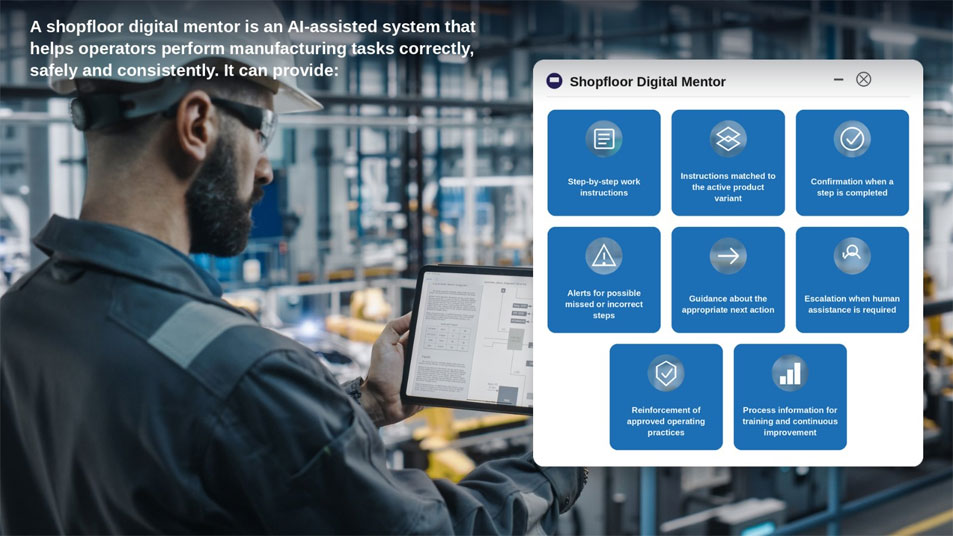
Unlike a static manual, a digital mentor responds to the state of the operation. It does not simply display what should happen. It uses cameras and connected information to assess configured process events and provide relevant assistance.
Why manufacturing needs a digital mentor
Manufacturing expertise is often concentrated among experienced operators, supervisors and process engineers. These individuals possess valuable practical knowledge:
Some of this knowledge is documented in SOPs. Much of it remains tribal knowledge acquired through observation and experience. This creates several challenges.
Experienced employees are not always available
Supervisors and senior operators may support multiple lines, leaving new employees without immediate help when questions arise.
Training quality can vary
Different trainers may explain the same operation differently. Important details can be omitted or interpreted inconsistently.
Product complexity is increasing
High-mix production and frequent changeovers require operators to remember more variants, sequences and exceptions.
Paper instructions are passive
An SOP can describe the correct process, but it cannot normally determine whether the operator has completed the current step correctly.
Feedback may arrive too late
When an error is discovered at final inspection, the operator may no longer remember the circumstances that caused it. A digital mentor addresses these problems by putting validated process knowledge at the workstation and delivering feedback closer to the moment of execution.
How is an AI digital mentor different from digital work instructions?
Digital work instructions present process information on a screen, tablet or wearable device. They may include text, images, videos and diagrams. An AI digital mentor adds a layer of awareness and responsiveness.
| Capability | Digital work instructions | AI digital mentor |
|---|---|---|
| Displays approved instructions | Yes | Yes |
| Supports images and videos | Yes | Yes |
| Adapts to product variants | Sometimes | Yes, when integrated and configured |
| Recognizes process progress | Usually operator-controlled | Can use Visual AI and production signals |
| Detects configured deviations | Limited | Yes |
| Provides contextual alerts | Limited | Yes |
| Escalates unusual situations | Usually manual | Can be rule-based |
| Creates process-event data | Basic completion records | Detailed configured events and exceptions |
Digital instructions tell the operator what to do. An AI digital mentor can also help determine what is happening and respond accordingly.
How Intelgic enables AI-guided mentoring
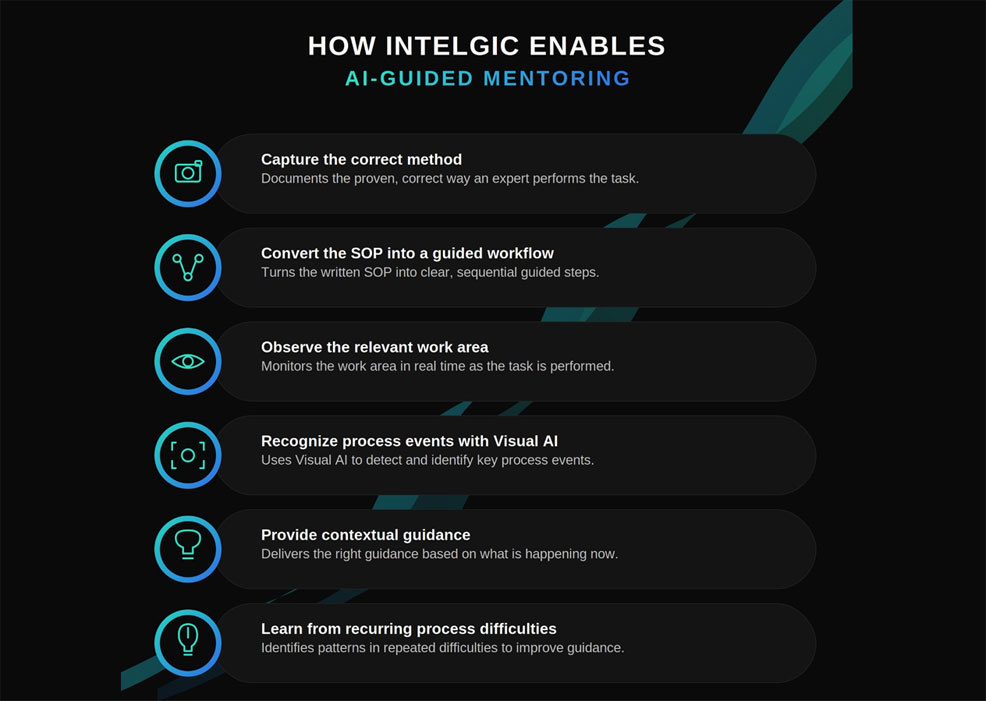
Intelgic provides a camera-based AI system for monitoring standard operating procedures and guiding operators in real time. A typical implementation involves the following stages.
1. Capture the correct method
The process is documented with input from:
Together, they identify:
This stage transforms individual expertise into structured process knowledge.
2. Convert the SOP into a guided workflow
The operation is divided into clear steps that can be presented and, where practical, verified. For example:
Each step can contain instructions, reference images, warnings and acceptance criteria. The system can also define what should happen if the operator selects the wrong item, misses a step or encounters an abnormal condition.
3. Observe the relevant work area
One or more cameras are positioned to view the process areas needed for monitoring. These may include:
The objective is to monitor relevant process activity—not to observe unrelated employee behavior. Lighting, viewing angle, obstructions and product variations must be considered during deployment.
4. Recognize process events with Visual AI
Computer vision analyzes the camera stream to identify configured objects, movements and conditions. Depending on the application, the system may determine whether:
Not every requirement is visually measurable. Some processes may also require data from barcode readers, torque tools, sensors, PLCs or manufacturing software.
5. Provide contextual guidance
The digital mentor presents information relevant to the current operation. Examples include:
When the expected action is confirmed, the system can proceed to the next instruction. The operator receives guidance based on the current situation instead of navigating an entire manual.
6. Learn from recurring process difficulties
Process-event data can reveal where operators most frequently need help. For example, manufacturing teams may discover that:
The AI does not automatically solve every problem. It gives process owners evidence that can support better decisions.
A practical example: mentoring a new assembly operator
Consider an operator learning a manual assembly process with multiple product variants. Without AI guidance, the operator may need to remember which component and sequence belong to each variant. An experienced colleague must remain nearby to answer questions and inspect the work. With Intelgic’s AI-guided approach:
The operator continues to learn from human experts, but routine guidance is available consistently throughout the shift.
Can AI transfer expert knowledge?
AI can help capture and distribute certain forms of expert knowledge—but it cannot capture everything an experienced person knows. Knowledge that can be structured effectively includes:
Some expert capabilities are more difficult to digitize, including:
For this reason, the best model is not AI instead of human mentoring. It is AI handling repeatable guidance while experienced people focus on judgment, coaching and process improvement.
How AI accelerates operator onboarding
Traditional onboarding frequently follows a pattern:
AI assistance can reinforce each stage by providing consistent instructions during actual production.
Learning happens in context
Operators receive guidance at the workstation, where the instruction is directly connected to the physical task.
Feedback is immediate
A possible deviation can be addressed when it occurs rather than discussed during a later review.
Product variants become easier to manage
The system can present the process associated with the active product instead of expecting the operator to recall every variation.
Supervisors can focus on higher-value coaching
Routine reminders can be handled digitally, allowing supervisors to concentrate on situations requiring experience and judgment.
Training needs become more visible
Recurring pauses, alerts or repeated steps may identify areas where additional instruction is required. AI guidance does not remove the need for formal qualification. It can make the path to competence more structured and measurable.
How a digital mentor improves manufacturing quality
Quality problems often begin as process deviations:
If these conditions are detected early, the operator may be able to correct them before the product advances. An AI digital mentor can support:
However, AI cannot guarantee that every defect will be eliminated. Its effectiveness depends on what can be observed, how the system is configured and how well it performs under real production conditions.
Supporting multilingual and diverse workforces
Modern manufacturing teams may include operators with different languages, educational backgrounds and levels of experience. An AI-guided system can make instructions easier to understand through:
Visual guidance can reduce dependence on long blocks of technical text, but translations and visual instructions should still be reviewed by qualified process and safety personnel.
The digital mentor as a continuous-improvement tool
A human mentor notices when several trainees struggle with the same task. A digital system can help identify similar patterns across larger numbers of operations. Useful measures include:
These insights can guide changes to SOPs, workstation design, material presentation and training content.
What an AI digital mentor should not become
Poorly designed monitoring can damage employee trust. A digital mentor should not become:
Manufacturers must define the purpose and boundaries of camera-based AI before deployment. Operators should understand what is monitored, what is recorded, how information will be used and how they can challenge incorrect guidance.
Human-centered principles for shopfloor AI
A responsible digital-mentor program should follow several principles.
Assist before evaluating
The primary purpose should be to help operators perform the process correctly.
Monitor the process, not the person
Where possible, focus cameras and analytics on components, tools and work zones rather than identity.
Escalate uncertainty
If the AI cannot confidently interpret a situation, it should request human review instead of presenting uncertain guidance as fact.
Keep people in control
Operators and supervisors should have a clear way to report inaccurate instructions and handle exceptions.
Protect employee data
Access, retention and permitted uses should be documented and controlled.
Involve operators in the design
The people performing the operation can identify practical details that process documents may overlook.
Validate before scaling
The system should be tested under real operating conditions, including different shifts, products, lighting conditions and working styles.
How to start an AI digital-mentor pilot
Choose an operation that is:
A pilot can follow these steps:
Measuring the value of a digital mentor
Manufacturers can track:
The goal is not simply to count how often the AI intervenes. A successful system should improve outcomes while becoming less disruptive as operators gain competence.
The future is human expertise amplified by AI
AI can become the shopfloor’s digital mentor—but only within clearly defined boundaries. It can preserve approved process knowledge, deliver contextual instructions, recognize configured deviations and make routine guidance available at scale. It can help new operators develop confidence and help experienced operators manage complex product variations. But it cannot replace human judgment, empathy, creativity or responsibility. Intelgic’s approach combines Visual AI, SOP monitoring and real-time operator guidance to build a support system around the workforce. Human experts define the correct process. AI makes that knowledge available during execution. Operators use both guidance and judgment to complete the work. The result is not a shopfloor with fewer experts. It is a shopfloor where expert knowledge can reach more people.
Give every operator access to expert guidance
Are long training cycles, product variations or inconsistent SOP execution affecting your manufacturing operation? Intelgic can help identify a suitable use case for an AI-guided workstation. Talk to an Intelgic expert about building a digital-mentor pilot for your shopfloor.
Frequently Asked Questions
What is an AI digital mentor in manufacturing?
An AI digital mentor is a system that delivers contextual work instructions, monitors configured process events and guides operators during manufacturing activities.
How does an AI digital mentor work?
Cameras and computer vision observe relevant objects and work areas. Detected events are compared with a configured SOP so the system can confirm progress, identify possible deviations and provide the appropriate instruction.
Can AI replace an experienced manufacturing mentor?
No. AI can handle repeatable guidance and process verification, but human mentors remain necessary for judgment, coaching, unusual conditions and safety-critical decisions.
Is an AI digital mentor the same as digital work instructions?
No. Digital work instructions display process information. An AI digital mentor can also use Visual AI and production signals to understand the current process state and provide contextual responses.
Can AI help train new manufacturing operators?
Yes. AI can reinforce training with step-by-step instructions and immediate feedback during production. It should complement, not replace, formal training and supervised qualification.
Can AI monitor whether an operator follows an SOP?
AI can monitor SOP steps that create visually observable or digitally measurable events. Conditions that cannot be seen may require data from tools, sensors, PLCs or manufacturing software.
Can an AI digital mentor support multiple languages?
Yes. Instructions can be presented in different languages and supported with images, videos, visual cues and audio. Translations should be validated for technical and safety accuracy.
Does camera-based operator guidance violate employee privacy?
Privacy depends on system design and organizational policy. Monitoring should be limited to necessary process activity, with clear rules governing data access, retention and use. Employees should be informed and involved before deployment.
What happens when the AI is uncertain?
The system should identify low-confidence situations and request operator or supervisor review. It should not treat an uncertain prediction as a confirmed process error.
Which manufacturing operations are suitable for a digital mentor?
Suitable applications can include manual assembly, kitting, packaging, inspection, changeovers, maintenance and other repeatable operations involving observable objects, actions or sequences.
How can manufacturers measure the ROI of an AI digital mentor?
ROI can be assessed through changes in training time, First-Time-Right performance, rework, scrap, supervisor interventions, cycle-time variation and production consistency.