AI Vision Inspection for Cellophane and Transparent Film Packaging Defects
Cellophane and other transparent overwrapping films give products a clean, premium appearance while protecting them from dust, handling and tampering. They are widely used for cigarette cartons, cosmetics, confectionery, retail products, gift baskets, tapes and labels.
Their transparency is commercially valuable—but it also makes automated inspection challenging. The film reflects surrounding lights, conforms to the product below it and may contain folds that are acceptable in one region but defective in another. Subtle tears, wrinkles, incomplete seals and trapped contamination can easily escape manual inspection on a fast packaging line.
Intelgic combines controlled industrial imaging, machine vision and AI to inspect transparent packaging at production speed. The system can verify the film, folds, seals, tear tape, labels, artwork and underlying product presentation, producing a real-time pass-or-fail decision for every pack.
Cellophane and Film Defects Intelgic Can Detect
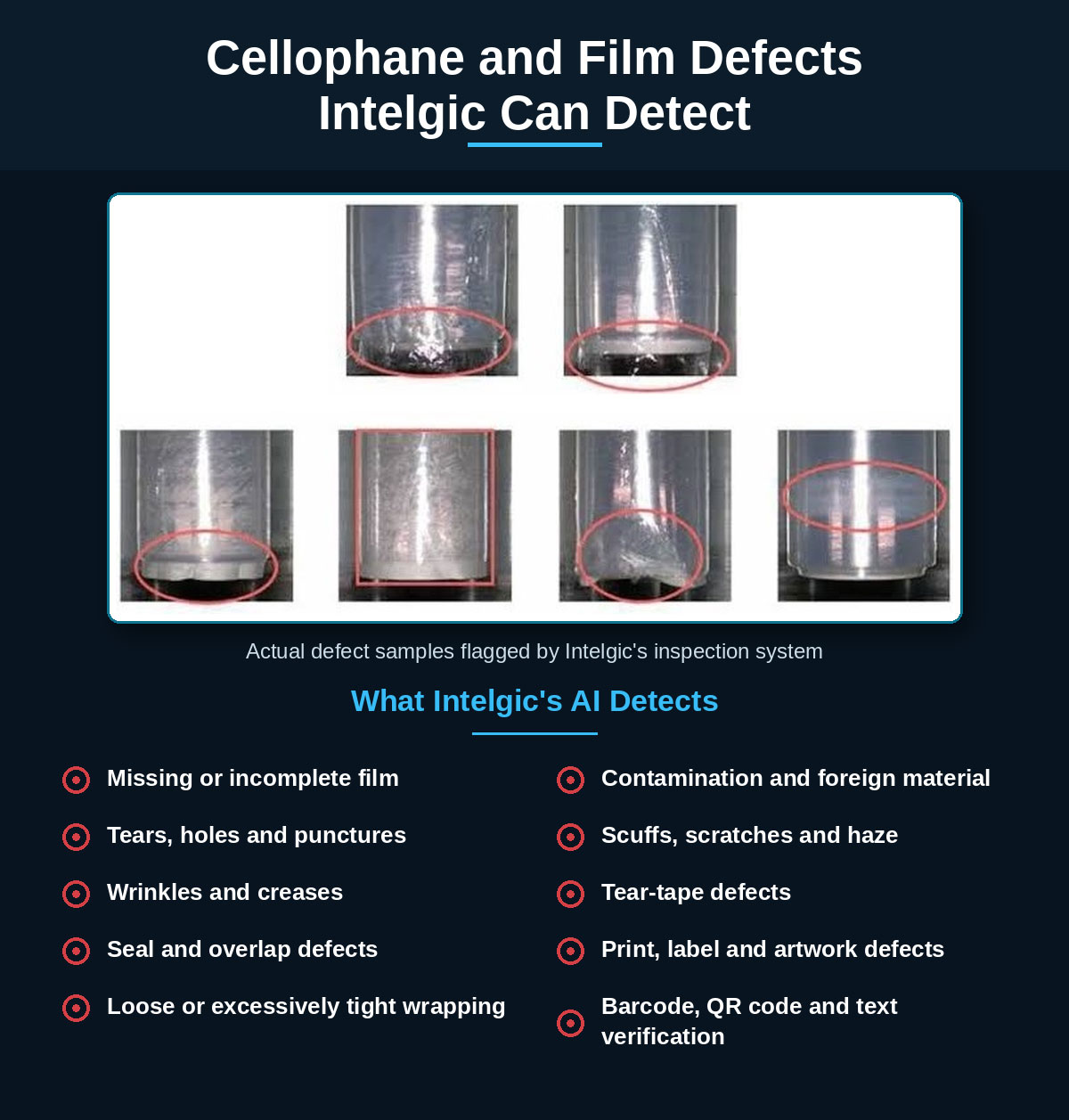
The inspection scope is configured according to the package style, film behavior and manufacturer’s acceptance criteria.
Missing or incomplete film
The system can confirm that the transparent wrapper is present and covers the intended product area. It can detect:
Tears, holes and punctures
Mechanical handling, sharp carton edges, excessive tension or sealing problems can damage the film. Intelgic’s vision system can be trained to identify visible:
The smallest detectable defect depends on camera resolution, line speed, film clarity, product appearance and lighting geometry.
Wrinkles and creases
Wrinkles change the way transparent film reflects and refracts light. The system can detect excessive:
Not every wrinkle is necessarily a defect. Intelgic can define separate tolerances for different regions of the package, allowing normal corner folds while rejecting wrinkles on front display panels or sealing surfaces.
Seal and overlap defects
Depending on the package design and visible characteristics, the system can inspect for:
Machine vision evaluates visible evidence of seal quality. If the application requires confirmation of hermetic integrity, seal strength or microscopic leaks that do not produce a visible feature, an additional test method may be required.
Loose or excessively tight wrapping
Poor temperature, film tension or wrapping-machine settings can create loose packs, sagging film or excessive shrinkage. Vision inspection can detect visible indicators such as:
A 3D imaging sensor may be added when surface height, bulging or package geometry must be measured more directly.
Contamination and foreign material
Transparent film can trap unwanted material during wrapping. Depending on visibility and required defect size, the system can detect:
Scuffs, scratches and haze
Film handling can create scratches or scuffed areas that reduce package clarity. Specialized lighting can make these low-contrast defects more visible.
Polarized imaging can also enhance some defects in transparent materials that may be difficult to see with conventional illumination. Transparent-material inspection principles
Tear-tape defects
Tear tape provides a controlled way to open many overwrapped packages. Intelgic can inspect:
Print, label and artwork defects
The transparent wrap may carry printed branding, safety information or a label. Alternatively, the system may need to inspect the carton artwork through the film.
Possible checks include:
Barcode, QR code and text verification
The system can read barcodes, QR codes, batch numbers and other human-readable text on or beneath the film. It can verify:
Reflection from the overwrap can interfere with code reading, so lighting and polarization are designed to reduce glare in the code region.
Why Transparent Packaging Is Difficult to Image
An ordinary camera image depends on light reflected from the object. Transparent film reflects some light, transmits some and changes the direction of the remaining light.
As a result, the camera may see:
There is no single lighting arrangement that reveals every possible cellophane defect. Intelgic selects and tests the illumination method according to the specific package and defect requirements.
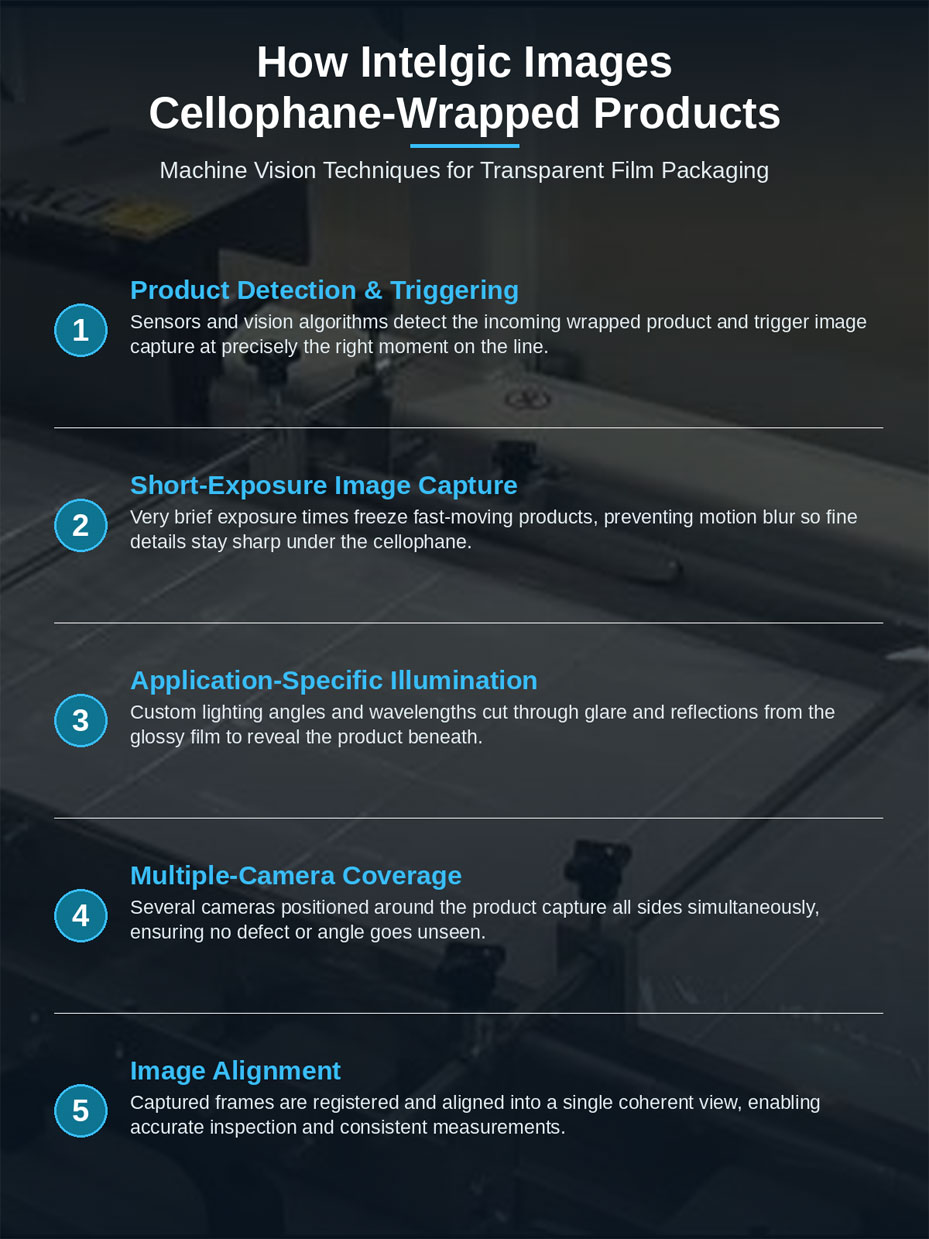
How Intelgic Images Cellophane-Wrapped Products
1. Product detection and triggering
A photoelectric sensor detects the approaching package. The camera and lighting are triggered when the product reaches the inspection position.
An encoder may be used when conveyor speed varies or when the system must track a rejected product to a downstream removal station.
2. Short-exposure image capture
High-speed packaging lines require a short exposure to freeze product movement. Industrial global-shutter cameras and synchronized LED lighting capture sharp images without stopping the conveyor.
Camera resolution is selected according to:
3. Application-specific illumination
Intelgic may combine several lighting techniques.
Diffuse lighting
Diffuse dome or tunnel illumination reduces harsh reflections and creates a more uniform view of glossy packaging.
Dark-field illumination
Low-angle light makes wrinkles, scratches and raised film features appear bright against a darker background.
Backlighting
When the package construction allows it, transmitted light can reveal film edges, folds, holes and material trapped in transparent seal regions.
Polarized lighting
Polarizing filters can suppress surface glare or reveal stress-related differences in transparent materials. Polarization has been used to enhance scratches, internal debris and other difficult transparent-material features. Polarized imaging example
Multi-angle lighting
Images captured with illumination from different directions can separate genuine defects from reflections. A wrinkle that is difficult to see from one direction may become clear from another.
4. Multiple-camera coverage
A single top camera cannot normally inspect every surface of a three-dimensional package. Intelgic can position cameras around the conveyor to inspect:
The results from all views are combined into one product-level decision.
5. Image alignment
Packages do not always arrive in exactly the same position. The software locates key product features and aligns the inspection regions before evaluating the film.
This allows small, acceptable changes in product position or orientation without creating unnecessary rejections.
How AI Detects Packaging Defects
Transparent-film defects often have irregular shapes and can look different on each product design. Fixed image-processing rules may struggle when reflections and underlying artwork change.
Intelgic uses AI to learn the visual difference between acceptable packaging variation and genuine defects.
Supervised defect detection
The AI model is trained using labelled examples of tears, wrinkles, seal faults, missing tape and other known defects. It learns to locate and classify similar problems during production.
Anomaly detection
When defect examples are rare, an anomaly-detection model can learn the normal appearance of an acceptable package and flag unexpected visual regions.
This is useful for identifying new or uncommon defects that were not included in a predefined defect list.
Pixel-level segmentation
Segmentation identifies the exact shape and area of a defect. It can measure:
Reference and artwork comparison
The system aligns the package image with an approved reference and detects missing, shifted or damaged visual elements. Separate product recipes support different carton sizes, film types, artwork and promotional variations.
Hybrid AI and conventional vision
AI can locate irregular defects, while conventional machine-vision tools perform repeatable measurements such as:
This hybrid approach provides both adaptability and measurable acceptance limits.
Application: Cigarette Carton Overwrap Inspection
A cigarette carton generally requires a neat, tightly controlled overwrap. Small defects can affect presentation, tamper evidence and downstream retail acceptance.
Intelgic can inspect:
A multi-camera configuration may be used to cover all critical surfaces while the carton remains in motion.
Application: Retail and Cosmetics Packaging
Transparent wrap helps preserve the appearance of perfume, skincare, soap and other premium retail cartons.
The system can detect:
Inspection tolerances can be stricter on the front display surface than on less visible package regions.
Application: Food and Confectionery Packaging
For chocolates, sweets, biscuits and other confectionery products, the system can check:
Where food safety depends on verified seal integrity, visible inspection should be combined with the appropriate leak or seal-integrity test.
Application: Gifts and Baskets
Gift baskets and irregular products create greater variation than uniform cartons. Flexible film can form different folds around handles, ribbons and product arrangements.
AI can be trained to tolerate approved presentation differences while detecting:
Multiple cameras or a controlled inspection cell may be required to obtain adequate coverage of complex shapes.
Application: Tapes and Labels
Transparent tape and label inspection may take place on a continuous web or after application to a product.
Intelgic can inspect:
For continuous materials, a line-scan camera can build an uninterrupted image as the web moves through the inspection station.
Real-Time Production Decisions
After all required views have been processed, Intelgic’s software generates a pass-or-fail result within the production cycle.
A failed product can trigger:
Accurate product tracking ensures the corresponding defective pack is removed at the reject station.
Traceability and Process Improvement
Each inspected package can generate a record containing:
Defect trends can reveal changes in sealing temperature, film tension, cutter condition, wrapping-machine alignment or material quality.
For example, repeated wrinkles on one end of a carton may indicate a folding or tension problem rather than random product variation. Early warnings allow operators to correct the process before large quantities are affected.
Understanding Inspection Accuracy
AI can detect cellophane and transparent-film defects with high accuracy when the imaging system is designed and validated for the actual product.
Performance depends on:
Intelgic evaluates representative good and defective samples during a feasibility study. Detection performance should then be validated using agreed production metrics, including missed-defect rate, false-reject rate and defect-classification accuracy.
A generic accuracy percentage should not be applied to every product or packaging line without application-specific testing.
Intelgic’s End-to-End Inspection Approach
Intelgic’s cellophane packaging inspection solution can include:
From Manual Sampling to 100% Inline Inspection
Cellophane inspection is fundamentally an imaging challenge. Transparent film must be made visually measurable before software can determine whether it is acceptable.
Intelgic combines appropriate camera angles, controlled illumination and AI-based analysis to reveal defects that are difficult to detect consistently under normal factory lighting. The system can inspect every package at production speed, automatically reject defined defects and create a digital record for quality improvement.
For cigarette cartons, cosmetics, food, confectionery, retail products, gifts, tapes and labels, this turns transparent-film inspection from a subjective manual task into a consistent, traceable quality-control process.
Frequently Asked Questions
What defects can Intelgic detect in cellophane packaging?
Depending on the package and imaging configuration, the system can detect missing film, tears, punctures, wrinkles, loose wrapping, incorrect folds, visible seal defects, trapped contamination, missing tear tape, label errors and damaged print.
Can transparent film be inspected with a normal camera?
An industrial camera may be used, but lighting is critical. Transparent film often requires diffuse, dark-field, backlight, multi-angle or polarized illumination to make defects visible and suppress unwanted reflections.
Can the system inspect packages on a high-speed conveyor?
Yes. Cameras and synchronized LED lights are triggered as each package reaches the inspection point. Short exposures freeze motion, allowing inspection without stopping normal conveyor movement.
Can Intelgic inspect all sides of a package?
Yes. Multiple cameras can be positioned around the line to inspect the top, bottom, sides, ends, folds, seals and tear tape. The necessary views depend on the package geometry and defect requirements.
Can the system detect microscopic pinholes?
Only when the pinhole produces a visible feature large enough for the selected optical resolution and lighting method. Microscopic holes without a reliable visual signature may require a dedicated leak or integrity-testing technology.
Can vision inspection confirm that a package is airtight?
Machine vision can detect visible seal abnormalities, folds and contamination. It does not automatically prove hermetic integrity or seal strength. Critical applications may require additional leak, pressure, ultrasonic or destructive seal testing.
Can the system distinguish acceptable folds from defective wrinkles?
Yes. Inspection regions and tolerances can be configured separately. AI can also learn examples of normal corner folds and distinguish them from excessive or misplaced wrinkles.
Can Intelgic inspect printed information through cellophane?
Yes, if the information remains visible at the required quality. Controlled lighting and polarization can reduce glare so the system can inspect artwork, barcodes, QR codes, batch codes and other text beneath the film.
Can it inspect tear tape?
Yes. The system can verify the tape’s presence, continuity, color, position, alignment and pull-tab location.
Can it detect trapped contamination?
Visible contaminants such as fibres, particles, product fragments and dark specks can be detected when they provide sufficient contrast and meet the defined minimum defect size.
Can the system handle multiple product formats?
Yes. Recipe-based configuration allows the same inspection station to support different package sizes, artwork, film types and defect tolerances, subject to the station’s optical and mechanical range.
What samples are required for a feasibility study?
Representative acceptable products, naturally defective products, packaging specifications, minimum defect sizes, line speed and available installation space are normally required. Intentionally created defects can supplement—but should not completely replace—real production examples.
Talk to an Intelgic Machine-Vision Expert
Contact Intelgic to discuss your package dimensions, film material, line speed, critical surfaces and defect requirements. Representative good and defective samples can be tested to determine the appropriate cameras, lighting, AI model and automation configuration.
Request a Demo