Manufacturing Quality Starts Before Final Inspection
Most manufacturing defects are not created at the final inspection station. They originate much earlier, when an operator:
Traditional quality inspection identifies defects after they occur. But what if manufacturers could prevent those defects while the work is being performed?
Industrial cameras combined with computer vision AI can observe manufacturing operations, verify critical steps, detect deviations, and guide operators to take corrective action before moving to the next step.
Footage is stored for a person to review later.
Compares what happens at the workstation against predefined manufacturing procedures.
The objective is not simply to monitor operators. It is to ensure that every product is manufactured using the correct process, in the correct sequence, with the correct components.
Why Manufacturers Need AI-Based Process Monitoring
Even highly automated manufacturing facilities depend on people for assembly, material handling, machine setup, inspection, and packaging. Manual processes introduce several challenges:
Missed operations, incorrect component placement, and assembly mistakes.
Different operators may execute the same SOP differently.
Supervisors cannot continuously observe every workstation.
Errors may only become visible during final inspection or customer use.
Traditional production records often confirm completion without proving how the work was performed.
New operators need continuous guidance, especially for complex assembly operations.
Errors discovered downstream require disassembly, reinspection, and additional labor.
AI camera-based monitoring helps address these problems by introducing automated process verification directly at the workstation.
Instead of relying exclusively on checklists, manual supervision, and final inspection, manufacturers can create a digital record of how each product was assembled.
15 High-Value Use Cases of AI Camera-Based SOP Monitoring
The following applications cover assembly, quality assurance, material handling, packaging, maintenance, and production management. They include established computer vision applications and emerging opportunities for AI-driven process assurance.
Each use case below is described by its challenge, the AI solution, and the business value. Select a use case to jump to it.
Assembly and Operator Use Cases
Assembly Sequence Verification
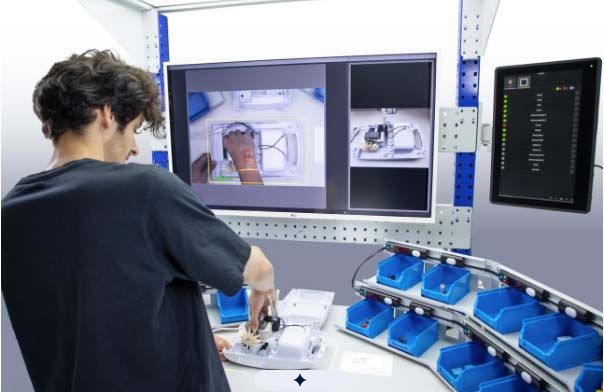
Operators may skip an assembly step or perform operations in the wrong sequence.
Cameras monitor the assembly process and verify that each required operation occurs in the correct order.
For example, during automotive component assembly, AI can verify that an operator:
Prevents missed assembly steps, reduces rework, and improves first-pass yield.
Wrong Component and Material Selection Prevention
Similar-looking components can be mistakenly selected, particularly in high-mix manufacturing.
Computer vision identifies components picked from bins and compares them against the bill of materials (BOM) and current production order. If an operator selects an incorrect component, the system generates an immediate alert.
Reduces assembly errors, material waste, and product mix-ups.
Fastener Installation and Torque Process Assurance
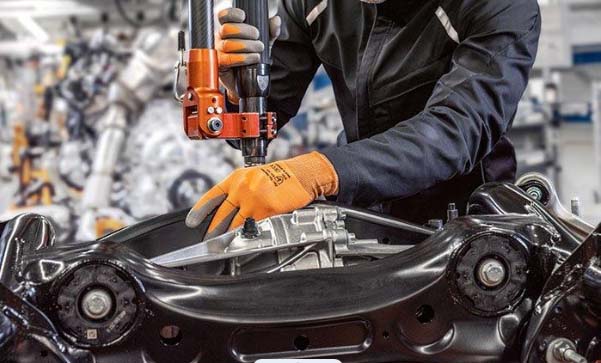
Missing screws, incorrect fastening sequences, and improper torque application can compromise product reliability.
Cameras verify fastener presence, tool position, and fastening sequence. Integration with a digital torque wrench confirms the actual torque value.
Improves fastening consistency and creates traceable evidence of assembly quality.
A camera alone cannot reliably confirm applied torque. Torque verification requires data from the fastening tool or an appropriate sensor.
Operator Hand Movement and Action Verification
Complex assembly operations often involve subtle hand movements that are difficult to verify through conventional inspection.
Hand tracking and action-recognition models analyze interactions between the operator, tools, and components. Applications include:
Enables process verification where the final product appearance alone cannot confirm that an operation was performed.
Real-Time Operator Guidance and Error Correction
Printed SOPs and static work instructions cannot detect mistakes while operators are working.
AI continuously compares observed activities against the active SOP and displays contextual instructions when a deviation occurs. For example, if an operator forgets to install a washer, the workstation screen can display:
Reduces dependence on continuous supervision and helps operators correct errors immediately.
Materials, Process, and Packaging Use Cases
Kitting and Parts Placement Verification
Missing or incorrect parts in a kit can interrupt downstream assembly.
Overhead cameras inspect kitting trays, count components, and compare their identities and positions against the required kit configuration. The system can verify that every component is present before releasing the kit to production.
Prevents incomplete kits, reduces assembly interruptions, and improves material traceability.
Welding Process Sequence and Preparation Monitoring
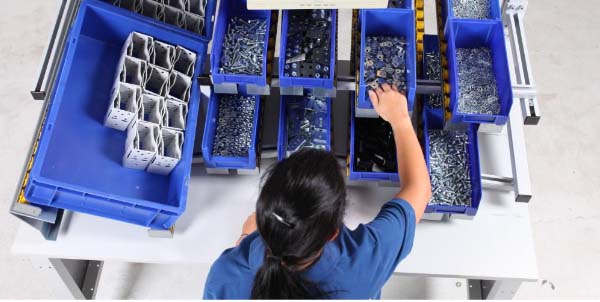
Welding quality depends on preparation, component positioning, and execution of the approved procedure.
Cameras monitor part placement, fixture engagement, clamp positions, and welding sequence. Specialized imaging or integration with welding equipment can provide additional process verification.
Helps identify preparation and procedural errors before they lead to defective welds.
Camera-based SOP monitoring complements, rather than replaces, qualified weld inspection and process parameter verification.
Adhesive, Sealant, and Lubrication Application Verification
Missing, interrupted, or incorrectly positioned adhesive and sealant beads can create product failures.
Cameras inspect application paths, coverage, continuity, and visible bead geometry during or immediately after dispensing. AI can also verify that the correct dispensing sequence was followed.
Reduces sealing failures, material waste, and downstream rework.
Packaging SOP and Label Verification
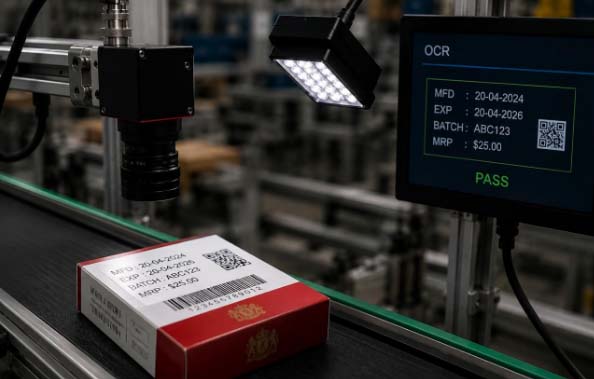
Incorrect labels, missing accessories, and improper packing sequences can result in customer complaints and shipment errors.
Cameras verify packaging operations, including:
Reduces shipping errors and strengthens end-of-line quality assurance.
Setup, Safety, and Maintenance Use Cases
Machine Setup and Changeover Verification
Incorrect machine setup during product changeovers can generate large batches of defective products.
Cameras verify visually observable setup conditions, including tooling selection, fixture positioning, material loading, and machine configuration indicators. The system can compare the observed setup with the active production recipe and flag discrepancies before production begins.
Reduces changeover mistakes, startup scrap, and production interruptions.
PPE and Safety Procedure Compliance
Safety procedures may be overlooked during maintenance, material handling, and production activities.
Computer vision identifies visible PPE, restricted-area entry, machine-guard conditions, and selected unsafe activities. For example, AI can alert when a person enters a defined hazardous zone while equipment is operating.
Supports proactive safety intervention and provides visibility into recurring safety risks.
AI monitoring must complement engineered safety controls, not replace certified guards, interlocks, or emergency-stop systems. NIOSH emphasizes the need to manage risks introduced by workplace AI itself.
Maintenance SOP and Equipment Servicing Verification
Maintenance procedures may contain critical steps that are difficult to verify after the work is completed.
Cameras can verify visible maintenance activities such as component removal, filter replacement, lubrication access, and reassembly sequence. Integration with maintenance software links evidence to the work order.
Improves maintenance documentation, procedural consistency, and service traceability.
For lockout/tagout and other safety-critical activities, visual verification is supplementary and must not substitute for approved physical verification procedures.
Analytics, Evidence, and Traceability Use Cases
Production Cycle Time and Bottleneck Analysis
Manufacturers often know total production output but lack visibility into the time spent on individual manual operations.
AI recognizes the beginning and completion of each operation and calculates process-level cycle times. The system can identify recurring delays, waiting periods, and process variations across workstations.
Supports line balancing, throughput improvement, and data-driven process optimization.
Digital Proof of SOP Compliance
Traditional checklists confirm that a procedure was marked complete, but rarely provide objective evidence that each operation occurred correctly.
The monitoring system creates a digital record containing:
Creates auditable manufacturing records, supports root-cause investigations, and improves product traceability.
Multi-Station Process Traceability
A product may pass through multiple assembly stations, making it difficult to determine where an error originated.
AI monitoring at individual workstations links verified process events to a common product identifier. A manufacturer can trace which operations were completed, which deviations occurred, and where corrective action was performed.
Enables end-to-end manufacturing process visibility and faster quality investigations.
Beyond SOP Monitoring: 5 Innovative AI Use Cases
The next generation of manufacturing AI can move beyond recognizing individual activities to understanding relationships between process steps, equipment conditions, and product quality.
These are promising advanced applications that require appropriate validation, integration, and production data.
AI learns patterns that commonly precede mistakes, such as repeated repositioning or unusual operation sequences, and warns operators before an error occurs. This requires sufficient historical evidence to establish reliable predictions.
AI analyzes repeated production activities to identify differences between documented procedures and actual shop-floor workflows. Process engineers can use these findings to improve SOPs and remove unnecessary operations.
AI combines product identification, BOM data, and work instructions to activate the correct SOP for each product variant. Operators receive relevant guidance without manually searching for instructions.
AI correlates recorded SOP deviations with downstream inspection failures to identify which manufacturing activities are most strongly associated with specific defects. Engineers can prioritize the highest-impact process improvements.
Operators can ask questions, and an AI assistant retrieves approved instructions and explains the detected deviation using workstation context.
These applications align with broader developments in industrial AI, including advanced perception, explainable AI, and connected manufacturing systems identified in NIST’s 2026 smart manufacturing roadmap.
How an AI Camera-Based SOP Monitoring System Works
Industrial cameras monitor predefined workstation regions.
Identify components, hand interactions, tools, and process events.
Compare observed activities with required checkpoints, order, and timing.
Record verification and allow next step
Alert operator and request corrective action
Store verification results, deviations, and product-level records.
The system can integrate with:
Edge AI processing can reduce dependence on network connectivity.
Cloud platforms can support centralized reporting and analytics.
Where Can Manufacturers Deploy AI SOP Monitoring?
Business Benefits of AI-Based Process Assurance
AI SOP monitoring is most valuable when it prevents costly errors rather than simply recording them.
The American Society for Quality (ASQ) distinguishes prevention costs from the costs of inspection, rework, scrap, and failures. AI-driven process assurance can help manufacturers shift quality investment toward prevention.
Measuring ROI
Manufacturers should track measurable outcomes before and after deployment, including:
Assumes those errors would otherwise have required rework. This is an illustrative calculation, not a guaranteed saving. Actual ROI depends on detection performance, process economics, and operating costs.
What Makes an AI SOP Monitoring System Reliable?
A successful deployment requires more than installing a camera.
Manufacturers should consider:
AI models must be validated against real manufacturing conditions, including:
The system must distinguish between confirmed deviations and uncertain observations. Critical decisions should have appropriate review or override mechanisms.
Monitoring should focus on relevant manufacturing operations, with clear policies for data retention, access, and employee transparency.
Intelgic: AI-Powered SOP Monitoring and Process Assurance
Intelgic develops industrial AI solutions that help manufacturers monitor, verify, and improve shop-floor operations.
Our camera-based SOP monitoring approach combines computer vision, AI-driven activity recognition, process verification, and manufacturing system integration. The solution can be configured to:
Our objective is simple: help manufacturers prevent process errors before they become product defects.
From Quality Inspection to Quality Assurance
Manufacturing quality should not depend solely on identifying defects after production. AI-powered SOP monitoring introduces an additional layer of process assurance by verifying how products are manufactured.
Evaluates the finished product for defects.
Verifies the process that creates it.
By combining industrial cameras, computer vision, and real-time operator guidance, manufacturers can reduce preventable errors, improve process consistency, and create digital evidence of manufacturing quality.
The future of manufacturing quality is not just inspecting the finished product. It is verifying the process that creates it.
Frequently Asked Questions
What is AI-based SOP monitoring in manufacturing? +
AI-based SOP monitoring uses cameras and computer vision to verify whether manufacturing activities follow predefined standard operating procedures. It can detect missing steps, incorrect sequences, and other observable process deviations.
How is AI SOP monitoring different from traditional CCTV? +
Traditional CCTV records video for human review. AI SOP monitoring automatically analyzes manufacturing activities, recognizes process events, verifies compliance, and generates alerts when deviations occur.
Can AI detect operator mistakes in real time? +
Yes. AI can detect trained and visually observable errors, such as missing components, incorrect part selection, and skipped assembly steps. Detection speed and accuracy depend on the imaging setup, AI models, and process complexity.
Can AI monitor multiple SOP steps using a single camera? +
Yes. A single camera can monitor multiple activities within its field of view. Complex workstations may require multiple cameras to eliminate blind spots and capture critical operations.
Can AI SOP monitoring integrate with existing MES and ERP systems? +
Yes. Integration through APIs and other industrial interfaces can enable automatic retrieval of work orders, product variants, BOMs, and SOP instructions, as well as reporting of verification results.
Does AI SOP monitoring require operators to wear cameras? +
No. Fixed industrial cameras installed above or around workstations are suitable for many applications. Wearable cameras may be considered for specialized mobile operations.
Can AI generate proof that an SOP was followed? +
Yes. The system can generate digital process records containing timestamps, verified checkpoints, supporting images, detected deviations, and corrective actions. These records provide evidence for the operations that the system can reliably observe and verify.
What is the difference between AI quality inspection and AI process assurance? +
AI quality inspection evaluates the product for defects. AI process assurance verifies whether manufacturing operations were performed correctly. Combining both approaches provides stronger quality control.
What are the main challenges of implementing AI SOP monitoring? +
Key challenges include camera occlusion, variable lighting, complex hand movements, changing product variants, false alerts, and integration with existing production systems. A properly scoped pilot helps establish technical feasibility.
Which manufacturing processes benefit most from AI SOP monitoring? +
Manual assembly, kitting, fastening, packaging, machine setup, component installation, and other repeatable operations with clear visual checkpoints are strong candidates.