AI-Powered Assembly Line Monitoring
Modern manufacturing assembly processes can involve hundreds of components, tools, operations, and sequential steps that must be performed correctly. This is particularly challenging in complex manufacturing environments such as:
Even highly trained operators can occasionally miss a component, install the wrong component, perform an operation incorrectly, or execute assembly steps in the wrong sequence. Traditional quality inspection often discovers these mistakes only after the assembly has been completed.
Intelgic changes this approach.
Intelgic’s AI Assembly Line Monitoring System uses cameras and Computer Vision AI to continuously monitor the assembly process, understand what is happening at each workstation, identify deviations, and provide real-time feedback to operators when an assembly error occurs.
Instead of finding the defect at the end of the process, Intelgic helps manufacturers prevent assembly defects while the product is being built.
Why Complex Assembly Processes Are Difficult to Control
Consider an operator assembling a complex automotive component, aircraft subsystem, control panel, engine, or industrial machine. The operator may need to:
Multiply this process across dozens or hundreds of components and operations, and assembly becomes increasingly difficult to monitor manually.
Common assembly errors
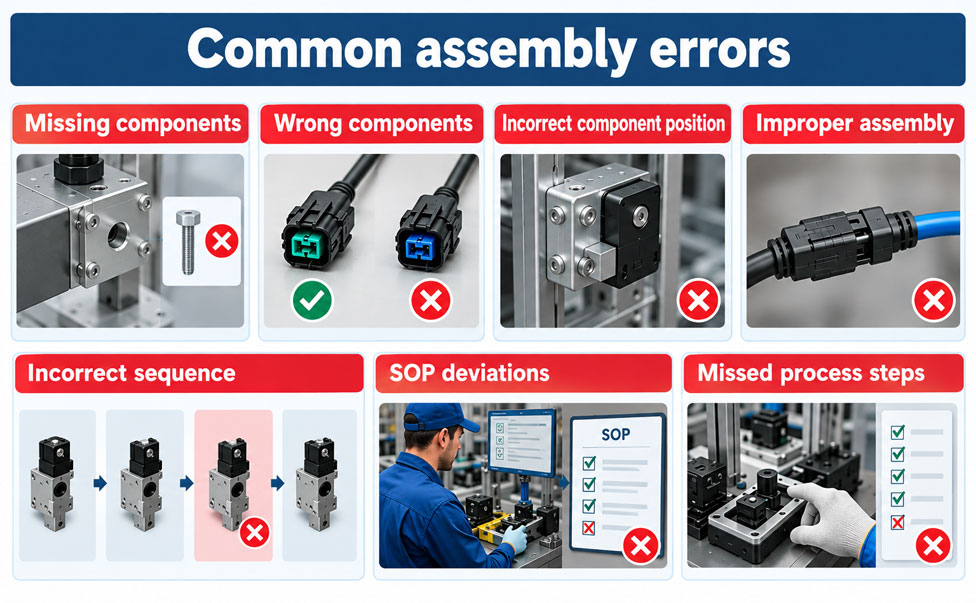
A required component, fastener, connector, bracket, clip, seal, or other part is not installed.
The operator selects a visually similar but incorrect component or variant.
The correct component is installed but placed in the wrong location or orientation.
A component is present but has not been correctly seated, connected, aligned, or assembled.
Assembly operations are performed in a sequence that does not follow the defined process.
The operator skips or incorrectly performs a required Standard Operating Procedure (SOP) step.
A required inspection, fastening, connection, placement, or verification step is unintentionally skipped.
These mistakes can result in downstream defects, rework, line disruptions, warranty issues, or costly quality escapes.
Intelgic AI Assembly Process Monitoring
Intelgic uses industrial cameras and Computer Vision AI to monitor assembly operations in real time.
Cameras are positioned around the workstation to provide visibility into the product, components, tools, and relevant operator activities. The AI analyzes the video streams to understand what is happening throughout the assembly cycle.
Instead of simply inspecting the finished product, the system monitors how the product is being assembled. The process becomes:
This creates an intelligent quality-control layer directly within the assembly process.
Detect Assembly Errors in Real Time
One of the most important advantages of AI assembly monitoring is the ability to identify mistakes when they happen.
Consider an assembly that requires 15 components to be installed in a particular sequence. If the operator skips component #8 and continues assembling the product, traditional inspection may discover the missing component only after the complete assembly is finished.
Component #8 is skipped. Intelgic’s AI recognizes the missed component or operation in the sequence before the assembly continues.
Intelgic’s AI can monitor the sequence and recognize that the required component or operation was missed. The system can immediately alert the operator:
The operator can rectify the issue while the product is still at the workstation. This changes quality control:
The objective is not simply to detect defects—it is to prevent assembly errors from becoming finished-product defects.
AI That Understands the Assembly SOP
Intelgic’s system can digitize the assembly SOP and use it as the reference for monitoring production. The AI can track expected assembly steps and compare them with activities observed by the cameras. For example:
Instead of depending entirely on the operator to remember every step, AI becomes an intelligent assistant that continuously verifies the process.
Real-Time Operator Guidance
Intelgic’s AI is designed not only to identify a problem but also to help the operator correct it at the appropriate time.
When a deviation is detected, the system can provide real-time feedback through:
The feedback can indicate
This creates an AI assistant for the assembly operator—continuously monitoring the process while helping ensure that the correct procedure is followed.
Component Presence and Assembly Verification
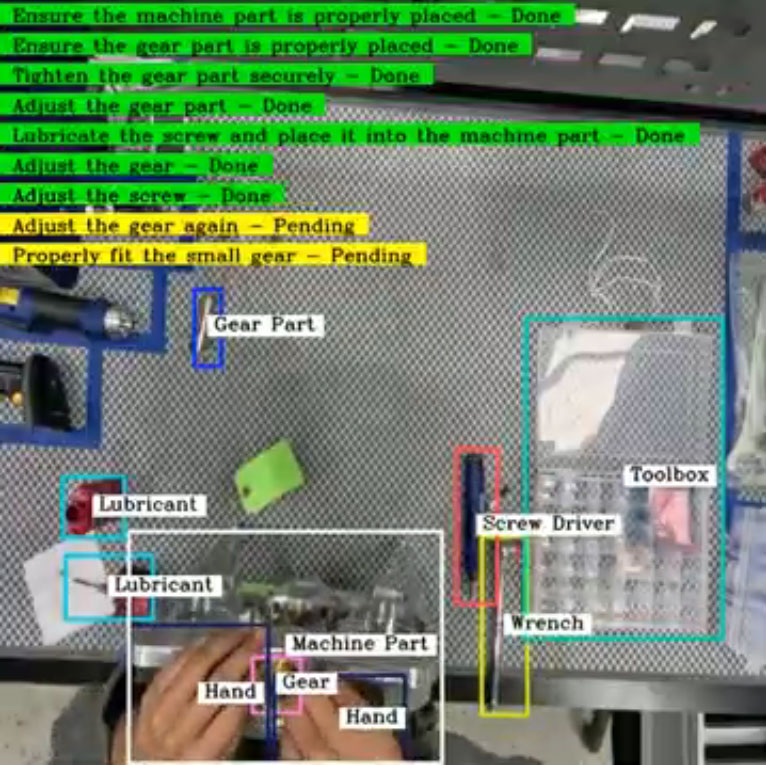
Computer Vision AI can monitor components throughout the assembly process. Depending on the application and visibility available to the cameras, Intelgic can verify:
This is particularly valuable for assemblies containing many visually identifiable components.
The system could monitor the installation of components against the expected assembly configuration:
AI can monitor components as the product moves through the assembly process:
From Cameras to Manufacturing Intelligence
Assembly lines generate enormous amounts of operational information that historically has never been captured. A traditional production system may know:
But what happened between those events?
These activities happen every day on manufacturing floors, but much of this information remains invisible data.
Intelgic uses Computer Vision AI to turn physical assembly activity into structured manufacturing data.
Capture Assembly Data That Was Never Available Before
Intelgic’s AI assembly monitoring platform can capture operational metrics such as:
Time required to complete the entire assembly.
Time spent performing individual assembly operations.
Number of components installed during the process.
The actual order in which assembly steps were completed.
Whether required steps were completed according to the defined process.
How frequently particular assembly mistakes occur.
When the AI detected a deviation and corrective action was performed.
Assembly stages that consistently consume more time than expected.
Changes in assembly performance across products, shifts, lines, and time periods.
This creates a new layer of operational visibility for manufacturing teams.
AI-Powered Assembly Analytics
The value of the system extends beyond real-time monitoring. Once assembly activities are converted into structured data, manufacturers can analyze the process at a level that was previously difficult to achieve.
- ?Which assembly steps generate the most errors?
- ?Where is the most rework occurring?
- ?Which operations consume the most cycle time?
- ?Which components are frequently missed?
- ?Where are operators waiting during the process?
- ?Which SOP steps are frequently performed incorrectly?
- ?How does actual assembly behavior differ from the designed process?
- ↑Workstation design
- ↑SOPs
- ↑Component presentation
- ↑Operator training
- ↑Line balancing
- ↑Overall production efficiency
Supporting Multiple Products and Variants
Complex assembly lines frequently manufacture multiple product variants. Intelgic’s system can use recipe-based process monitoring.
When a product enters the workstation, its variant can be identified through:
The assembly recipe can define
The AI monitors the assembly against the requirements for that specific product rather than applying the same rules to every variant.
Digital Assembly Record and Traceability
Intelgic can generate a digital record for each assembly cycle. Depending on the application, the record can include:
Images or relevant event records can also be associated with the assembly process where required.
This creates digital traceability of how the product was assembled, rather than recording only whether it passed a final inspection.
Benefits of AI Assembly Line Monitoring
Detect mistakes while the product is still being assembled so operators can correct them immediately.
Monitor whether required assembly steps are performed and identify deviations from the defined process.
Use Computer Vision AI to verify component presence, count, type, position, and orientation where visually observable.
Correcting a mistake at the point where it occurs can prevent additional assembly work from being performed on an already defective product.
Give operators immediate feedback when the AI identifies an assembly deviation.
Convert physical assembly activities into structured information that manufacturing systems traditionally could not capture.
Measure the complete assembly cycle as well as individual process-step times.
Use historical AI analytics to identify bottlenecks, recurring errors, and opportunities for process improvement.
Moving Quality Control From Detection to Prevention
“Was the product assembled correctly?”
“Is the product being assembled correctly right now?”
This distinction is important. Finding a missing component at final inspection identifies a defect. Identifying that missing component immediately when the operator skips the assembly step can prevent the defect from progressing downstream.
Intelgic combines the following to create an intelligent monitoring layer for complex assembly operations:
The result is a manufacturing environment where AI does not simply inspect the finished product—it observes, understands, verifies, and helps improve the process used to build it.
Frequently Asked Questions
What is AI assembly line monitoring? +
AI assembly line monitoring uses cameras and Computer Vision AI to observe manufacturing assembly operations in real time. The system can recognize components, assembly steps, and process events and compare them against predefined assembly requirements or SOPs.
Can AI detect missing components during assembly? +
Yes. When the component and installation area are visually observable, Computer Vision AI can verify whether required components are present and identify missing components during the assembly process.
Can AI identify the wrong component? +
Depending on the visual differences between component variants and the imaging conditions, AI can be trained to distinguish different components and verify whether the correct part is being used.
Can the system monitor whether operators follow an SOP? +
Yes. Assembly SOPs can be converted into defined process steps that the AI monitors. The system can identify observable skipped steps, incorrect sequences, missing components, or other defined process deviations.
What happens when the AI detects an assembly error? +
The system can provide real-time feedback through a workstation display, HMI, stack light, audio notification, or integration with other factory systems. The operator can then correct the assembly before proceeding.
Can the system measure assembly cycle time? +
Yes. The system can measure total assembly cycle time as well as the time associated with individual observable assembly steps.
What manufacturing processes can use AI assembly monitoring? +
The technology can be applied to automotive assemblies, aerospace components, electrical control panels, industrial machinery, engines and powertrains, battery systems, electronic equipment, medical devices, wiring assemblies, appliances, pumps, valves, and other complex manual or semi-automated assembly processes.
Can AI assembly monitoring support multiple product variants? +
Yes. Intelgic can use recipe-based monitoring where different products have different components, SOP sequences, inspection criteria, and process requirements.
Does the system replace the operator? +
No. The system can function as an AI assistant for the operator, continuously monitoring observable assembly activities and providing feedback when a defined deviation is detected. The objective is to help operators perform complex assembly processes correctly and consistently.
Can assembly monitoring integrate with MES and PLC systems? +
Yes. The system can integrate with PLCs, MES platforms, production databases, barcode or QR readers, HMIs, and other manufacturing systems to exchange product, variant, process, and inspection information.
Turn Your Assembly Line Into an Intelligent Process with Intelgic
Complex assembly processes generate thousands of actions and decisions every production shift. Most of this information has traditionally disappeared the moment the activity occurred.
Intelgic transforms cameras into intelligent manufacturing sensors.
Our AI continuously monitors assembly operations, verifies components and process steps, detects deviations, provides real-time feedback to operators, and converts shop-floor activities into actionable manufacturing data.
The result is more than automated inspection. It is an AI-powered assembly process monitoring and error-prevention system designed to help manufacturers:
Contact Intelgic to explore how Camera and AI-based assembly monitoring can be implemented on your production line.
Contact Intelgic →