Manufacturing quality depends on more than advanced machinery. Operators must follow the correct standard operating procedure (SOP), in the correct sequence, at precisely the right time. Even experienced employees can occasionally miss a step, select the wrong component, use an incorrect setting, or overlook a developing equipment problem.
An AI agent for manufacturing lines helps prevent these mistakes by continuously observing production through cameras, sensors, and connected equipment. It understands what is happening at each workstation, compares the activity with the approved SOP, and guides operators in real time.
Intelgic deploys AI agents that help manufacturers improve process compliance, product quality, safety, and operational consistency.
What Is an AI Agent for a Manufacturing Line?
A manufacturing AI agent is an intelligent system that monitors production activities, interprets live operational data, and recommends or initiates the appropriate response.
Unlike traditional monitoring systems that only record events or trigger fixed alarms, an AI agent can combine information from multiple sources, including:
By analyzing these inputs together, the AI agent can understand the current stage of an operation and determine whether the work is being performed correctly.
How the AI Agent Guides Operators
The AI agent acts like a digital manufacturing assistant that remains alert throughout every production cycle.
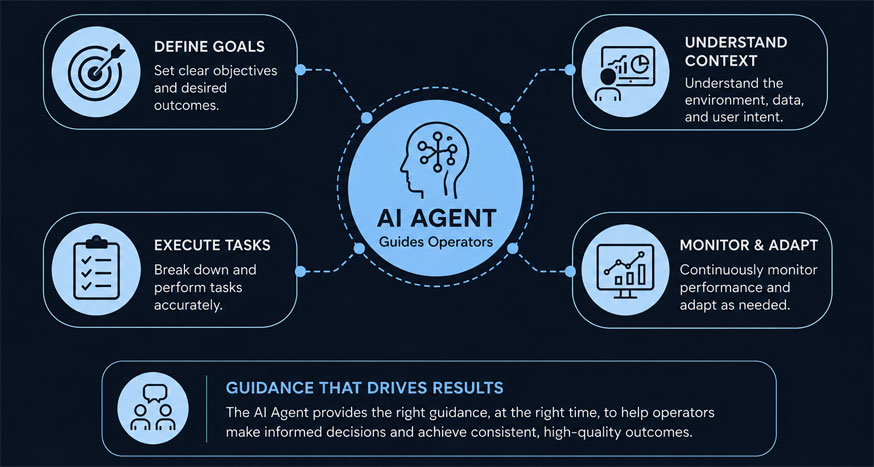
It recognizes the operator’s current task
Using cameras, sensors, and equipment signals, the agent identifies the product, workstation, tools, materials, and current process step. For example, it may recognize that an operator has positioned a component, picked up a torque tool, or begun an inspection procedure.
It compares the activity with the SOP
The system checks the observed activity against the approved procedure. It can verify:
- Whether the correct component was selected
- Whether every required step was completed
- Whether the steps were performed in the correct order
- Whether the correct tool was used
- Whether machine settings were within approved limits
- Whether process measurements met quality requirements
- Whether required personal protective equipment was present
It provides instructions at the right moment
Instead of requiring operators to search through manuals, the AI agent can present the next instruction automatically on a workstation display, tablet, wearable device, light system, or voice interface.
Instructions can include text, images, animations, warnings, or confirmation prompts. This contextual guidance is particularly valuable for complex assembly processes, frequent product variations, and employee training.
It intervenes before an error becomes a defect
When the system detects a missing, incorrect, or out-of-sequence action, it can notify the operator immediately.
Depending on the process and the manufacturer’s control policies, the AI agent may:
- Display a warning
- Explain the required corrective action
- Prevent the operator from advancing
- Request supervisor verification
- Stop or pause connected equipment
- Create a quality event
- Record visual and sensor-based evidence
The objective is to correct the process at the point of work—before the product reaches final inspection or the customer.
Manufacturing Errors an AI Agent Can Help Prevent
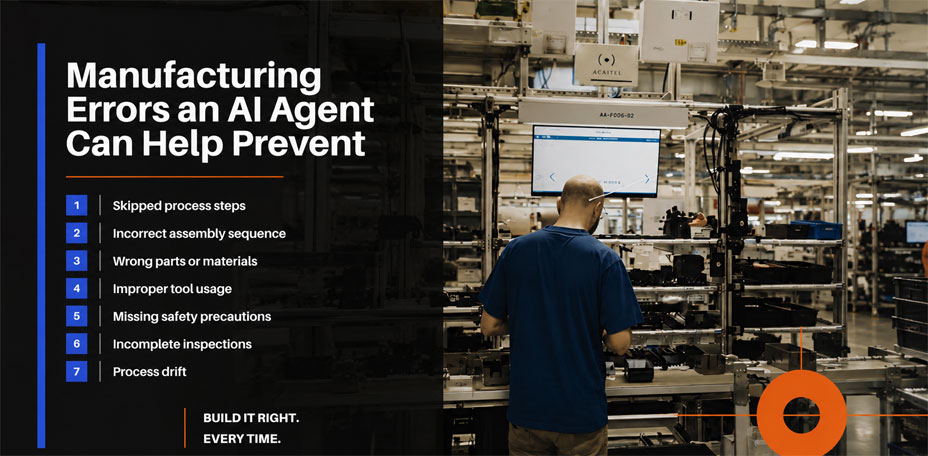
AI-assisted monitoring can address many common sources of production error.
Skipped process steps
The agent confirms that each required operation has been completed before the product proceeds to the next stage.
Incorrect assembly sequence
Some components must be installed, tightened, tested, or inspected in a specific order. The system detects sequence deviations and guides the operator back to the correct step.
Wrong parts or materials
Computer vision, barcode scanning, and RFID data can help verify that the selected component matches the product configuration and work order.
Improper tool usage
The AI agent can check whether the correct tool is being used and confirm values such as torque, pressure, temperature, or cycle time when connected to compatible equipment.
Missing safety precautions
The system can identify selected safety conditions, such as required protective equipment or entry into a restricted area, and provide an immediate alert.
Incomplete inspections
The agent can guide inspectors through every checkpoint, record results, and help ensure that required inspections are not missed.
Process drift
Sensor data may reveal that a process is moving away from its normal operating range. Early detection allows teams to investigate the condition before it produces a larger quantity of defective products.
From Final Inspection to Quality at the Source
Traditional quality control often identifies problems after production has been completed. At that stage, the manufacturer may already face rework, scrap, delayed orders, or additional inspection costs.
An AI agent supports a more proactive model: quality at the source.
Instead of relying only on downstream inspection, the system verifies critical actions while the work is taking place. This creates an opportunity to prevent defects rather than simply discover them later.
The AI agent can also create a digital record of each production cycle. Depending on the implementation, this record may include completed steps, timestamps, measurements, alerts, corrective actions, and images associated with important quality events.
This traceability can support root-cause analysis, audits, continuous improvement, and regulated manufacturing requirements.
Benefits for Manufacturers and Operators
More consistent SOP compliance
Operators receive the correct instructions for the specific product and process, reducing dependence on memory and informal knowledge.
Fewer defects and less rework
Detecting deviations at the workstation helps prevent incorrect products from moving further through production.
Faster operator training
New employees can receive step-by-step assistance while performing real work. The system can reinforce approved procedures without replacing the guidance of qualified trainers and supervisors.
Better handling of product variations
The AI agent can provide instructions based on the current model, configuration, or work order in high-mix manufacturing environments.
Improved operational visibility
Manufacturing leaders can understand where errors occur, which steps cause delays, and which processes may require redesign, training, or maintenance.
Greater confidence for operators
The technology functions as an assistant, giving operators timely information and helping them resolve uncertainty before taking the next action.
Keeping People at the Center of Manufacturing
The purpose of a manufacturing AI agent is not simply to watch employees or replace human judgment. Its most valuable role is to support people with timely, relevant, and actionable guidance.
Operators contribute experience, dexterity, problem-solving ability, and contextual understanding. The AI agent contributes continuous observation, rapid data analysis, and consistent process verification.
Perform and manage the work
Monitors critical process conditions
Handle exceptions and complex decisions
Use operational insights to improve the process
Responsibilities, escalation rules, privacy protections, and human-override procedures should be clearly defined during deployment.
Deploying an AI Agent with Intelgic
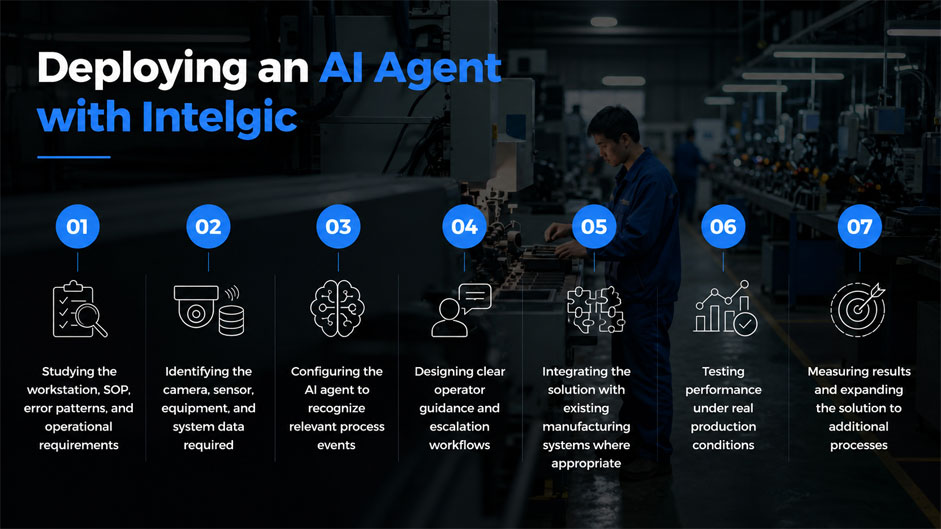
Intelgic deploys AI agents for manufacturing lines by connecting visual intelligence, sensor data, production systems, and digital SOPs into a coordinated operational solution.
A typical deployment begins with a clearly defined use case, such as preventing a frequently occurring assembly error or verifying a critical quality step. The process generally includes:
Starting with a focused, high-value use case allows the manufacturer to establish measurable outcomes and build operator confidence before scaling across the production line.
Building a Path Toward Zero-Defect Manufacturing
No technology can promise that every possible manufacturing error will disappear. However, an AI agent can substantially strengthen the controls that prevent mistakes, detect deviations, and guide corrective action.
By understanding what is happening on the line and delivering the right guidance at the right time, AI can transform SOPs from static documents into active operational support.
Intelgic helps manufacturers deploy AI agents that work alongside operators, connect with existing production environments, and move quality control closer to the moment when every critical action occurs.
The result is a smarter manufacturing line—one that can observe, understand, guide, and continuously improve.
Intelgic Manufacturing AI